Pollsters asked 500 Philadelphians to pick the focus of a ‘new revolution’ Philly could lead. Here is how they responded.
The CityView poll by Suffolk University and The Inquirer offers a glimpse into the mindset of 500 Philadelphians across the city's 66 wards.
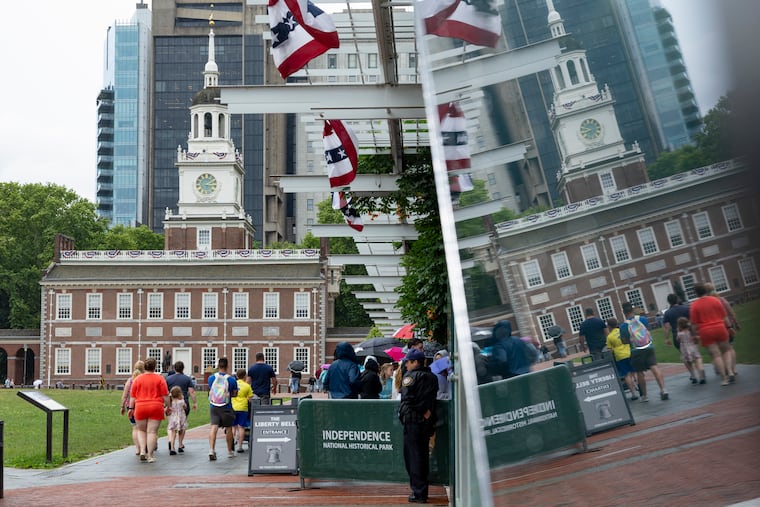
Two hundred and fifty years after the Declaration of Independence was signed in Philadelphia, nearly 50% of Philadelphians said the most important “new revolution” the city needs to lead is “closing the educational and economic wealth gap,” according to a new CityView poll by Suffolk University and The Inquirer.
The poll of 500 Philadelphians living in all 66 city wards was conducted between June 16 and June 20. The margin of error was 4.4 percentage points.
A majority of those who supported eliminating barriers to education and economic opportunity — 57% — were women, while respondents aged 18 to 24 supported the educational/wealth “new revolution” at the same percentage.
Mai Miksic, executive director of the nonprofit advocacy group Children First in Spring Garden, said she “loved” to see poll results like these, but was not surprised by them.
“From speaking with parents, I know that moms are incredibly aware of the gap between how kids are educated here and future prosperity,” she said. “Mobility and economic security really resonate with them.” As for young people, she said, “it’s important because this is directly about their lives.”
The poll’s other findings showed that 17% of Philadelphians felt that it was more important to support “revolutionizing community-led public safety”; 14% were behind making the city “the top hub for technology and medical innovation”; and 12% wanted to fight for “clean energy and green urban spaces.”
It makes sense that poll respondents linked education to increased prosperity. Philadelphia residents with a bachelor’s degree had an average annual income of $64,205 — more than twice the income of residents with less than a high school diploma, who earned about $29,000, according to estimates from the Census’s 2023 American Community Survey.
High school graduates in Philadelphia make an average salary of about $44,077, more than 30% less than a college graduate, according to Zip Recruiter.
Healthcare a right?
In another poll question connected to the theme of America’s creation, city residents were asked, “If the Framers of the U.S. Constitution rewrote the document in Philadelphia today, what right should be added first?”
Nearly 38% of respondents named “the right to affordable, high-quality healthcare,” as their first pick followed by ”secure, affordable housing for all" (24%); then — echoing the “new revolution” poll answer about schooling and wealth — “equitable, fully funded public education” (15%); and finally, “a safe, healthy environment and clean air” (nearly 13%).
Ann Marie Healy, executive director of Philadelphia Health Partnership, believes healthcare is very much a right. The foundation, located in Center City, is committed to improving the health and well-being of people in Philadelphia.
“Everyone, whether you’re a citizen or not, should have a right and opportunity to access quality healthcare in a manner aligned with their beliefs,” Healy said.
This is change “that could take generations,” Healy acknowledged. It will require a combination of harnessing new technologies and finding alternate, untraditional ways of administering healthcare, such as relying more on nurse practitioners and tools such as telehealth.
Espousing the opposite view, Kevin Flynn, president of HealthCare Advocates Inc., a patient advocacy organization in Center City, had a succinct rebuttal.
“Health care is a privilege, not a right for most people,” he said.
“One has to work at a job to be able to obtain healthcare,” Flynn said. Beyond Medicaid and Medicare, it isn’t something “that’s bestowed,” he added.
Even a system like Obamacare, built to help people without traditional health insurance, has become expensive and difficult to manage, Flynn said.
While it sounds like a good idea to think of the ability to see a doctor as an inalienable right, Flynn said, “healthcare isn’t a life, liberty, and the pursuit of happiness sort of thing.”
Whether healthcare is seen as a right or a privilege, says the nonpartisan Builders Movement, a nonprofit dedicated to finding common ground on knotty issues, there’s one clear takeaway: Healthcare isn’t easy to navigate, and so in the end, “what people really want is a system that works.”