What Philadelphians close to the criminal justice system want DA Larry Krasner to do in his third term
District Attorney Larry Krasner asked for the public's help in setting the agenda of his third term. Lawyers and advocates have some suggestions.
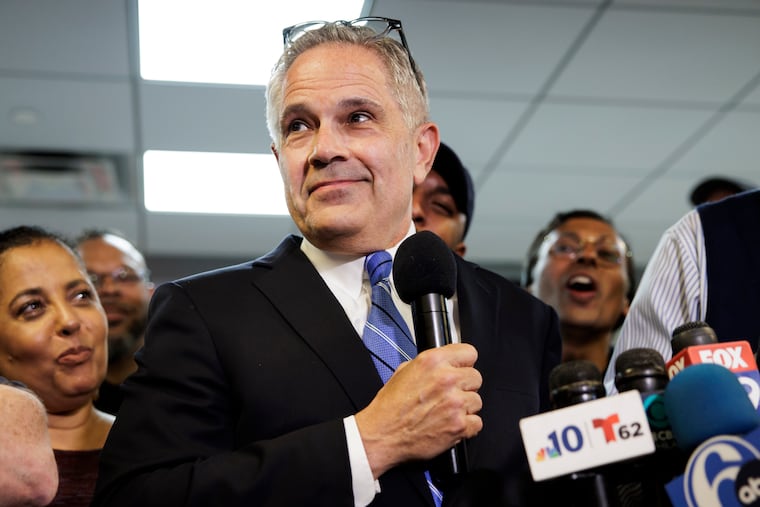
District Attorney Larry Krasner has never been one to temper his words.
When he first campaigned to be the city’s top prosecutor in 2017, he promised not to seek the death penalty, to hold police accountable, and to overhaul an office culture that he said prioritized convictions over justice.
And when he won a second term in 2021, at the height of an unprecedented gun violence crisis, he pledged to expand the unit that investigates questionable convictions and to continue to push for a less punitive justice system.
But this week, as he was reelected for another four years — positioning him to be one of Philadelphia’s longest-serving district attorneys — Krasner offered no clear agenda for what he will pursue next.
Instead, he said he wants the public’s help in deciding what to focus on over what he has said could be his final term.
“If you are a criminologist, please,” Krasner said Wednesday morning. “If you are or have been a victim or a survivor of crime, please. If you are or have been a witness, a juror, even a defendant — we want your ideas. We want to take them into account."
People closest to some of the city’s most pressing criminal justice issues — lawyers and former judges, advocates for crime victims and those accused of crimes — have some ideas for the district attorney and how his policies could evolve in the years ahead.
Here’s what they said:
Prioritize domestic violence cases
The shooting death of Kada Scott last month raised questions about prosecutors’ handling of earlier assault cases against the man now charged with killing her, and that has led some to call for more vigilance in such cases.
When the alleged victim failed to show up in court, Krasner’s office dismissed the charges against Keon King, and he walked free. Krasner said he regretted that decision and vowed to revisit how his office handles domestic violence cases.
But to some advocates, the case underscored the need for assigning experienced prosecutors to cases that are often complex.
Joanna Otero-Cruz, executive director of Women Against Abuse, said that too often, young, inexperienced attorneys are assigned to handle crimes of domestic violence and that sometimes leads to disappointing results.
Because the attorneys are juggling so many cases, she said, they typically don’t have the time to speak in depth with victims and witnesses in advance of court proceedings to understand the totality of the abuse, their fears, and the defendants’ criminal history.
And because victims move to escape abuse or have unstable housing, they can be difficult to reach, and lawyers in the district attorney’s office need to do more than call once or send a subpoena to summon them to court.
Krasner can change that, she said, by assigning seasoned lawyers to prosecute such crimes, reducing their caseloads, and providing more training on understanding the complexities of victims’ lives as well as those of the people accused of assaulting them.
“These cases really, truly require a deep understanding of domestic violence and trauma,” she said. “We encourage the district attorney’s office to assign experienced prosecutors to domestic violence cases through every step of the way — from charging to the verdict.”
Resist ICE
Krasner has been clear in his commitment to protecting undocumented Philadelphians.
Keisha Hudson, chief defender of the Defender Association of Philadelphia, lauded his assurances so far but said he could do more to ensure that other law enforcement agencies share that pledge, especially as U.S. Immigration and Customs Enforcement ramps up deportations nationwide under President Donald Trump.
Hudson said the city, with support from Krasner and the police department, should take steps to restrict ICE’s access to courthouses and to information revealing when undocumented people are due in court.
Hudson said her office is launching a new unit to provide legal services to undocumented people charged with crimes. Krasner, she said, should make a similar effort to support undocumented victims and limit ICE’s access to both defendants and victims.
» READ MORE: Charges against a man were dismissed. Then a Philly police officer escorted him into ICE custody.
ICE agents have been inside Philadelphia’s courthouse every day this week, Hudson said, and at least two of her clients — both charged with nonviolent crimes — were detained after showing up for their hearings.
The agents’ presence is discouraging victims from coming to court, she said.
And as Trump has threatened to send National Guard troops to Democratic-controlled cities, Krasner has vowed to charge federal agents if they overstep the laws and commit crimes.
Sergio Cea, the political director for the progressive group Reclaim Philadelphia, said he was encouraged by Krasner’s resistance and hopes he holds firm on that if the time comes.
“We’re very interested in somebody who will actually hold these masked agents accountable for the actions that they do,” Cea said.
Expand restorative justice work
Krasner’s administration has worked to reduce the number of young people held in the city’s juvenile jail, but some advocates want him to reimagine accountability for them.
“This victory — especially in what could be his final term — gives him a really clear mandate to carry out some of his more visionary ways of reshaping the juvenile justice system,” said Sarah Morris, codirector of the Youth Art and Self Empowerment Project, or YASP, which works with juveniles accused of crimes.
YASP’s restorative justice diversion program, called Healing Futures, was the first program of its kind to collaborate with the district attorney’s office, starting in 2021, and works with teens charged with crimes that do not involve guns — including felonies like robbery, arson, and assault.
Over a six-month program, the teens connect with the people they harmed, take accountability, and work to make amends. Upon completion of the program, charges are withdrawn.
A recent study of 30 young people, their parents, and the victims who participated between 2021 and 2023 showed that 100% said they had a positive experience, Morris said. Only one of the 30 teens was adjudicated delinquent of another crime after leaving, they said.
» READ MORE: Philly still locks up kids at a rate seen in few other cities
But Morris said the program’s reach is limited because it lacks city funding and because Krasner bars the participation of teens charged with sex offenses or crimes involving guns or drugs. The group would like Krasner to allow young people charged with gun crimes to take part in the program.
And Morris said the district attorney has made little progress in reducing the number of juveniles charged as adults.
“This is the moment when he should really make good on his commitment to treat kids as kids,” Morris said. “In doing so he can really cement his legacy as being a truly transformative figure in our juvenile justice system.”
Retrain inexperienced prosecutors
Even the man Krasner twice defeated in his race to a third term has some ideas for the district attorney.
Patrick Dugan says one of the reasons he left his job as a Municipal Court judge to run for district attorney was the way that he saw prosecutors handle cases in his courtroom.
Attorneys often withdrew criminal charges because a witness did not show up to court, he said, but then acknowledged they had done little to try to get the witness there. At times, he said, younger attorneys stumbled and did not have a more seasoned prosecutor to lean on for help.
The district attorney’s office has for years been a landing spot for young lawyers, but Krasner dismissed dozens of experienced attorneys when he took office in 2018. Dozens more left on their own accord.
Dugan — who lost his bid to unseat Krasner both in the spring, when he ran in the Democratic primary, and in the fall, when he challenged him as the Republican nominee — made a lack of experience among prosecutors a key part of his pitch to voters.
The former president judge of Municipal Court said often on the campaign trail that one of his first actions as district attorney would be to retrain the hundreds of lawyers in the district attorney’s office and ensure that attorneys with less experience have supervisors available to help them obtain convictions.
He hopes Krasner considers doing it himself.
Improve the relationship with City Hall
City Hall is just across the street from the district attorney’s office, but at times over the last eight years of Krasner’s tenure, it has felt like a wider divide.
Krasner clashed with former Mayor Jim Kenney over his progressive policies and has had a tumultuous relationship with some members of City Council, at times angering members by being defensive during hearings about the work of his office.
Former City Councilmember Sharon Vaughn, who has supported Krasner and his criminal justice reform agenda, says that his relationships with City Hall have improved over his first two terms, but that more can be done on both sides.
While Krasner has not publicly clashed with Mayor Cherelle L. Parker, they are not known to have a close relationship.
The city’s top officials, Vaughn said, should be meeting “at least once a month” to discuss crime prevention and criminal justice reform.
“At this point, the race is over. He has become the winner,” she said. “Let’s get together as a team and make our city the great place that it could be to live.”