Trump statue maker from Malvern faces high demand for bronze likenesses of the president after assassination attempts
"Whenever bullets fly around Trump," people want to buy his statue, says Steven Barber, former Malvern resident who commissions bronze homages to the president.
Within an hour of an armed man’s attempt to storm the White House correspondents’ dinner while President Donald Trump and administration officials were on stage last weekend, Steven Barber said he received 10 calls from people wanting him to make them statues of the president.
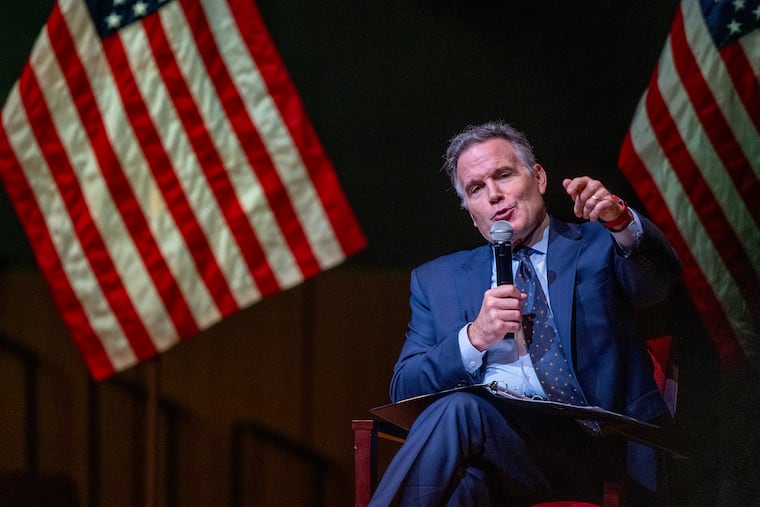
“Whenever bullets fly around Trump, I get contacted by MAGA men and conservatives fascinated by the president, and how he survives attempts on his life,” said Barber, a former Malvern resident and self-described “non-MAGA conservative Republican” who has built a business around commissioning sculptures of the sitting president.
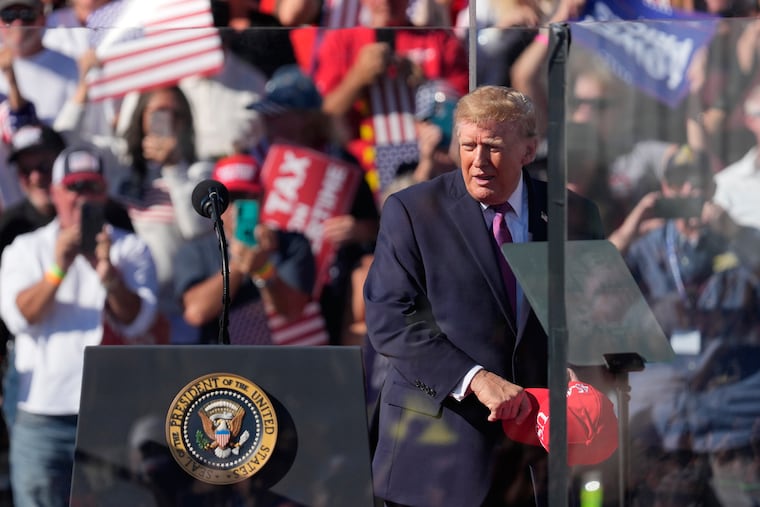
In July 2024, when Trump raised his fist after being shot in Butler, Pa., and said, “Fight, fight, fight,” Barber said he knew he had to capture the moment in bronze.
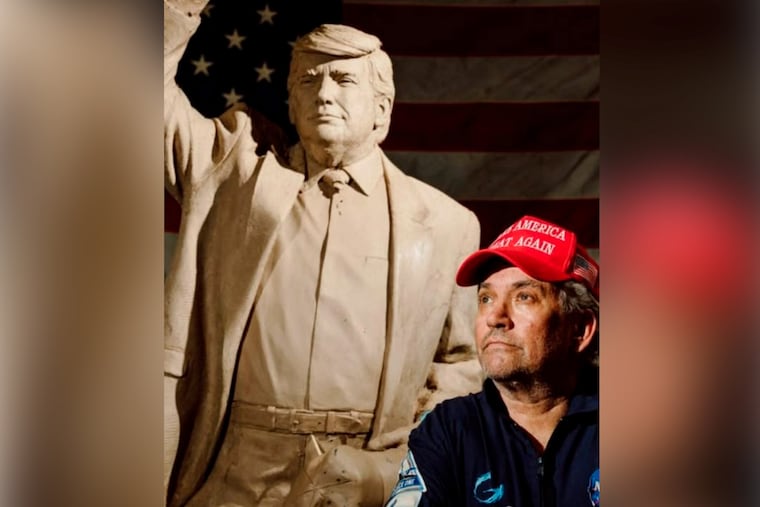
Barber commissioned a statue depicting the event, securing the funding and coordinating with the sculptor, Colorado-based George Lundeen, to realize his idea. Lundeen received $300,000 for the statue, while Barber earned $50,000.
“I’m primarily a documentary filmmaker,” he said. “I don’t do monuments for the money.”
Now, Barber and Lundeen’s 7-foot, 700-pound statue of Trump stands at Trump International Golf Course West Palm Beach in Florida. It shows Trump’s right arm raised and a Make America Great Again cap in his left hand.
“That’s a monument of defiance,” said Barber, 65, who attended Spring-Ford High School in the 1970s. He added, ”I believe it’s the most significant presidential monument in history."
The wealthy buyers who called Barber after Secret Service agents led Trump to safety were newly inspired by what they saw as their hero once again cheating death. One requested a $250,000 reproduction of the Florida statue, while nine others asked for 12- and 18-inch replicas costing $4,000 to $6,000 apiece, Barber said.
“Why not?” Barber said from his Santa Monica home. “I’m in the God and patriotism business, after all. Sculpture is a higher calling. And conservatives care about art just like liberals.”
In all, Barber has envisioned and raised funds for 17 statues of famous Americans, among them Sally Ride, Amelia Earhart, and the Apollo 11 astronauts.
Lundeen, the sculptor, has achieved renown himself for creating, among other works, the Ben on the Bench bronze sculpture of Benjamin Franklin reading a copy of the Pennsylvania Gazette on a Locust Walk bench at the University of Pennsylvania.
When Lundeen and his team made the Trump statue, he had to decide how accurately to portray the president.
”We used a little artistic license in his form,” Lundeen acknowledged. The bronze Trump is slimmer than the real one.
“In the old days,” Lundeen joked, “when a king asked an artist to portray him, you’d lose your head if you showed all the warts.
“But we make people look good.”
‘You got my hair perfect’
As a teenager in Malvern, Barber said, he was a C student without direction who spent long hours alone in the woods near his family’s house.
“I wasn’t as dynamic as I am today,” he said.
Barber left Pennsylvania and pursued a dream of Hollywood stardom. But working as a “glorified extra” on General Hospital in 1984 when he was 23 didn’t lead to an acting career.
He developed a drinking problem and in 2001 became sober with the help of Apollo 11 astronaut Buzz Aldrin, who he met through Alcoholics Anonymous.
Soon after, Barber landed his “first sober job” as a sales executive at Robb Report, a luxury lifestyle publication. That’s how he met Trump, who bought $140,000 in ads for his Taj Mahal casino in Atlantic City, Barber said.
“I simply liked him,” said Barber. “We talked once a month. He was a builder, and I liked that he got things done. The Trump I met was contemplative, quiet, soft, kind — a listener.”
After getting into the business of making documentaries with his company, Vanilla Fire Productions, Barber said he went on a bike ride one day. Thinking about Aldrin as he pedaled, Barber envisioned a tribute in bronze to his old friend and to Neil Armstrong, the first men to walk on the moon, as well as to the third astronaut on the mission, Michael Collins.
More statues followed, and Barber became what he calls “America’s monument maker” — the term he prefers over statue. Not long ago, he decided that Trump would be a great subject.
Trump was “enthralled” when he saw the statue last year, Barber recalled. “He put me in a headlock and said, ‘You got my hair perfect!’ I was floating on air.“
Neither Robb Report nor the White House replied to requests for comment.
‘Noble citizens’
The subjects of Barber’s documentaries are wartime icons he calls “noble citizens.”
They include Leon Cooper, a World War II veteran who revisited a battle site in the Pacific in Barber’s Return to Tarawa, and Ed Ramsey, the subject of Barber’s Never Surrender, who, during World War II in the Philippines, led what’s believed to be the last horse-mounted cavalry charge in U.S. military history.
Another documentary Barber produced, The WASPS: Taking Flight, which tells the story of female Air Force pilots during World War II, was released last month on various streaming platforms.
Currently, Barber has several statues in the works, including pieces depicting former President Jimmy Carter, as well as Ellen Ochoa, whom NASA calls the first Hispanic woman in space. He also plans to place a Trump statue in Orange County, Calif., later this year.
Backlash
Lundeen described Barber as “very creative, personable, and a little crazy — a salesman who goes 100 miles an hour all day. I’m a country boy, and I tell him, ‘Steven, slow down.’ He never does.”
The sculptor said members of his studio received death threats when the Trump sculpture was being created.
“That’s funny,” Lundeen said, “because I’ve been a Democrat since 1968 when I went door-to-door campaigning for Eugene McCarthy."
Barber views the backlash to the Trump sculpture as “silly,” much as he believes the wider push to remove statues of historical figures — most notably those who engaged in slavery or fought for the Confederacy during the Civil War — is misguided.
“Pulling down Confederate monuments makes no sense,” Barber said. “This is history, and you preserve history. Why take down monuments of Americans?”
Trump restored a Confederate statue in Washington, D.C., last year and at the same time has pushed for the removal of references to slavery at national parks, including at the President’s House in Philadelphia.
Barber knows not everyone supports Trump or agrees with his decision to immortalize the president as a statue, but for him, it’s a point of national pride.
“I’m out here maneuvering with patriotism and love of country,” he said, “shining the light on American exceptionalism at the highest level. And I won’t stop.”