As corporations vanish from central Wilmington, Del., apartments are taking their place
The companies that occupied the corporate headquarters that once loomed over Wilmington’s Rodney Square have left. The buildings are becoming residential.
Wilmington, Del., is America’s corporate capital, the legal and nominal home of most big American companies and most new ones, despite critics like Elon Musk.
For a century, Wilmington was also a real-life corporate headquarters with the DuPont Co. and banks erecting concrete and glass office towers around downtown Rodney Square, each employing thousands.
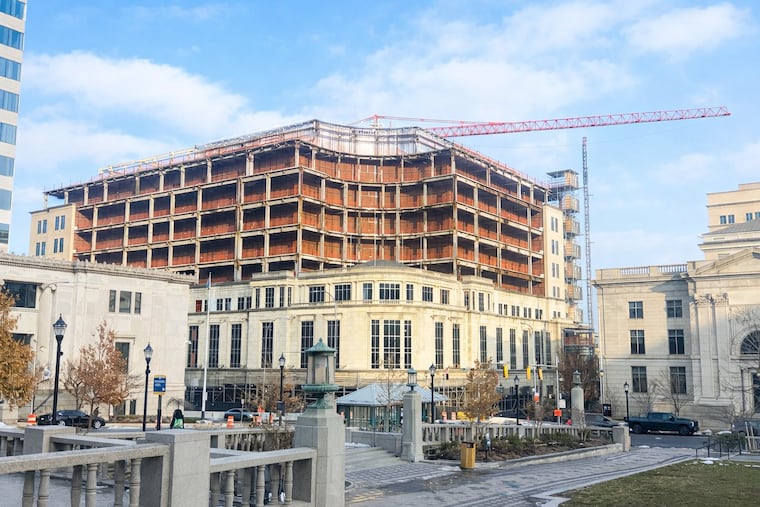
But after a wave of mergers and relocations, the last of the corporate headquarters that loomed over the square is being turned into apartments. Residential conversion was proposed after the collapse of a last attempt to reuse the whole tower as corporate offices. Construction stopped midwinter leaving upper floors open to winter storms.
The former MBNA America Bank opened its headquarters and parking garage in 1995. After Bank of America, which bought MBNA in 2007, consolidated in the suburbs, Herve Hoppenot, then-CEO of Incyte Corp., the fast-growing drug developer based just north of the city, said in 2024 that Incyte would buy the building and another in the former MBNA campus. It planned to base up to 800 new or relocated staff there.
But on Feb. 10, Hoppentot’s successor, Bill Meury, said in his annual report to shareholders that he had killed that plan.
Incyte wrote off $76 million the company had spent to buy and gut the office tower and parking garage. Incyte says it now plans to rent two lower floors for 200 staff, but no longer own, operate, or fully occupy the building.
Wilmington’s Buccini brothers stepped into the gap, as they have when other corporate headquarters left town. Their Buccini Pollin Group plans to add 202 apartments atop Incyte’s space.
That brings the total apartments the firm has built in central Wilmington since the 2000s to nearly 3,000, including more than 1,000 in former headquarters towers.
Hello apartments, goodbye HQs
In 2003, Buccini Pollin turned the former Delaware Trust Tower, west of the square, into 280 apartments after fire forced demolition of the attached former Hercules Powder Co. headquarters tower. (Not to be confused with the later, blue-glass Hercules Plaza by the Brandywine, now divided into offices.)
“We learned office-to-residential conversion from our partners in the Delaware Trust project, Ira Lubert and Dean Adler,” real state investors in Philadelphia, Rob Buccini said. His firm has continued to manage the building and last year rebuilt the elevators. First-floor retail includes Wilma’s restaurant and duckpin bowling alley.
Buccini Pollin added 683 apartments, with an additional 100 now planned, in two of the three block-long towers that begin on the square’s long north side, formerly home to the DuPont Co.
Under executive chairman Edward Breen of New Hope, DuPont, a longtime economic and political force in Delaware, has sold or spun off a majority of its former businesses and consolidated to smaller suburban offices.
In 2015, DuPont pulled the last of its businesses out of the former 2.4-million-square-foot complex — comparable in size to Philadelphia’s twin Comcast, Liberty Place, or Centre Square tower complexes — and moved to DuPont’s Chestnut Run suburban industrial and office park west of town. DuPont Chemours chemical-maker spinoff stayed in the building. Another spinoff, pesticide maker Corteva, plans to move its 150-plus corporate staffers back to the complex’s remaining office spaces later this year.
Buccini Pollin also has renovated the company’s former hotel, theater, and Green Room restaurant on the site and added the DE.CO Food Hall on the ground floor. The complex also houses The Mill start-up space and shops.
Law offices occupy most of the Brandywine building in the newest part of the complex, farthest from the square and closest to I-95’s Delaware Avenue exits.
The DuPonts have been the busiest of the handful of regional developers adding apartments in central Wilmington. Others include Philadelphia’s Westrum Development Co., Paoli-based Westover Cos., Wilmington-based Capano, and a joint National Development-Princeton Properties project.
These developers have turned the city center into a residential neighborhood among the remaining office buildings, featuring live theaters, boutique hotels, higher-end restaurants, chain and independent coffee shops, and a bookstore that recently moved into larger quarters. There are still vacant storefronts along its Market Street spine.
A second, suburban-friendly downtown with chain hotels, larger restaurants, a movie theater, and abundant parking has grown up along the Christina waterfront, a former shipbuilding center east of the Amtrak station that sits at the foot of Market Street.
Even on a reduced scale, the jobs Incyte will move to the space they will rent, plus expected jobs from projects to move college programs downtown, will be “the most significant new job growth in Wilmington in 20 years,” said Michael Hare, executive vice president for development at Buccini Pollin.
“The city has saved itself with residential growth,” Hare said, and its finances, aided by state support, remain stable.
A changing Wilmington
It’s hard to determine whether the new apartments have had a net impact on Wilmington’s population. The city’s U.S. Census total, which peaked at 110,000 in 1950, stabilized at around 71,000 from 1990 through 2020, with decline in outlying neighborhoods canceling any impact of new units in the old corporate district.
By comparison, New Castle County, which includes Wilmington and is home to more than half Delaware‘s population, rose by one-third, to nearly 600,000 from 1990 to 2020, with growth centered in new suburban neighborhoods southwest and northwest of the city.
More recent U.S. Census estimates suggest Wilmington began a modest recovery to around 74,000 by the end of 2024.
MBNA, under founding CEO Charles M. Cawley, had reinvigorated Wilmington’s downtown as DuPont began fading in the 1990s. It constructed look-alike tan buildings on six blocks and moved the bank headquarters, along with a smaller “international headquarters,” to the city from a former grocery building in the suburbs.
The company became the largest independent Visa and Mastercard issuer, and Delaware’s largest for-profit employer. But Bank of America emptied the city buildings in stages, consolidating in suburban locations closer to the University of Delaware after buying MBNA in 2007.
Rob Buccini notes that Widener Delaware Law School has listed its suburban campus on U.S. 202 for sale and is expected to move to downtown Wilmington. City boosters also hope to use public and private foundation aid to lure operations from the University of Delaware, whose campus is in Newark a half-hour hour away, and a nursing program at Delaware State University in Dover to a proposed center in other former MBNA space.
The former Wilmington Trust Co. headquarters on the east side of Rodney Square is still occupied by M&T, the Buffalo bank that bought the former du Pont family financial company in 2010. A second, newer ex-Wilmington Trust tower two blocks away is for sale.