MLS strikes a deal with prediction market Polymarket, says it’s about protecting the integrity of games
Prediction markets work by having users choose from two possible outcomes for an event, and are given a percentage likelihood of each. They are legal nationwide, unlike traditional sports betting.
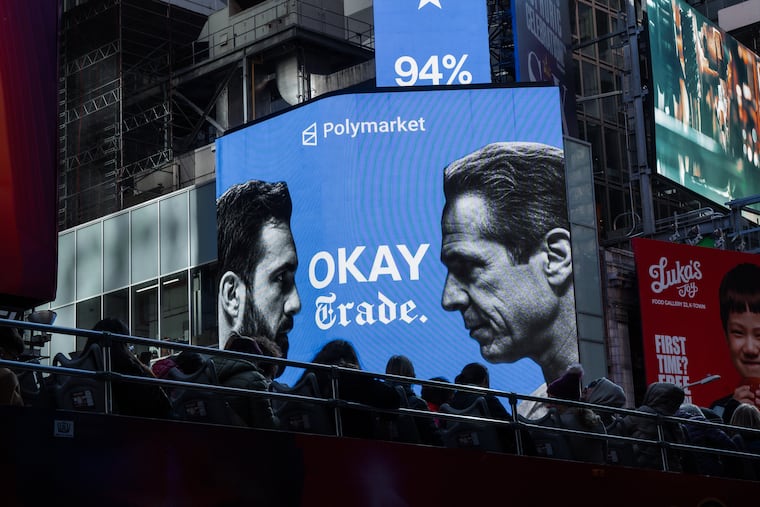
Major League Soccer announced Monday that it has started a partnership deal with Polymarket, a prediction market platform that’s similar to sports betting but not quite the same.
Prediction markets work by having users choose from two possible outcomes for an event, and they are given a percentage likelihood of each. That plus how much money people put down translates into how much money they make if their pick is correct.
Polymarket is one of a few such platforms, with Kalshi the other big one. The concept has been controversial for many reasons, the biggest being that although prediction markets resemble sports betting, they’re regulated separately from traditional sports betting firms.
The reason behind that is the platforms’ claim that they offer “financial contracts” instead of bets. Those contracts are overseen by the federal government’s Commodity Futures Trading Commission, while sports betting is regulated by each state.
As a result, prediction markets are legal nationwide, although a judge in Massachusetts this month issued an injunction stopping Kalshi from taking sports bets in the state.
In the announcement, which also covers the Leagues Cup that MLS runs with Mexico’s Liga MX, MLS deputy commissioner Gary Stevenson said: “Partnering with Polymarket allows us to integrate prediction markets as a new fan engagement format and position MLS as an early leader among global soccer properties.”
The announcement’s text also said the deal “includes safeguards designed to protect the integrity of MLS and Leagues Cup matches, including independent monitoring of trading activities and collaboration on MLS and Leagues Cup markets offered.”
» READ MORE: More than $5 million has been wagered on Philly’s daily high temperatures during the last three months
Another MLS executive, senior vice president of emerging ventures Chris Schlosser, told The Inquirer that the deal is just as much about preserving the integrity of games.
“All of the major prediction markets have markets on MLS — they all offer trading on the league,” he said. “And so we felt like we really needed to lean in on the integrity side and create a framework for protection.”
The ‘best shot’ at ‘ensuring integrity’
Schlosser said MLS and Polymarket will create an “authorized prediction market” status similar to the “authorized gaming operator” status that various sports betting firms have from MLS and other sports leagues.
“The goal,” he added, “is to get those with any any prediction market that has a CFTC license.”
Doing so will “codify a whole number of integrity principles for us,” he said. “Things like approval over markets, things like working with a league on restricted individuals, league staff, club staff, players, referees, owners to make sure that they’re not trading on the sport of soccer.”
“Markets” in this case refers to the offers that prediction markets give the public.
» READ MORE: Who is Shane Hennen, the high-stakes Philly gambler at the center of the latest sports-betting indictment?
Schlosser notably did not mention players at first. Asked if players have been banned from using prediction markets until now, he said: “Until we updated the guidelines and rules, no, and we needed to make sure that the prediction markets would actually work with us to prohibit that trading.”
FIFA, world soccer’s governing body, has a code of ethics that bans players, officials, and agents from “either directly or indirectly, betting, gambling, lotteries or similar events or transactions related to football matches or competitions.”
Schlosser said that a third-party entity will be employed to “monitor all trading volume on league markets and report any strange occurrences,” and that entity will be involved in any needed investigations.
“It’s a multipronged approach, and we think it gives us the best shot at ensuring the integrity of the competition,” he said.
Controversy over prop bets
There is particular concern among outsiders about the proliferation of prop bets, just as there is in sports around the world. American sports fans need only look at the recent federal charges against college athletes accused of betting on basketball games here and in China, with some players from Philadelphia schools allegedly involved.
Prop bets in soccer could come on whether a player will draw a yellow or red card, or miss a penalty kick, or take a certain number of shots — or something as small as committing a foul in a certain minute. A recent report by sports investigation website PlayTheGame.org cataloged how unlicensed companies around the world are using FIFA’s in-house streaming platform, FIFA+, to offer in-play bets on games shown there from lower-level leagues worldwide.
FIFA also recently struck a deal with global sports data provider Stats Perform “to distribute official betting data and livestreams” to gamblers worldwide.
MLS has had some small scandals over the years with players breaking the league’s rules on traditional sports betting. Prediction markets open up another area of risk, especially since they’re legal nationwide. (Polymarket is not legal in Canada, which has three MLS teams.)
» READ MORE: Fran Dunphy speaks for the first time about how the NCAA point-shaving scandal touched La Salle | Mike Sielski
“The prop bets that really can concern us are the bets that are easily single-player controlled,” Schlosser said, listing the ones mentioned above and a few more. “Those are the kinds of things that concern us, and actually that concerns us in all gaming.”
Traditional sports betting is currently legal in some form in 40 states and the District of Columbia. In 2023, MLS started writing to 41 states and territories asking for a ban on prop bets for players getting yellow or red cards. Thirty-three states agreed and banned the bets, and eight states did not.
A list of the states in each column was not available when this article was published.
“Even in sports betting, we’re not always successful in getting the framework that we want,” Schlosser said. “At least in these prediction market agreements, we have, I’d say, a broader right of consultation and approval over the markets that are going to be listed on MLS. And we feel that’s a strong protection to eliminate the markets that may be problematic.”
Becoming more popular, and controversial
The popularity of prediction markets has skyrocketed in recent times. The Financial Times reported last month that from early 2024 through November 2025, the total value of wagers on the platform rose from $100 million per month to over $13 billion.
» READ MORE: Philly is now the No. 1 market for online gambling companies — and addiction helplines are ringing off the hook
But that rise has come with many controversies. The first is claims that there aren’t enough regulations to stop insider trading, a matter that has arisen in the platforms offering bets on political events — which is controversial enough on its own.
The industry has deep ties to cryptocurrencies. Polymarket accepts deposits through the Polygon blockchain along with traditional U.S. dollars and credit cards.
During Joe Biden’s administration, the CFTC accused Polymarket of running an illegal exchange, leading to a settlement in which the company agreed to wind down its U.S. operations. But after Donald Trump returned to the White House, the CFTC backed off a probe into the company and it returned to operation.
Polymarket also now has one of President Trump’s sons, Donald Trump Jr., on its advisory board.
Is there a risk of reputational damage to MLS, whether over the expansion of direct ties to betting or Polymarket’s ties to the Trumps? Monday’s announcement did not seem popular with fans on social media, many of whom sent their reactions to this reporter’s post of the news.
» READ MORE: A $400,000 payout after the U.S. captured Venezuela's former president is putting prediction markets in the spotlight
“I can’t speak to any of that, but what I can say is we felt like we had a duty to act in the space to protect the integrity of our competitions,” Schlosser said. “These guys have markets on MLS, they have active trading, and it’s growing quickly. In that world, we can’t just stick our head in the sand.”
With that in mind, he continued, the league decided that “this is the best way we saw to ensure that we could actively protect the integrity of the league. That really is the foundation of everything we’ve done in this space.”