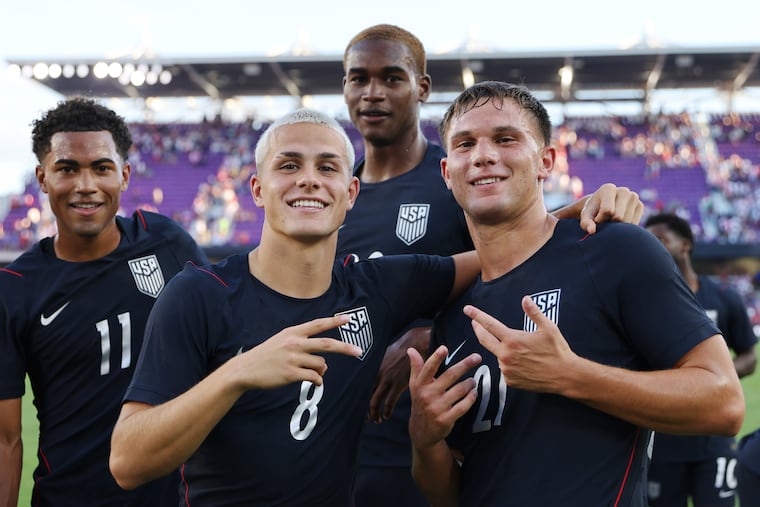
A failed experiment by Mauricio Pochettino proves one of his biggest moves with the USMNT was right
After success with a three-centerback defense last fall, Pochettino returned to a two-centerback setup against Belgium. It left far too much space to exploit, and the Red Devils feasted in a 5-2 rout.
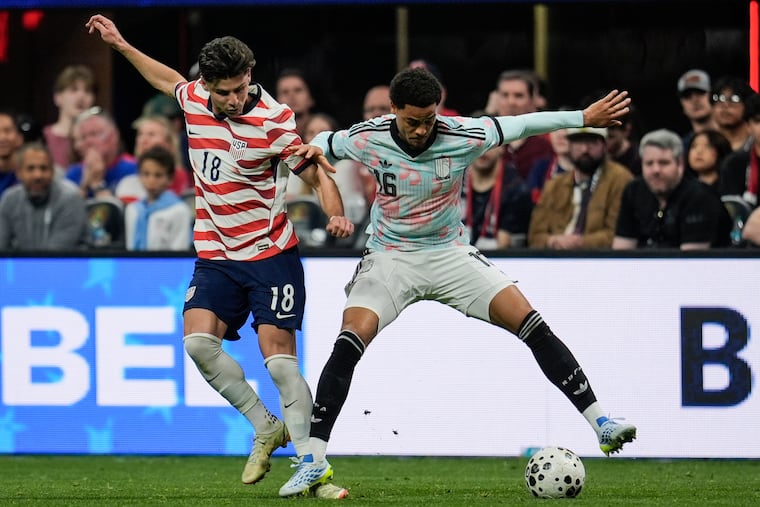
ATLANTA — There’s usually nothing wrong with experimenting in a friendly game before a World Cup. But on Saturday, a big experiment by the U.S. men’s soccer team blew up and left a mess.
After three months of success with a new three-centerback defense last fall, U.S. manager Mauricio Pochettino went back to the four-back setup that he and the program had used for a long time before then.
The 4-2-3-1 Pochettino deployed against Belgium was loaded with attacking firepower, in particular a three-midfielder line of Christian Pulisic, Malik Tillman, and Weston McKennie. That was the biggest difference from the 3-4-2-1 that worked so well previously, even though it couldn’t fit both Tillman and McKennie in a full-strength team.
Playing all three creators came at the expense of a defender on a day when Chris Richards was on the bench injured and Tyler Adams wasn’t in town. But the tactical issue might have been exposed even if they’d been on the field.
Tim Weah thrived as a right wingback last fall in the 3-4-2-1. It’s a more advanced position than right back in a 4-2-3-1. The latter role sits next to two centerbacks, and can end up isolated on the field more often. That’s exactly what happened in the 5-2 loss.
Belgium’s left winger Jérémy Doku — “the detonator,” as manager Rudi Garcia called him after the game — feasted on that flank, repeatedly forcing Weah and Mark McKenzie into one-on-ones.
» READ MORE: The USMNT flunks a test against Belgium’s stars in a 5-2 blowout loss
Later in the game, the focus swung to the left side. Thomas Meunier and substitute Dodi Lukébakio took aim at Max Arfsten, who has never been good at playing the defensive flank solo. Lukébakio scored twice, once by beating Arfsten twice in a row and once by almost walking past three U.S. players in a give-and-go with Timothy Castagne.
After the game, Pochettino was asked about those moments. He first lamented that other players didn’t pitch in enough, which was certainly true.
“We have two midfielders, three midfielders that arrive to the same line [with] Tim, but they never go to help him — and we were talking about [needing] to help him always, in this type of situation,” Pochettino said. “That is too many bodies inside the box. We made the effort to arrive, yes, but after we were not aggressive enough or not intense.”
‘No one helped’
A few minutes later, a question came about whether playing a three-back line would have decreased the odds of those moments happening. He disagreed, but in an interesting way.
“It looks like [that], I agree with you, but it wasn’t the problem,” Pochettino said to start. “When you see the action, I think the problem that we have is that no one helped in the last third [of the field], in the areas that are really important to help.”
» READ MORE: The injury bug bit the USMNT in the days before the Belgium game
He then turned to the tactical side, and made a case that how the U.S. planned to defend in this game wasn’t actually so different from the past.
In his mind, when he deployed what was a 3-4-2-1 on paper, he wanted his team building attacks with three at the back but defending with four. That’s how he saw it in the autumn games, with one of the wingbacks — a nominally defensive position — staying high up the field. Against Ecuador in October, for example, it was Weah, and against Uruguay in November it was Sergiño Dest.
“It looked like we play with three [at the back], but it wasn’t,” Pochettino said. “But the characteristics of the players sometimes help to create in our mind that idea.”
He had a point. But if there had been more time to go deep on the subject, there would have been a little pushback. The four-man defense he described had three centerbacks and one deeper wingback. This game had two centerbacks and two outside backs.
» READ MORE: Tim Ream is Mauricio Pochettino’s captain with the USMNT, but that doesn’t spare him any pressure
If you’re new to soccer, that’s a big difference. Hopefully you’ve learned a little tactical lesson. (And if you know more about American football than the world’s version, you might be amused that in an NFL stadium’s press box, we debated a soccer team’s pseudo 3-4 defense.)
During Saturday’s game, a reader wrote to me saying that if centerback is the U.S. team’s biggest weak spot, it shouldn’t play with three of them. My response was that it is indeed a weak spot, but you make up for it by playing three instead of two.
As said at the start, that move requires sacrificing a player elsewhere, most likely an attacking midfielder. It might also require a sacrifice from some fans.
It’s great to dream of watching the U.S. play dynamic soccer on a big stage, but almost no team gets to do that in a World Cup. Everyone plays defense first, no matter how many stars are on the field, and no matter the opponent. Just ask France, whose stars are forced to sacrifice a ton but has made the last two finals.
» READ MORE: In a chase for the USMNT’s World Cup roster, Media’s Auston Trusty is all in on the ‘why not me’ mentality
With that in mind, the moment seemed to fit another American football phrase: At the World Cup, “you play to win the game.”
Missed chances
This wasn’t the first time that Pochettino took the stage after a loss talking about positives first. But he wasn’t entirely wrong. The U.S. ran even with Belgium until the Red Devils’ equalizer late in the first half, creating its fair share of chances.
There were two early in the second half that could have been buried, one by Pulisic that really should have been (and he knew it) and one by Weah. Amadou Onana put Belgium up 2-1 between those two plays, and Charles De Ketelaere scored the third on a penalty kick not long after Weah’s miss.
When five goals go in, it’s easy to blame the goalkeeper. But while Matt Turner didn’t earn the starting job back in his first cap since last May, Pochettino was right to say this game was everyone’s fault.
» READ MORE: Gio Reyna knows it’s ‘controversial’ that he’s back with the USMNT, and aims to show his talent again
“Of course, the players we need to blame is to blame all together, first myself and then the whole team,” he said. “It’s not that when you concede a goal it’s only the keeper, or a mistake of the keeper.”
Pochettino said he thought it was “good to see [Turner] perform after a long time. We all know that he has experience in the national team and the previous World Cup, and that is a point that we need to use being in the starting 11 or not.”
U.S. fans can only hope things get better from here, though the next challenge will be even steeper, against Portugal on Tuesday (7 p.m., TNT, Telemundo 62).
Don’t be fooled by Cristiano Ronaldo being out injured — this team is actually better without him. The Paris Saint-Germain trio of midfielder Vitinha, right back João Neves and left back Nuno Mendes are all among the world’s best at their positions, and Manchester United’s Bruno Fernandes joins Vitinha in the engine room.
“It’s a good reality check for us, because now is the moment to feel this type of situation,” Pochettino said.
He was right about the first part, but he’s running out of moments. Using this one to experiment didn’t end up feeling good.
» READ MORE: Brenden Aaronson is fighting to make the World Cup squad, and to stay in the Premier League

Nine nations will compete in five group stage matches this summer, plus two more in a knockout game on July 4. Here’s what you need to know about those countries — and what those fans need to know about Philly. Click here for more.