How Philadelphia's World Cup setup became the envy of fans in New York, Boston, and beyond
From private financing to years of behind-the-scenes planning, here's an inside look at what Philadelphia has done right to get ready for its moment on the world stage.
While Massachusetts and New Jersey sock World Cup fans for transit tickets, Philadelphia’s will cost just $2.90.
While tailgating will be banned around some stadiums, the Eagles insist it will stay welcome here.
And while many cities slash their World Cup fan fests and charge entry fees, Philadelphia’s will stay free and open for all 39 days of the tournament.
» READ MORE: Philly gets free Broad Street Line rides home after World Cup matches
How has this supposedly parochial city been able to do so much right when more famous ones haven’t?
Or, as they might mutter under their breath in New York and Boston, how has a city they love to hate kept getting away with it?
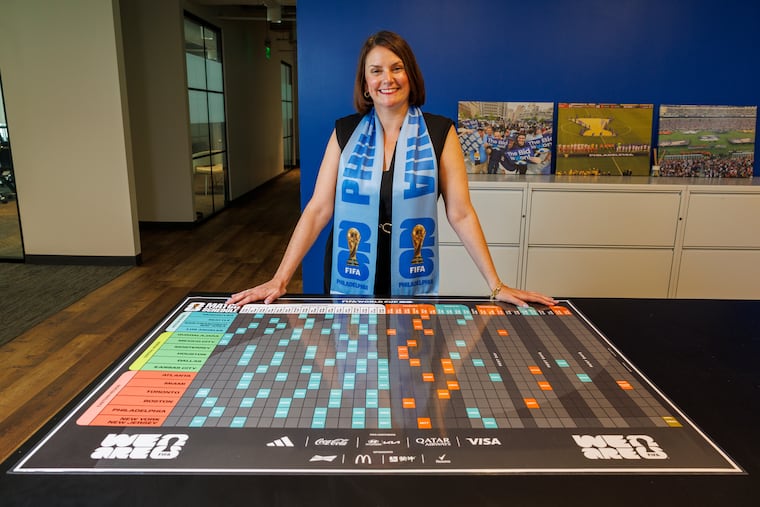
“It’s not about getting away with anything,” said Meg Kane, host city executive of Philadelphia’s local organizing committee, at a moment when this town faced an even rarer sight than a proper spring: a slew of compliments.
“It’s just that we’ve been working on this for a significant amount of time,” she continued. “We have always really put the fan experience at the center of what we wanted to build the FIFA World Cup in Philadelphia around.”
» READ MORE: SEPTA will keep $2.90 fare for World Cup transit rides. Boston is charging $80.
That started six years ago, when soccer’s global governing body started evaluating potential host cities.
“In 2020, when we first introduced ourselves to FIFA, we had to explain who Philadelphia was,” Kane said. “And that fandom is at the heart of why we were selected. … That’s really the thread that I think you can see throughout this entire planning process.”
A big boost from private financing
If there is a secret sauce, it isn’t Cooper Sharp — which, if you’re reading this from afar, has long since overtaken Cheez Whiz as the best cheese for a cheesesteak. (Though we’ll remind potential visitors that roast pork with broccoli rabe is the true local delicacy.)
In fact, the trick has been a ton of private financing. That has saved logistical headaches, and potentially some taxpayer headaches, too.
» READ MORE: No, FIFA isn’t actually banning tailgating at the Linc during the World Cup
“One of the things that differentiated us in the bid, and has continued to be part of our story,” Kane said, “is the fact that our business community and the philanthropic community stepped up in such a significant way, from the beginning of this bid all the way through what we’re doing, through the end of this. It’s been lockstep of a true public-private partnership.”
That includes securing a group of big-spending local sponsors, in the face of FIFA making it devilishly hard for host cities to make any money for themselves this summer. There’s no doubt that if the governing body would back off a bit, NJ Transit wouldn’t be charging $150 for train tickets from Manhattan to the Meadowlands, facing a reported $48 million bill for eight games. Nor would the Bay Area have pulled the plug on an official fan festival entirely.
Here in Philadelphia, the process started years before the official announcement of eight “host city supporters” this past January, with each putting up at least $5 million. In fact, it started as the city was coming out of the pandemic.
“Our board, specifically the leadership of [previous chair] David L. Cohen and [current co-chairs] Dan Hilferty and Michelle Singer, these are experienced stewards of the city of Philadelphia from a corporate perspective,” Kane said. ”And their ability to rally the business community, especially at a time when it was really hard to do so … when I think of the success, it is rooted in the fact that we had incredibly strong leadership at the board level, and at that leadership level, from the beginning of this.”
» READ MORE: NJ Transit's president says it's "not trying to gouge anybody" with $150 World Cup fares
She praised the civic-mindedness of the corporate and philanthropic entities that have written checks.
“Many have done this, have stepped up, because it is a civic endeavor,” Kane said. “Being a host city for the World Cup is very different than being a host city for any other major event, and people recognize that it changes the profile of the city of Philadelphia. … We’ve tried to be exceedingly custom where we can make sure not just our official host city supporters, but the more than 60 businesses that stepped up as donors are also feeling that level of support and engagement.”
That’s not to say there’s been no public money; there’s been plenty. But Kane said her group has been “really been thoughtful around the asks that we made” to city and state officials.
“There’s been incredible ways in which we’ve had the federal government, the state government, and the city government, at different times, be able to provide us funding,” Kane said. “And of course, 2026 being such an incredible year for the commonwealth, we’re very grateful to Gov. [Josh] Shapiro and DCED [Pennsylvania’s Department of Community and Economic Development] on what they’ve done for all of the support of major events, whether it’s the NFL draft [in Pittsburgh], FIFA World Cup, or MLB All-Star Game, PGA Championship.”
» READ MORE: Lincoln Financial Field will look almost unrecognizable during the World Cup
The remaining checklist
What’s left to do now, with under two months until the tournament kicks off? The biggest items are finalizing the transportation plan, which should be announced in the coming days, and the security perimeter in the sports complex.
“Those are the tent poles,” Kane said. “Because a great fan experience is rooted in people feeling safe and secure no matter where they are, and being able to move — nobody likes to stand in a line, right? And so with those two things at the forefront, how do we make sure that we’re getting those plans finalized to the point that we can then launch know-before-you-go campaigns, get everybody up to speed.”
The perimeter details have been much-anticipated, as they set out how far fans — including potential tailgaters — can get without needing a game ticket. There was always going to be one, if you’re wondering, as it has long been a major part of any World Cup’s operations.
“We are finalizing safety and security, which, as you know, in a major event is never truly final,” Kane said. “It is to the point where it is ready to be nimble and flexible and responsive to anything that happens, but it is ready.”
» READ MORE: A World Cup in Trump’s America is insane. How this fan is coping. | Will Bunch
There’s also the small matter of building up excitement for Philadelphia’s biggest-ever moment on the world stage. There will be some pep rallies in the next few weeks, and Kane said a collaboration with Mural Arts is in the works.
She also joined the many fans in town who will do their best to roll out the welcome mat for visitors, even though the Trump administration’s immigration restrictions have raised so much anger around the sport.
Then, at last, there will be six star-studded games. There will be giants in Brazil and France, and underdogs in Curaçao, Haiti, and Iraq. Côte d’Ivoire will make Chester and Wilmington its base camp, Ecuador will bring a huge crowd for its group opener, and Ghana and Croatia will play what could be the best group-stage matchup of the lot.
The curtain will fall on July 4, with a round-of-16 game that will be France vs. Germany if the seeds hold. Short of the U.S. playing here, as unlikely as that is, Philadelphia was dealt a quite good hand by FIFA’s schedule-makers.
“For us, it’s really getting everybody excited to have a World Cup experience in Philadelphia,” Kane said. “When people are contemplating where do they want to spend their time and their money to have that World Cup experience, we want them to spend it in Philadelphia. We’re trying to do everything we can to make that proposition as enticing as possible.”

Nine nations will compete in five group stage matches this summer, plus two more in a knockout game on July 4. Here’s what you need to know about those countries — and what those fans need to know about Philly. Click here for more.