The World Cup has always been political, but it feels even more so now
From war in Iran to visa headaches and ICE threats, this World Cup has not stuck to sports. This week's FIFA Congress is a chance for the world to protest to soccer's leaders. But do they really care?
VANCOUVER, B.C. — The history books don’t say whether fans in the 1930s wrote letters to newspapers telling athletes to stick to sports. But they do say that the World Cup has been a political event since the start, nearly a century ago.
Uruguay hosted the first edition in 1930 after its president hosted FIFA’s first president for a barbecue. Across the Atlantic, Benito Mussolini saw the event’s success, then used the next one in 1934 to glorify fascist Italy.
In 1978, Argentina’s junta ran a detention and torture facility less than a mile from the stadium in Buenos Aires that hosted the final. That was 40 years before the controversial trifecta of Russia in 2018; Qatar in 2022; and the United States, Canada, and Mexico this year.
So what’s going on right now isn’t new. It’s just that this time, the headlines are on these shores; and the country in the hot seat has been a democracy for 250 years.
That’s not to diminish the issues, to be clear. They are serious, as are their impact.
The list begins with a host nation bombing a participant. There obviously are many opinions about the U.S.-Iran conflict, and they generally are aired in The Inquirer’s op-ed pages instead of the sports section. But the first paragraph of this sentence is a fact, and a point made by some of the soccer world.
In March, after the U.S. killed Supreme Leader Ayatollah Ali Khamenei, Iran’s sports minister said “under no circumstances can we participate in the World Cup." A few weeks later, Iran asked FIFA to move the team’s games to Mexico, and FIFA said no.
» READ MORE: A friend of the U.S. navigates the collision of sports and politics leading up to the World Cup
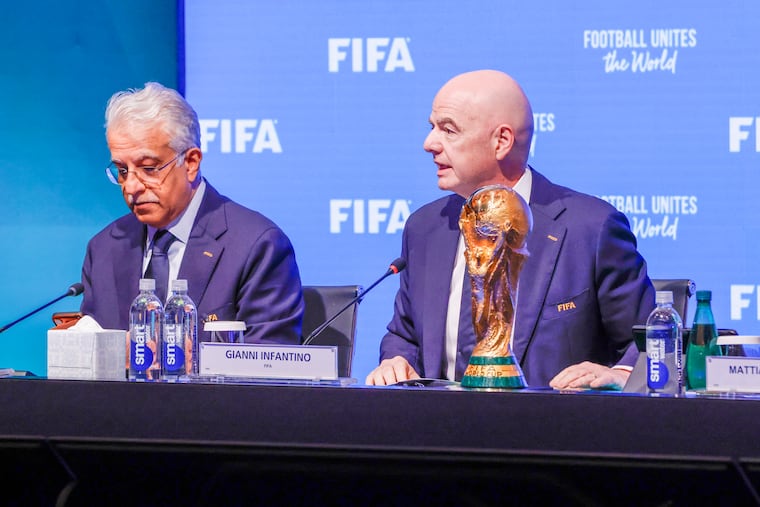
At one point, Trump said “I really don’t care” if Iran plays or withdraws. That reportedly sent FIFA president Gianni Infantino rushing to the White House to get an emergency meeting with the president, whom he views as a close friend — a relationship Infantino has cultivated loudly.
Afterward, Infantino said on Instagram that “President Trump reiterated that the Iranian team is, of course, welcome to compete in the tournament in the United States.” But the next day, Trump said on his Truth Social platform that “The Iran National Soccer Team is welcome to the World Cup, but I really don’t believe it is appropriate that they be there, for their own life and safety.”
It took Infantino going to one of Iran’s games in late March to finally calm the waters for a moment. But things erupted again last week when one of Trump’s envoys, Paolo Zampolli, said he asked the White House and FIFA to replace Iran with Italy, which disastrously failed to qualify for a men’s World Cup for the fourth straight time.
“I’m an Italian native and it would be a dream to see the Azzurri at a U.S.-hosted tournament,” Zampolli told the Financial Times. He told the Associated Press that “my request was for the Italian people and the American-Italian people,” although he hadn’t asked if they all agreed.
» READ MORE: Trump ally asked FIFA to have Italy replace Iran at World Cup
(It’s worth noting some context here: Zampolli has a long history of headline-grabbing words and a long history with Trump. He reportedly introduced the future president to his future wife, Melania, in 1998 when she was a fashion model.)
The Italians promptly dismissed the idea as if booting a clearance to the stands. The nation’s Olympic Committee president, Luciano Buonfiglio, said he “would feel offended,” and the government’s finance minister, Giancarlo Giorgetti, called it “shameful.”
Another specter looms. If the United States and Iran finish second in their World Cup groups, they would meet in the round of 32 in Arlington, Texas.
And the controversy isn’t just limited to the U.S. This week, Iran’s delegation to FIFA’s Congress — the annual gathering of every national soccer federation — was denied entry to Canada after arriving at Toronto’s airport.
Immigration authorities had given Iranian federation Mehdi Taj, a former member of Iran’s Revolutionary Guard, a temporary visa to attend the Congress, and he arrived on Tuesday. Canada’s government has labeled the Revolutionary Guard a terrorist organization since 2024, and Taj’s arrival sparked an outcry.
» READ MORE: How this fan is coping with a World Cup in Trump's America | Will Bunch
Taj remained in Toronto until Wednesday, when according to the Canadian Press the visa was revoked before he was allowed to travel on to Vancouver. Iran’s state news agency said soccer secretary general Hedayat Mombeni and deputy secretary Hamed Momeni also were denied entry.
Canada’s immigration authority said in a statement to sports investigateive outlet Josimar: “While we cannot comment on individual cases due to privacy laws, the government has been clear and consistent: IRGC officials are inadmissible to Canada and have no place in our country.” FIFA has not yet answered a request for comment.
A peace prize, but not much peace
Yet Iran’s status is one of only many controversies.
At the same time that the United States captured Venezuela’s president and threatened to annex Greenland and Canada, Infantino gave Trump the inaugural FIFA Peace Prize at the World Cup draw.
On Monday, Norway’s soccer association president, Lise Klaveness, called for the prize to be abolished. She also backed a complaint filed to FIFA’s ethics committee in December that the peace prize broke FIFA rules on political neutrality.
Trump’s administration has banned citizens of some nations that will play in this summer’s tournament from entering the United States. Though there’s an exemption for official delegations at the World Cup, there’s no exemption for fans.
Iran and Haiti are among the banned nations. That affects Philadelphia directly, as Haiti plays Brazil in the city’s highest-profile group stage game on June 25.
Additionally, because of a Trump administration policy, visitors from a few other countries must pay a $15,000 refundable bond to enter, including World Cup participants Algeria, Cape Verde, Ivory Coast, Senegal, and Tunisia.
» READ MORE: Fans from four nations headed to Philly for the World Cup face real obstacles to get here — including travel bans
That also impacts Philadelphia, as Ivory Coast will play two games here and use the Union’s facilities as its base camp. Senegal will play the U.S. on May 31 in Charlotte, N.C., in the Americans’ first game with their tournament squad assembled.
Last month, The Athletic reported that it was unclear whether World Cup delegations would be exempt from the bonds, with the State Department and FIFA not ruling out the possibility.
Other nations’ fans who can get in have had headaches getting U.S. visas, from long waits to demands to search social media posts for opinions the government does not like.
When fans do arrive, they might have fears of Immigration and Customs Enforcement raids in mind. In February, ICE acting director Todd Lyons did not rule out the possibility in a heated congressional hearing.
» READ MORE: Can the U.S. play in Philly at the World Cup? It’s complicated.
The Athletic reported earlier this month that FIFA leaders, all the way up to Infantino, have discussed asking Trump for a formal moratorium on ICE raids during the World Cup. It’s unclear whether the request has been made.
FIFA’s own decisions hit teams and fans
Wherever fans come from, almost everyone going to a game will have paid exorbitant prices, from thousands for tickets to train fares of $150 in New Jersey and $80 in Massachusetts. (Philadelphia’s moves to leave SEPTA prices alone and offer free rides after games earned the city worldwide praise.)
Many fans and media have complained — including plenty in this country. But with rare exceptions, most soccer officials have not. They’ve seen that FIFA projects $14 billion in revenue from this summer and want their piece of it, even as some national teams fear actually losing money on operational costs.
For that, FIFA has agreed to raise payouts to the participating teams. But the governing body hasn’t budged on much else, and there isn’t long until the tournament kicks off.
» READ MORE: How Philadelphia's World Cup setup became the envy of fans in New York, Boston, and beyond
The biggest chance critics have left to do something formal could be at the FIFA Congress, which takes place Thursday. It’s in North America for the first time since 2016, and just the eighth time ever.
Vancouver has among the richest soccer histories of any city on the continent. The Whitecaps have played professional soccer for more than a half century, from the old North American Soccer League to MLS, and aim to find a new owner that keeps them here.
The city’s soccer stage, BC Place, towers over the photogenic shores of False Creek. It’s the only MLS stadium that has hosted a World Cup final: the 2015 women’s edition, where 54,000 American fans roared for Carli Lloyd’s hat trick. This summer, it will host six games, including two of Team Canada’s and two in the knockout rounds.
Across town, the convention center stands next to the 2010 Olympic cauldron. It almost feels like a relic these days.
So, for all the controversies and complaints, will anyone speak out against Infantino on the big stage? And if not, then what? Those billions do a pretty good job of keeping the soccer world quiet, even the countries that can afford to speak up.
Answers will start to come soon. The Congress starts at 12:30 p.m. Philadelphia time, streamed live on FIFA’s website.
As ever — but especially now — the world will be watching.

Nine nations will compete in five group stage matches this summer, plus two more in a knockout game on July 4. Here’s what you need to know about those countries — and what those fans need to know about Philly. Click here for more.