A friend of the U.S. navigates the collision of sports and politics leading up to the World Cup
Anter Isaac, the head of Australia's soccer governing body, offered a wide-ranging perspective to The Inquirer ahead of FIFA's Congress gathering in Vancouver — the first in North America in a decade.
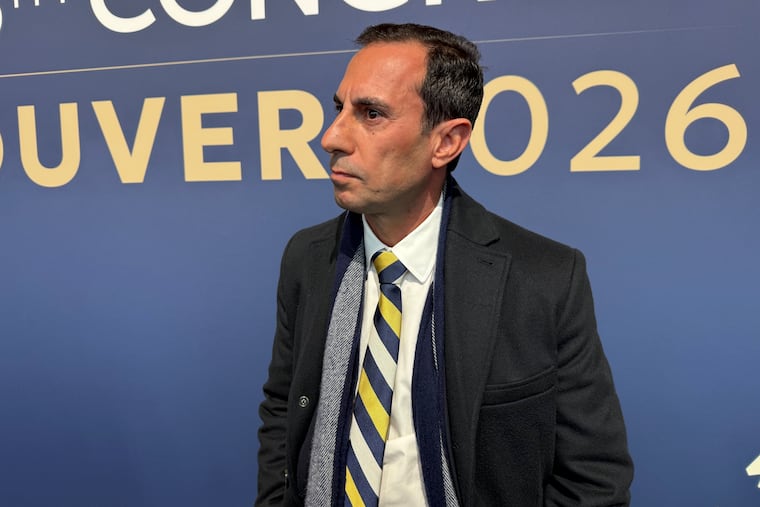
VANCOUVER, B.C. — With six weeks to go until the World Cup, the people who run world soccer have gathered here this week for FIFA’s annual Congress meetings. And to little surprise, the headlines aren’t about anything happening on the field.
The war in Iran overshadows everything, including who will be here in the first place. Iran’s delegation was not present at the Asian Football Confederation’s continental Congress on Tuesday, due to what AFC general secretary Windsor John called “some visa formalities issues.”
But a few minutes later, during a presentation honoring Asian countries that have qualified for World Cup, John said Iran’s delegation would get its honor “when they arrive.”
That implied they would, but a FIFA spokesperson reached by The Inquirer declined to comment. The spokesperson referred all questions about visas to Canada’s government.
Word went around that Iranian football federation president Mehdi Taj was in Toronto on Tuesday and on his way to Vancouver, having been given a temporary visa by Canada’s government. Taj reportedly worked in Iran’s Revolutionary Guard in the past, and that sparked an outcry in some quarters about allowing him into the country.
Other national soccer leaders couldn’t travel because of the war’s impact on their countries, including representatives from Kuwait, Lebanon, Nepal, and the United Arab Emirates.
But the hall was still full, not just with national soccer chiefs but FIFA president Gianni Infantino and all eight FIFA vice presidents. They included Concacaf president Victor Montagliani, who’s also a Vancouver native.
There were other familiar faces too, and one that knows the United States well even from afar. Football Australia chair Anter Isaac has been around the game for many years, helped host the outstanding 2023 women’s World Cup, and has seen his country’s men’s and women’s teams play in the U.S. many times.
» READ MORE: How Philadelphia's World Cup setup became the envy of fans in New York, Boston, and beyond
He’ll see it again in June, when the Socceroos face the American men in their second World Cup group stage game in Seattle. It will come just eight months after a hard-fought friendly between the teams in suburban Denver.
“We’re very much looking forward to the tournament,” Isaac said of what will be Australia’s sixth straight men’s World Cup. “In particular, that game against the USA, I mean, we don’t need any more motivation than you can imagine. We obviously we want to knock off the hosts, and we look forward to doing that.”
There was room for some levity in the moment, but Isaac is no stranger to politics intruding in sports.
When Australia hosted the women’s Asian Cup earlier this year, five Iranian players and two staff sought asylum to avoid persecution when they got home. The matter drew the attention of U.S. President Donald Trump, who demanded Australia grant the requests.
» READ MORE: Fans from four nations headed to Philly for the World Cup face real obstacles to get here — including travel bans
That did happen — and was in progress before Trump spoke about it — though some of the players returned to Iran afterward.
“I think we handled it sensitively, delicately,” Isaac said. “We always try to be dignified, we always try to be respectful — I think that’s the Australian way. … We also understand that in Football Australia and in the Australian football community, wherever possible, not only will we welcome people from all walks of life, different backgrounds, different races, different cultures, different religions, but we also have a role and responsibility to protect people, and protect the football, and what the game stands for.”
Iran fans have unfurled prohibited Lion & Sun flags and come over to the tunnel where the players are exiting the field to sing and chant and applaud them. they also seem to be throwing insults at some of the staff members. #AFCWAC
— Sam Lewis (she/they) 🌈 (@battledinosaur.bsky.social) March 5, 2026 at 3:20 AM
[image or embed]
Like the United States, Australia is a country with a diverse population, and has long welcomed the world to its shores. But there’s also a diversity of political opinions, and in recent times that has turned into a cultural polarization that also resembles America’s culture.
Isaac reflected on that when asked how he sees America’s upheaval.
“I mean it’s very difficult for us,” he said. “You always see, a diversity of opinion is what I would call it now, in news. I think the days of news trying to inform people is a lot different now. I think news now, we’re seeing very polar positions being formed, and indoctrination.”
» READ MORE: How this fan is coping with a World Cup in Trump's America | Will Bunch
He was well aware of the worldwide complaints about this World Cup’s exorbitant ticket prices. Isaac offered some sympathy, but only some.
“I think it’s always a difficult challenge finding that balance between accessibility and making it commercially viable,” he said. “That’s always going to be a challenge for anyone who’s hosting and leading tournaments of this nature, right? But wherever possible, if we can get more fans at accept accessible prices, of course that’s something we should celebrate.”
He was also honest about a fact that’s been overlooked by some critics: the prices aren’t the U.S. Soccer Federation’s fault. The 2026 bid book’s proposed prices were far lower than what FIFA unilaterally decided to set them at.
“I think there has to be an acceptance, a tolerance that [it] will happen,” Isaac said. “Because the environment, the circumstances when people bid for these kind of tournaments, they change drastically, let alone in over a period of six or seven years, — let alone just in a year. So I think there’s a tolerance, there’s an acceptance that you’re never going to deliver 100% accurately on a bid book.”
» READ MORE: No, FIFA isn’t actually banning tailgating at the Linc during the World Cup
But he was optimistic overall, encouraging his fellow Australians to travel to North America for the summer.
“On the field, off the field, the U.S. has always hosted great events. The Americans, like the Canadians and Mexicans are wonderful hosts, always have been … I think it’s always a wonderful opportunity to experience a new country, new culture, and a new way that a nation — in this case three nations — embrace a World Cup and the global game.”

Nine nations will compete in five group stage matches this summer, plus two more in a knockout game on July 4. Here’s what you need to know about those countries — and what those fans need to know about Philly. Click here for more.