This World Cup was nearly 20 years in the making for U.S. Soccer. The history is worth knowing.
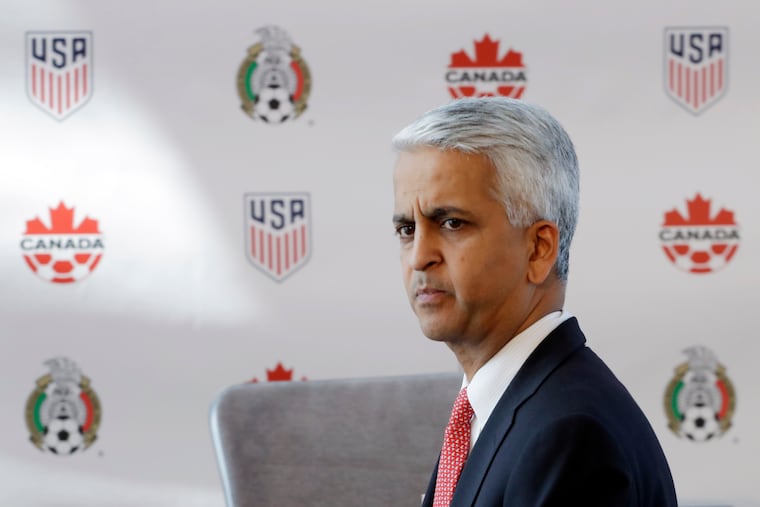
Former U.S. Soccer president Sunil Gulati knows better than almost anyone how an idea hatched in 2007 grew into the biggest sporting event in human history. He shares some stories with The Inquirer.
IRVINE, Calif. — For Philadelphians new to seeing a World Cup in person, it might feel like the road to this point began when FIFA picked the city to host games in 2022.
For others, it might feel like the first steps were taken when the U.S.-Canada-Mexico joint hosting bid won the formal vote in 2018, or when the bid was filed the year before.
In fact, the process began much longer ago than that, in 2007. That’s when U.S. Soccer Federation officials started seriously thinking about bringing the men’s World Cup back to the United States for the first time since 1994.
Nineteen years is a long time in American sports, and especially American soccer, where so much changes from year to year, not just decade to decade. So as the 2026 spectacle unfolds, it’s worth taking a moment to step back and turn to the history books.
There aren’t too many Americans who’ve been on the entire ride. In fact, there’s barely anyone at U.S. Soccer who has been, in part because the presidency has changed hands twice since 2007.
One who has and who knows Philadelphia well is Sunil Gulati. The longtime economics professor at Columbia University led U.S. Soccer from 2006-18 and has also served on the FIFA Council and the former FIFA Executive Committee.
Few people have seen more of soccer’s growth in this country up close, not just in his years as president but in a variety of roles across Major League Soccer, FIFA, and recently as the chair of European soccer confederation UEFA’s Club Financial Control Body.
Gulati has a lot of stories to tell, and not all of them are allowed to see the light of day. But he was happy to share some with The Inquirer as he enjoys this tournament just like the rest of us.
‘The day after’
When U.S. Soccer took those first steps in 2007, Gulati had been president for less than a year, and it was only 13 years since the 1994 tournament — not too long in World Cup terms. But some flickers of the afterglow were still there, and he knew how long it would take to bring the fire back.
» READ MORE: Before she married Tug, Diane McGraw led Philly’s bid for a World Cup
“The ’94 World Cup had been highly successful, and hosting an event like the World Cup generates a lot of positive benefits — and they’re not pure economic benefits, including this [2026] World Cup,” he said. “It was never about the financial returns to the federation, or federations, in this particular World Cup, and there are three of them.”
In his view, “it was always about trying to increase the demand for the game, [and] accelerate the growth of the game in the United States. It’s [wondering] what does the sport look like the day after?”
That acceleration included building the foundations of a soccer infrastructure in this country. Many future power brokers had launchpad moments in 1994: future U.S. Soccer CEO Dan Flynn, promoter and media personality Charlie Stillitano, broadcaster Derek Rae, and future women’s World Cup, Olympics, and NWSL executive Marla Messing.
Above all, that World Cup produced Major League Soccer, as FIFA required the U.S. to launch a top-level league as a condition of hosting.
“All the people that worked in senior positions or in entry-level positions that became part of the landscape in the sport … those people became important players in the growth of the game in different ways,” Gulati said. “And obviously, then if you talk about MLS, the development of the league leads to huge changes in infrastructure, the stadiums in particular, training facilities.”
Gulati believed another World Cup could do even more. So the long road began, with U.S. Soccer going in on 2022 when it became clear 2018 was going to Europe.
» READ MORE: Philadelphia’s World Cup love affair shows just how far we’ve come
For some time, it seemed like effort would pay off. But in December of 2010, a day came that will live in soccer’s infamy.
So many people around the sport remember where they were when then-FIFA president Sepp Blatter pulled Qatar’s name out of the envelope instead of the United States’. It hurt as much as any loss on the field, perhaps even more to some people.
But Gulati was ready for the gut punch because he sensed it might be coming.
“I had a better inkling, I think, than members of my team that it was going to go the wrong way for us,” he said. “Because we had a pretty accurate vote count, and that vote count relied on three European votes. And I had a pretty good idea that we weren’t going to get those — the votes that the weeks earlier, I was quite confident that we were going to get.”
Had those three votes on FIFA’s executive committee gone the U.S.’ way in the final round of voting, it would have been an 11-11 tie, and Blatter would have broken it in America’s favor.
“It didn’t shock me, but I think it probably shocked some other members of the team who maybe weren’t quite as close to the vote count,” Gulati said. “And it was obviously a huge disappointment, but not a shock.”
» READ MORE: The joy the World Cup has brought to Philadelphia feels like the escape we didn’t know we needed | Kerith Gabriel
Going bigger for 2026
As burned as Gulati was, he was also steeled.
“Right after the decision, I wasn’t sure if I ever wanted to go near this process again, or if I wanted to start right away,” he said, and he referred to an even stronger version of that line he gave to France’s Le Monde newspaper earlier this month.
“On the one hand, I wanted to immediately jump into our next bid,” that version went, “and on the other, I told myself that I never again wanted to have anything to do with that kind of thing, or with those people.”
As allegations that Qatar bribed FIFA officials to win the bid piled up, it would be a few years before the winner of Gulati’s internal battle emerged. When it did, the soccer landscape had changed in an even more epic way.
On May 27, 2015, the U.S. Department of Justice raided the Baur au Lac hotel in Zurich, Switzerland, and arrested a slew of international soccer officials. A few hours later in Brooklyn, N.Y., the department formally announced the charges and the people charged.
That day would lead to Blatter’s resignation and a pile of other impacts, including reforms to the World Cup bidding process.
» READ MORE: Philly’s path to the World Cup was paved at Newt’s, where playing on cinder was a ‘badge of honor’
Since Gulati was on the FIFA Executive Committee at that point, he had a role in those reforms. He acknowledged to The Inquirer that he wanted “to try to influence what the rules of the competition, in terms of the bidding process, would be. And those changed, which then allowed us to be more comfortable bidding again.”
By the end of that year, the wheels were in motion, and in 2016, Gulati started pushing for a multicountry plan. It started with just the U.S. and Mexico, as Gulati worked with the then-chairman of the powerful TV network Televisa, Emilio Azcárraga Jean. Then Canada joined the fold.
“There were some cultural reasons, frankly, that I wanted to do it with Mexico, about Hispanic relations, Mexico-U.S. relations, and so forth,” Gulati said. “And then we’re having a parallel set of discussions with Victor Montagliani, who was the president of the Canadian federation, and it eventually came to the three of us doing it together.”
Gulati knew a multicountry bid would look better to FIFA, but it would take convincing U.S. Soccer’s board first.
“I preferred having a 90% chance of winning 75% of the World Cup games than a 75% chance of hosting it all,” he said.
He also preferred the new FIFA president. Gulati played a key role in getting Gianni Infantino elected. During the election vote at the 2016 FIFA Congress, Fox’s TV broadcast repeatedly showed him working the hall.
» READ MORE: FIFA has gone to great lengths to appeal to American soccer fans. But they got us all wrong. | Kerith Gabriel
How this World Cup is working
There wasn’t time to ask whether Infantino’s tenure has gone differently than Gulati expected. But a recent New York Magazine investigation into Infantino had a quote from journalist and academic Leander Schaerlaeckens that struck a chord.
“U.S. Soccer is very much responsible for his rise,” Schaerlaeckens said of Infantino. “Did they anticipate what he would turn into? I suspect not.”
There are lots of things to point at with the ills of FIFA’s management of this World Cup, from the exorbitant ticket prices to the lack of hard pushback against the Trump administration’s visa restrictions. Much of that goes directly to Infantino, due to his vast power in FIFA’s decision-making and his purported close friendship with Trump.
Another aspect doesn’t attract big headlines but has had a huge impact behind the scenes. This is the first men’s World Cup where FIFA hasn’t had a national-level local organizing committee, run by domestic staff in the host countries, that handles marketing, venue deals, political relationships, and so on.
Instead, FIFA has tried to do almost everything itself. And as even casual soccer fans have seen by now, it has not gone well — especially just north of here in New Jersey.
» READ MORE: The World Cup has always been political, but it feels even more so now
Gulati didn’t want to go too far down that road in public, but he opened the door enough to sense what was beyond it.
“Some of the key figures in this World Cup are people that work for FIFA, which is fine, but it’s different, certainly,” he said.
Asked if FIFA was told that they weren’t going to be able to unilaterally rule over North American governments, he said: “They understood that. And that’s obviously posed a bunch of challenges … Not just state, local, federal, but three countries in this case.”
And asked in particular about dealing with state and local governments that don’t exist in other countries, Gulati said: “That’s obviously come up, and I get it. But look, there’s always some issues that come up in these things, whether it’s immigration or taxes, or who’s going to pay for what, or exclusivity, all those things — those are kind of par for the course in World Cups.”
A moment later, he added: “Maybe it’s a little bit easier given the obvious differences in governance that exist in other countries.”
» READ MORE: Rob Stone has spent half his life broadcasting World Cups. This summer, he leads what could be Fox’s last.
In the end, Gulati is an optimist about this World Cup’s long-term potential, including for Philadelphia specifically. He knows the city well, and knows the spotlight it’s in this summer.
“I think what it can do is bring greater attention to the sport and greater attention to the city if it becomes an important attraction, and games go well, and people feel at home, and it’s welcoming, and so on,” he said. “Philadelphia, it’s a great sports city, it’s got great venues. And hopefully, some of the teams that are playing there — and the fans more importantly — come, and they talk about it, and there’s more people that want to visit in the future.”

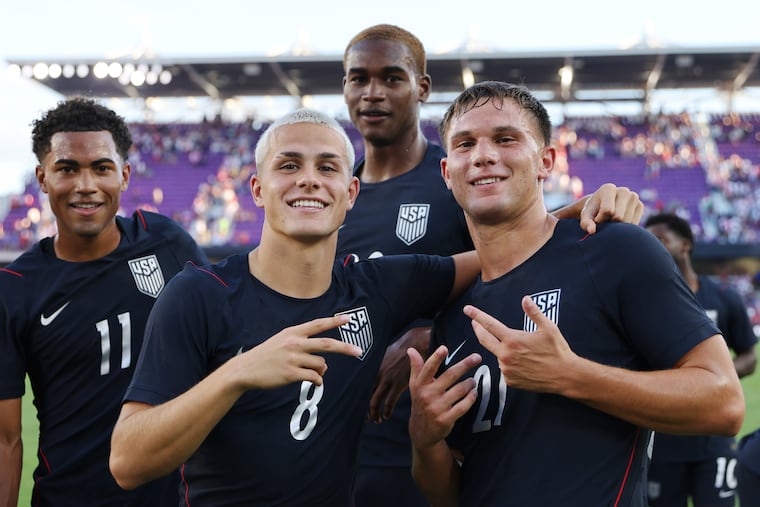
In this World Cup, underdogs have stolen the spotlight, the U.S. men made a notable run and Philadelphia not only welcomed the world but gave visitors a crash course on just how real the curse of the Rocky Statue can be.
Join Jonathan Tannenwald, the Inquirer's soccer writer, and host Lisa Carlin, analyst for CBS Sports Golazo, as they dissect the matches, the moments, and more as Philly has its moment in soccer's brightest spotlight. Watch our latest episode right here.
Watch previous episodes:
Episode 1: The Wait is Over!
Episode 2: Groups, Goals, and Glory
Episode 3: Electric Action in Philly
Episode 4: The Knockout Rounds Begin!