Jadin Aviles was a star athlete with a bright smile and maturity beyond his years. North Philly mourns his unfulfilled promise.
The death of the former All-Public League guard on May 12 has gutted his community and left questions for Aviles' loved ones.
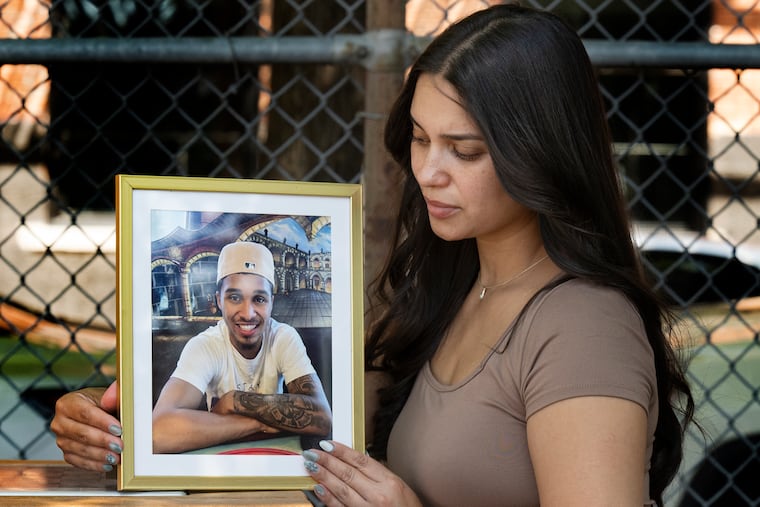
The first thing people noticed about Jadin Aviles was his smile. It was bright and big, and became part of his identity. Not just because of his youthful spirit, but the work that shaped each glistening tooth.
When Aviles was 9, his mother, Emelissa Gonzalez, saw that he was closing his mouth in photographs. Sometimes, he’d cover it with his arm. She asked why; Aviles explained that he was insecure.
Gonzalez turned to her son.
“Don’t worry,” she said. “Once we hit a certain age, we will get them done.”
A few years later, the mother surprised him with a trip to the orthodontist in Northeast Philadelphia. Not every child would react with enthusiasm, but this child did.
Aviles eagerly picked out the colors of his braces — red and blue — and was diligent in wearing his rubber bands. Tightening the wires was hardly a chore; the teenager saw this as a necessary (albeit painful) step to getting the grin he wanted.
By age 15, he finally had it. Aviles smiled constantly — so much so that his friends began to tease him. But he didn’t mind. Gonzalez had invested her hard-earned money. He had treated that investment with care. Wasn’t that something to be proud of?
Aviles brought the same industrious energy to basketball. He played in two youth leagues — La Liga Del Barrio and Timoteo Sports — as well as on his high school team, Maritime Academy Charter.
Athletic director Kevin Schultz would let the shooting guard and his teammates into school early, so they could shoot from 5:30 a.m. to 7:30 a.m.
“Class started at 8:02 [a.m.],” former Maritime teammate Andy Figueroa said. “So we was in the building before all the teachers.”
Aviles wasn’t competing in front of a packed Palestra, but he did become a “street legend” in North Philadelphia, according to those who knew him.
This was as much about his ferocity as it was his empathy. The teenager would rarely, if ever, jaw at referees. He’d often extend a helping hand to an opponent who’d fallen on the court.
“He would come to our church sometimes,” said Pastor Rob Whitmire, executive director of Timoteo, “and to see how he cared for people, it was something unique. Because, if I’m that guy, if I’m that player, that’s really not how they carry themselves. It’s not a caring spirit. And he just had a caring spirit."
His community is now trying to keep it alive. On May 12, Aviles was riding his moped in a bike lane on Aramingo Avenue. A pickup truck, turning left, ran him over. Aviles suffered extensive brain damage, and died that night.
He had just turned 20.
It is a devastating loss, one that friends and family have struggled to reckon with. To many, Aviles, with his beaming smile, was brightness incarnate. He seemed to make all the right choices. How could things go so horribly wrong?
As North Philadelphia celebrates his past, and mourns his unfulfilled promise, they’ll continue to point to Aviles as an example. Proof that a life built on kindness and respect can be a life well-lived, no matter how it ends.
Bonding through basketball
Aviles grew up with his mother. His parents broke up when he was 2 but maintained an amicable relationship. Even as a child, the future basketball star was self-sufficient.
He wasn’t the kind to throw a temper tantrum in a toy store. He rarely cried. If he did, his father, Sam, could quickly calm him down with a meal and some TV.
By age 9, Jadin’s uncle and grandfather, who worked in electricity and construction, were teaching him odd jobs around the house.
The third grader knew how to navigate a switchbox and how to repair a lamp fixture. Once, when a pipe burst in the bathroom, Aviles called Gonzalez’s brother, Emanuel.
“‘Hey Tío, how do I fix this?’” she remembered him saying. “And over the phone, he’s literally fixing a pipe.”
Sam introduced the younger Aviles to basketball at age 5.. He’d heard about La Liga through a cousin and signed Jadin up. One day, in the fall, they went to Towey Playground, around the block from Gonzalez’s home.
Sam was a new father, with no experience in youth sports. He did not realize that his son would be playing on a smaller court, with a hoop eight-feet high. So, they started practicing at the regulation-sized Towey, with Jadin chucking basketballs from above his head.
The boy didn’t complain, but once he and his father showed up to La Liga in December, it dawned on them that they had overestimated these dimensions. Even still, Jadin took to basketball, and began to participate in La Liga every winter.
Shortly after, Sam joined the organization as a coach. The father and son became inseparable; often watching games together, and taking extra shots at the Mariana Bracetti Academy gym (where La Liga is based).
The younger Aviles soon added another league, Timoteo, in the hopes of further refining his skills. At both stops, he established himself as a tough and bullish guard, who played far beyond his stature.
Whitmire became familiar with Aviles through his church, Grace and Peace Community Fellowship, where the teenager would volunteer. When the pastor first saw him play, in 2020, he didn’t recognize him.
The Jadin Aviles Whitmire knew was quiet and reserved. This kid was anything but. Eric Moore, assistant director at Timoteo, remembers that day vividly.
Aviles was in eighth grade, battling older students at the Esperanza High School gym. Moore and Whitmire stood in the back corner.
“And he was like, ‘Yo, is that Jadin?’” Moore recalled. “And I’m like, ‘Bro... yeah.’ And he’s like, ‘His defense is phenomenal.’
“And I was like, ‘Wait ‘til he gets the rock. Wait ‘til he handles the rock.’”
Added Whitmire: “I saw him come down and pull up on a guy and shoot, and I’m like, ‘Oh.’ There was something about his form that’s like, ‘No, that’s not normal. That’s not a rec player.’”
At La Liga, Aviles always competed above his age group, and consistently held his own. His father called him a “giant slayer”; fully grown, Jadin stood at only 5-8, but was unafraid of opponents who were taller and larger than he was.
The numbers back this up. For five years in a row, Aviles averaged at least 11.1 points per game. He increased his scoring in 2025, with 24 and 46-point games. But despite his offensive output, he also devoted time and energy to his shortcomings.
One of the guard’s proudest moments came in 2023, when Timoteo named him defensive player of the year.
“[A coach] started working out with him, and he would ask what they wanted to do that day,” Sam said. “And Jadin was like, ‘Defensive drills, defensive drills, defensive drills.’”
Sam joined Timoteo as a coach in 2021, with the goal of spending more time with his son. But then an unexpected opportunity presented itself.
In 2022, Maritime’s head coach, Ercel Ballinger, contacted Sam to see if he would be interested in running the junior varsity team. He agreed, and took a job at the school a year later as a member of the support staff.
Jadin, who spent his freshman year at Roman Catholic, transferred to Maritime to play for his father. It turned out to be a life-changing decision. The younger Aviles thrived in the Philadelphia Public League.
He was reunited with childhood friends like Yozuet Pagan, an older kid on the block who taught him ball-handling and finishing at Towey. And as he matured, Aviles became comfortable taking on that role himself, with younger teammates.
Andy Figueroa was the biggest example of this. Like Aviles, he’d tried Roman Catholic, only to find it wasn’t a fit. The veteran guard began to check in on his pupil, and one morning, he approached the 16-year-old in the hallway at school.
Jadin knew Figueroa had been struggling, and was at risk of becoming ineligible.
“He was like, ‘We need you on the court for our next game. So make sure you’re doing everything right,’” Figueroa recalled. “That made me realize that I got to make sure I do well, not just for me, but for my teammates, too.”
Aviles’ words were only bolstered by his play. By senior year, he was putting up career-numbers, in points (15.3), rebounds (4.3), assists (2.5), and steals (3).
It was good enough to earn him first team All-Public League honors.
The teenager’s magical season came to an end on Jan. 23, 2025, Maritime’s senior night. A few hours earlier, Aviles told his father, who had since been promoted to varsity head coach, that he would “leave it all out on the court.”
And he did. Facing Hill Freedman World Academy, which sat atop the conference, Aviles dropped 25 points with four rebounds and five steals. The Juniata Boys & Girls Club was packed to capacity, and their crowd was going berserk, almost as if it were a cathedral all their own.
A bright future, a brutal end
Aviles could have gone to college if he wished. Small institutions from Philadelphia and the surrounding areas sent him letters in the mail. Sam found a trade school in Media with a basketball team.
But none of this was enough to persuade him. Jadin wasn’t interested in sitting in a classroom, or accruing student debt. He was interested in working, though, and 30 days after he graduated, he was hired at Menasha, a packaging company on East Erie Avenue.
Two of his cousins worked there, as well as his uncle, James Arroyo Jr. It was an unnatural transition; Aviles was hired to work the night shift, from 11 p.m. to 7 a.m.
But as with most challenges in his life, the teenager embraced it. Before long, he was training for a promotion, going from stacking boxes, an entry-level role, to running the label machine.
“He got in there and [excelled],” said Arroyo Jr. “He hosed up pretty good.”
The job provided a good salary and strong benefits, giving Aviles a level of financial freedom he’d never experienced. He was proud of this, telling family and friends that he had “all of his bills on auto-pay.”
In February, Aviles and his girlfriend, Jaeda Rodriguez, rented an apartment at Roosevelt Boulevard and C Street. It was a big step for them; Aviles had never lived apart from his mother or father.
And Gonzalez was skeptical at first. She can still remember the day he told her; how nervous he was.
“I was like, ‘Is she pregnant?’” Gonzalez recalled. “‘Don’t tell me that I’m a grandma!’”
Aviles explained that he was moving out. His mother’s response was short and succinct: “Boy, no. You can’t be doing that.” But eventually, she warmed to the idea, and as Gonzalez unpacked her child’s belongings, in his new home, she began to cry.
“What’s wrong?” he asked.
“One day you will understand,” she replied.
The couple loved their newfound life. Within weeks, they’d adopted a pit bull from a local animal shelter — “Bubba” — and began to put him through dog training. Aviles suddenly had access to things like trips to the shore and a newer car.
From a young age, he was drawn to bikes. Sam bought his son a black moped when he was 16, a miniature-motorcycle from Walmart that had a “lawnmower for an engine.”
Now, Aviles was able to purchase one of his own, and on May 11, he and a family friend, Kenny Enrique, drove to Allentown to retrieve it. They loaded the two mopeds into Enrique’s car, and brought them back to Philadelphia.
The next afternoon, the two men departed Aviles’ apartment in Olney, riding the mopeds to visit Sam at Maritime. They turned onto a bike lane on Aramingo Avenue; Jadin in front, Enrique behind him.
As they approached the four-way intersection, a pickup truck emerged in the left lane, heading northbound. A Philadelphia police report stated that the driver turned while the light was green, but failed to yield the right of way.
The right side of the truck hit Aviles. He fell to the ground and was run over. Enrique ran to find his friend face down, with his hood over his head, the moped laying a few feet away.
Enrique knelt and placed his hand on Aviles’ arm. Traffic began to slow; a few passersby stopped to call an ambulance. As Enrique went to retrieve his bike, he noticed something out of the corner of his eye.
“The [driver of the truck] was still moving,” he said. “I’m not going to say he left, but he probably would have left if I didn’t start yelling at people to make him stop.
“So, I started yelling, ‘Stop that truck, stop that truck!’”
The driver remained at the scene, where both men were questioned by the police. Throughout his interview, Enrique asked whether or not officers would give an alcohol or drug test to the driver.
“He said that our officers are trained to identify when somebody is under the influence,” Enrique recalled. “And I said, ‘Well, what’s an opinion versus an actual drug test or a blood test?’
“And he just ‘never minded’ what I said. I said the same thing to the next officer. They just ignored me.”
Officers later discovered that the driver of the truck had twice had his license suspended for driving under the influence, and did not have insurance at the time of the crash, according to a copy of the police report obtained by The Inquirer.
The police department’s Crash Investigation Division obtained footage of the fatal collision. One of the responding officers’ body cameras was “activated through the duration” of the interviews at the scene, the report shows.
A police spokesperson said the crash remains under active investigation, and that the driver is cooperating with authorities.
The department did not respond to additional questions that The Inquirer submitted about the investigation, including why the driver of the truck was not required to undergo testing to determine if he was under the influence of drugs or alcohol.
Aviles was transported to Temple University Hospital, where his parents joined him. Sam’s girlfriend, Alexis Ferrante, met them there, as did Rodriguez. It wasn’t until 7:03 p.m. that the family was able to see Jadin, who was unresponsive.
The 20-year-old’s face was wrapped in a bandage, covering the smile he’d worked so hard for. He couldn’t move or speak. Doctors told Gonzalez and Aviles that they had about an hour to say goodbye.
The parents prayed, and listened to Christian music, and told their child how much they loved him. That they were there for him, even if he couldn’t see them, and that they’d always be there for him.
“And we all watched,” Gonzalez said, “my son go with the Lord.”
A funeral on hardwood
The funeral was held on the morning of May 22. Initially, Gonzalez and Aviles planned to use her church, but realized it couldn’t contain the large crowd they were expecting.
So, they moved the service to the Juniata Boys & Girls Club, a place where their son had some of his greatest moments. Building employees took out the scorer’s table, and angled team benches towards the court.
Rows of chairs were stacked in the middle, all facing a casket underneath the hoop. Just like on Jadin’s senior night, the gym was filled with people; so many that a line wrapped around the block onto Castor Avenue.
They came from all corners of the neighborhood — Hunting Park, Olney, Kensington — shuffling in and out to pay respects. At one point, the funeral director had to turn mourners away, because the family was only able to rent the gym for two hours.
It was a surreal day, especially for those who had played with Jadin on that same floor. Dominic Lopez, a Maritime teammate, thought about Aviles’ 25-point game.
Andy Figueroa did, too. After it was over, he walked up to Eric Moore, who’d watched Jadin grow up at Timoteo, to ask how he was doing.
“And I told him, ‘You are Jadin,’” Moore recalled. “‘Own it. Because you are him. You are that person.’”
There has been an emptiness in North Philadelphia since Aviles passed. Spaces he used to frequent are quiet. Ray and Esther Alvarez, who run La Liga, returned to their home gym in June.
Esther found herself thinking back to that kind boy, who would always greet her with, “Bendiciones, Titi.”
“I knew I wasn’t going to physically see him,” she said, “but I was waiting for my bendición.”
Aviles’ spirit will continue to permeate. La Liga is planning a memorial fund in his name. Sam is thinking about hanging one of his jerseys in the Maritime rafters.
But perhaps the best way to honor him is to emulate him. To tell young people about a giant on the court and a leader off it, who was so remarkable, and so loved, that he drew hundreds, maybe a thousand, to his funeral.
And that he did it all on his own, with hard work and a big smile, and that someday, they could, too.
