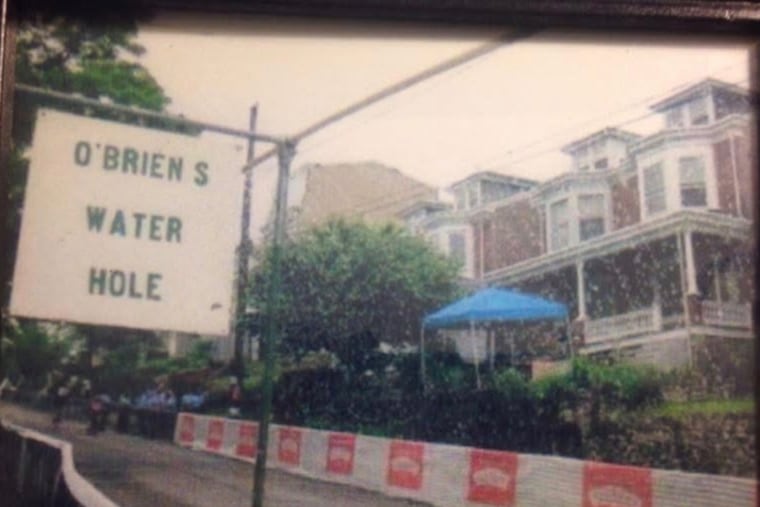
O’Brien’s Water Hole in Manayunk provided much-needed hydration to racers on ‘The Wall’ for 20-plus years
Bill O'Brien and wife Evelyn held court at 320 Lyceum Avenue and became a Philadelphia Cycling Classic institution.
Suzanne Edinger has lived in Pelham, Ala., since 2002, but a few months ago she began to receive an onslaught of messages from Philadelphians hundreds of miles away.
Most were Manayunk residents. Edinger’s family members reached out. Former neighbors reached out. Old classmates and friends reached out, tagging Edinger in photos and videos on Facebook.
They all had the same question.
“‘Is O’Brien’s Water Hole gonna be back?’” Edinger said. “He would be tickled to death. We’d probably have to come up there for a month if he was still around.”
The “he” is Edinger’s late father, Bill O’Brien, longtime steward of 320 Lyceum Ave. When the Philadelphia Cycling Classic came to town in 1985, its route ran right past his brick twin house.
While this might not seem notable for a 14.4-mile race, O’Brien’s stretch was unique. He and his wife, Evelyn, were located right in the middle of the notorious hill known as the Manayunk Wall, scaling 250 vertical feet.
It became a pivotal point of the competition, 800 yards that could make or break a cyclist. So, the maintenance man did what he’d do for any struggling stranger: He tried to help them out.
Throughout the first iteration of the Classic, O’Brien stood in his yard with a hose in one hand, a beer in the other, dousing bikers as they rode by. This setup didn’t last long; O’Brien realized it would impede his Budweiser consumption, and race organizers wanted an option for cyclists to avoid the stream.
Undeterred, the North Philadelphia native headed to his workshop in search of a solution. He quickly found one. By 1986, he’d connected a single shower head to his hose, lightly spraying water atop the riders.
By 1987, he’d added another shower head. The year after that, O’Brien moved his hose alongside his fence, so spectators wouldn’t trip over it.
A white wooden sign with kelly green font dangled from the pipe: “O’Brien’s Water Hole.”
He built on this tradition over 23 years. Every version would be better than the last: a few more shower heads, “O’Brien’s Watering Hole” T-shirts, a Manayunk-themed banner, hung high above the street.
On race day, his house would be packed with people, some of whom O’Brien knew, and many he didn’t. But “The Mayor of Manayunk” was unfazed.
“Every year he ordered more kegs, and mom had more burgers, and she needed a bigger bowl of potato salad, and an extra bowl of beans,” Edinger said. “And he fed off of that. He just thought it was great. They saved [money] all year.
“‘I need to get plates.’ I’m like, ‘Mom, it’s February.’ ‘June will be here before you know it!’ So, it was always buying a little of this and that, when the budget permitted.”
The O’Briens moved to Alabama for work in 2008, and Bill died in 2019. But the lore of his Water Hole has endured.
And on Sunday, when the Philadelphia Cycling Classic returns for the first time in a decade, locals will remember the small Irishman with the big imagination.
“You couldn’t help but think of him when the race came up,” said O’Brien’s former next-door neighbor, Marty Costello. “Because it was his thing.”
The community’s handyman
O’Brien was raised with seven siblings on West Thompson Street, near the Church of the Gesú. Craftsmanship ran in his family; O’Brien’s father learned the trade from his father, who worked as a cabinet maker and carpenter in County Tipperary, Ireland.
The lessons Bill absorbed as a child served him for the rest of his life. After he and Evelyn moved to 320 Lyceum Ave. in 1961, the handyman refurbished pianos.
He then worked in carpentry, and then at a paper mill, before getting a job in maintenance for the Sisters of Mercy in Merion in the early 1970s. Evelyn was hired to operate the convent’s old-school switchboard a few years later.
The O’Briens stayed on with the Sisters of Mercy for three decades. Even amid a spiritual sanctuary, the couple showed the same fun-loving spirit they’d eventually bring to the Water Hole.
On St. Patrick’s Day, Bill would dress up as a leprechaun, with high white socks, a green sweater, and a little black pot of gold in hand. He and Evelyn would dole out chocolate coins to sick nuns receiving medical care on the property.
The sisters loved it.
“Those nuns were the first in line at both of their funerals,” Edinger said.
Bill wasn’t raised in Manayunk but embraced his neighborhood wholeheartedly. He ran the grade-school CYO at St. John the Baptist for over 20 years, taking local kids on annual ski trips to get them out of the city.
The Irishman could easily repair a leaking sink or a broken roof at his own house, but also made a point of helping neighbors with their needs, too. Before Marty Costello moved next door to the O’Briens, his grandmother, Concetta Pompizzi, lived in the same building.
In the 1980s, Bill fixed the railing on her front porch, a renovation so sturdy it lasted 35 years.
“Everybody loved Uncle Bill,” said O’Brien’s nephew, Patrick. “If he wasn’t your uncle, you still called him Uncle Bill.”
O’Brien’s handiwork and hospitality were well-known within Manayunk. But after the advent of the Water Hole, he became a much more prominent figure.
Every year, local reporters would flock to the brick twin house to interview him; Pierre Robert of WMMR was a regular visitor. This happened so often that friends began placing bets on how many TV appearances O’Brien would make in a given weekend.
On a typical race day, the family would welcome hundreds of people to their home. One neighbor, Gerry Boyle, said he met tourists from as far as Italy, Austria, and Germany. Policemen regularly stopped for sodas and waters, race officials for food and refreshments.
Despite all the chaos, the event was a testament to a community’s love. O’Brien never worked alone. The night before the Classic, locals would drop off kegs of beer.
Dennis Kelly, a friend who lived a few blocks away, would bring doughnuts to make sure Bill had something to eat before he started drinking. Cousins would stand on ladders, hanging banners and flags across Lyceum Avenue.
Boyle would arrive at 6 a.m. on race day to set up the shower pipes. Fitzpatrick Funeral Home would lend its nearby parking lot to O’Brien’s friends and family.
An artistically inclined nun at the Sisters of Mercy even designed an “O’Brien’s Water Hole” T-shirt, written in Celtic font.
One of Edinger’s cousins wore it on a trip to Ireland years later. A passerby recognized the name.
“They’re like, ‘Oh, we see that on TV,’” Edinger said. “‘We know O’Brien’s Water Hole.’ It was just crazy. And that was a story that [my dad] just thought ... that was it. His name had reached the motherland.”
Continuing the tradition
After the O’Briens moved out in 2008, two friends, Gary Brett and Dan White, bought the property. They did so with the intention of keeping the Water Hole alive, and the Irishman was more than happy to assist.
He left them with his four shower heads attached to a pipe and walked the men through his setup with the hose and the fence. Brett and White put their own spin on it, adding spray nozzles to create more of a mist than a shower.
Just like O’Brien, the friends would host a party on race day. But it wasn’t the same without the handyman, and locals would often ask for him.
“All the time,” Brett said. “Every year. I mean, every single year. Like it could’ve been five years after he moved out, and they’re like, ‘Is Bill here?’”
The two men continued this tradition until the race was canceled in 2017 due to a lack of funding. O’Brien died of a stroke two years later, while visiting family in Phoenixville. He was 85.
When his body was transported from the viewing at Fitzpatrick Funeral Home to Mass at St. John the Baptist, the driver took a special route. Instead of turning onto Manayunk Avenue, she chose to stay on Lyceum, trudging up the hill, and pausing right outside No. 320.
The cars behind the hearse did the same, bidding a final farewell to a house that was a home for so many. It’s unclear whether the current owners will create a Water Hole of their own on Sunday.
But even if they don’t, locals will be thinking of the man who always showered his neighbors with water and warmth.