After more icy mornings in the Philly region, the snow may disappear in a hurry Thursday
So-called black ice — ice that masquerades as harmless wetness — is especially dangerous, officials warn, and conditions are ripe for it.
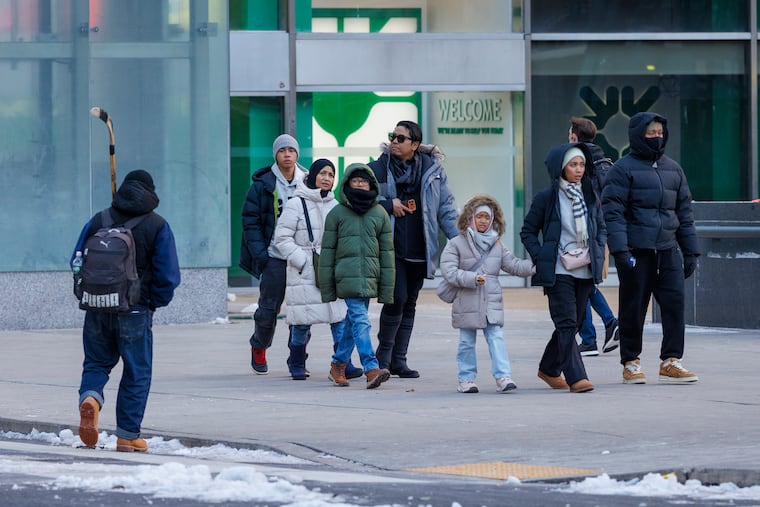
That icy glaze that has appeared on streets, sidewalks, and driveways this week reappeared Wednesday and will make an encore Thursday morning as water continues to ooze from the snowpack by day and freeze at night.
So-called black ice — ice that masquerades as harmless wetness — is especially dangerous, officials warn, and conditions are ripe for a harvest, given the generous snowpacks.
“Refreezing and black ice are definitely a concern,” said PennDOT spokesperson Brad Rudolph. “We will continue to treat areas as needed.”
SEPTA advised commuter to watch out for ice on platforms, walkways, and in parking lots.
Temperatures early Wednesday fell into the teens throughout the region — save for Philadelphia International Airport where the low was 26 — and on Thursday are due to drop into the 20s region-wide.
But along with that winter landscape, the atmosphere over the region is going to undergo radical changes by the end of the workweek, forecasters say, with a rapid but short-lived warmup, and something that’s been missing around here lately — a soaking rain.
As for more snow, the atmospheric scientists are saying it’s probably safe to put away the shovels for a while, and not just in the Philly region.
“In my opinion, cold looks hard to come by for most of the United States through the remainder of December,” said Amy Butler, research scientist at the NOAA Chemical Sciences Laboratory.
In short, prepare for a more typical Philadelphia December.
“With the pattern changing, we’re kind of getting closer to where we should be this time of year,” said Mike Lee, a lead meteorologist at the National Weather Service Office in Mount Holly.
The forecast for the rest of the week
Wednesday should be at least partially sunny with some substantial melting as temperatures are due to crack 40 degrees by early afternoon.
Then after one more overnight with readings dropping into the melt-freezing 20s, Thursday is forecast to become the first day with above-normal temperatures in Philadelphia since the Wednesday before Thanksgiving.
As temperatures rise through the 40s, several hours of soaking rain are forecast to begin in the early evening with the potential for up to an inch.
Throughout the region the snowpack contains about a half inch of water that will be heading to local storm sewers and local waterways, said the weather service’s Lee.
In addition to the rain, the high moisture content of the air is one of nature’s most-efficient snow-removal tools. When warm, moist air comes in contact with snow, it gives off a latent heating effect that accelerates melting.
“We’ll have to watch for the possibility of some localized flooding,” said Paul Dorian, a meteorologist with Arcfield Weather.
For now, Lee said, the weather service isn’t contemplating flood advisories. Precipitation the last 90 days has been substantially below normal throughout the region, and a drought warning remains in effect for New Jersey.
The outlook for the weekend and beyond
Friday’s forecast high in the mid-50s is likely to occur in the early morning hours, and then temperatures are forecast to crash, with wind gusts to 40 mph possible.
Saturday is expected to be dry but chilly, with readings in the low 40s, warmer than it’s been but still several degrees below normal, and in the mid-40s Sunday, closer to the long-term averages.
The polar vortex, the persistent low pressure system that spins around the Arctic and confines the cold air to the ice box of the planet, has been strengthening, said Butler.
It’s possible that it would undergo “stretching” and allow cold air to sink into parts of the contiguous United States, but “it’s not a signal that is very robust,” she said.
For now, she said no obvious dominant feature is emerging that would define the winter.
La Niña conditions continue in the tropical Pacific, where vast expanses of the sea surfaces are about a degree below normal. La Niña can have powerful effects on west-to-east winds that ferry weather to the United States.
In this case, however, La Niña is currently weak, meaning that its influence over global seasonal patterns is also weak, said Emily Becker, scientist with the University of Miami/Cooperative Institute for Marine & Atmospheric Studies.
For now, it would be prudent to savor what’s left of the snow cover, and it wouldn’t hurt to spread a little sand or gravel on the driveway or the front steps before going to bed.