Why weather apps’ forecasts are so varied — even for what’s happening right now
For all their flaws, the weather apps represent "an amazing technical achievement," says one academic expert.
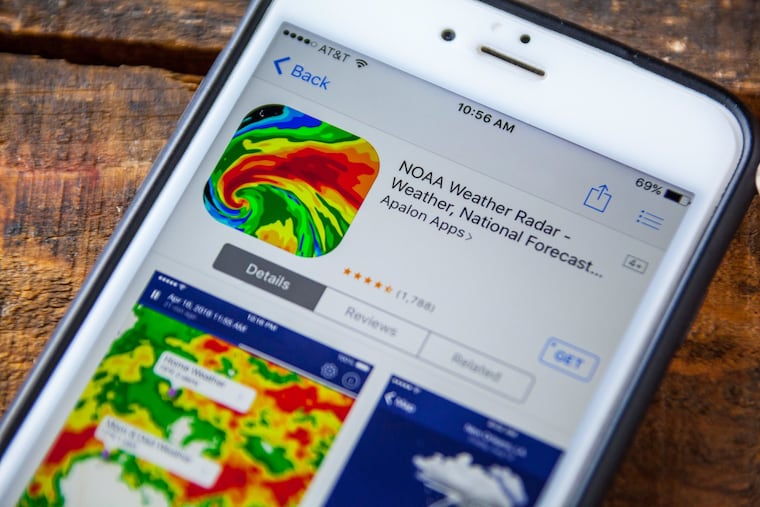
That puny pulse of rain Wednesday morning may have been a welcome watering for the plants and grasses and evidently didn’t cause problems — except for the heavy hitters in the weather-app universe.
About 6 a.m., the Weather Channel had rain ending around 7:15 a.m. in Philly — except it wasn’t raining at the time in town, and the bulk of the rain was a few hours away.
Just before 9 a.m., AccuWeather predicted that rain would start at Philadelphia International Airport in 51 minutes. But it already was raining at PHL, according to the National Weather Service’s official rain gauge. And the apps were at odds over the temperature.
At the time, the Weather Channel reported that the airport temperature was 54 degrees. AccuWeather said it was 51. The official reading was 53.
Such imprecisions and disagreements among apps should be “expected,” said Clifford Mass, a scientist at the University of Washington whose research specialties include numerical weather prediction and who is a frequent app consulter.
Nor is it surprising that legions of weather apps — including major providers like the Weather Channel and AccuWeather that have human backup and access to superior computer models — would quibble about what’s happening outside.
It’s not like app developers have spotters everywhere armed with body radar and temperature sensors.
For whatever their flaws, the apps should be appreciated as “an amazing technical achievement,” said Mass.
AccuWeather and the Weather Channel are among 35 companies registered with the National Weather Service, but the actual number of smartphone weather apps, including default apps and those maintained by media outlets in Philly and elsewhere, number in the thousands.
What they have in common is strong dependence on the U.S. government. And limitations.
Be aware that for an app, even capturing the “now” condition essentially is a forecast. Temperatures in most cases are best approximations. If you’re using the apps to time a walk or run, ride a bike, or put off something you don’t feel like doing outside, proceed with caution.
It is all the result of computing power, meteorological expertise, a dash of artificial intelligence — and the considerable contributions of the nation’s taxpayers.
What those weather apps can do
Once upon a time not all that long ago, micro-local temperature readings in public spaces were the province of random, out-of-kilter public thermometers, often on bank buildings (for whatever reason).
These days, those smartphone apps offer readings for wherever you are, with second, third, fourth opinions, ad infinitum, literally at fingertips. Along with the winds, relative humidity, discomfort levels, barometric pressure, they offer forecasts ranging from the next few minutes to July 4 weekend.
No apps, nor Punxsutawney Phil, nor anyone else, have yet mastered long-term outlooks with any level of precision, but Mass said that with short-term forecasting, “it’s stunning how good” the apps have become.
For its part, the weather service says it isn’t competing with the commercial services — which carry the agency’s alerts and warnings. To the contrary, a spokesperson said, it is providing “foundational data” that allows companies to provide “specialized services” to the public.
The weather service issues statements and warnings for short-term threats, such as approaching heavy rain, severe thunderstorms, and tornadoes, but it’s generally not in the minute-cast game and wouldn’t bother with prosaic pulses of rain like Wednesday’s.
In Mass’ view, the major private companies are producing forecasts that are better than the weather service’s.
And that would have a lot to do with the weather service, which is the No. 1 supplier of the raw material that includes short- and long-term computer model runs, quality-controlled temperature data, satellite imagery, and all-important radar.
How the weather apps make their forecasts
“All of our data is open access and free to use,” the weather service spokesperson said, all formatted to make it “easily accessible for private sector companies to develop mobile apps.”
Said Dan DePodwin, AccuWeather’s vice president for forecast operations, “The weather service plays a critical role.”
The government freebies include forecast guidance from 31 forecast models.
That input is “just the first step in the forecast pipeline” for the major apps, said Eric Floehr, head of Intellovations Inc., a software development company that specializes in weather and climate.
“The best providers use other models as well,” he said.
The Weather Channel uses a “proprietary” system that includes an “AI-driven multi-model ensemble,” said James Belanger, the Weather Co.’s vice president of networking.
Meteorologists at reputable providers backstop the virtual tools to make them more resemble reality.
For short-term forecasting, along with high-resolution models that update frequently, the private services rely heavily on the weather service’s Doppler radar.
And sometimes, often when it matters most, the atmosphere’s behavior can ambush a forecast.
Apps have their limits
Thunderstorms can be especially problematic, said Floehr. “The way they form can make it seem like they are moving faster or in a different direction than they really are.”
At times the apps can stumble over current conditions. In the app world, even what’s happening now is also more or less a forecast, said Floehr.
App providers obviously “don’t have observations everywhere,” said Mass.
And the available observations, said Floehr, “could be minutes to hours old.” Thus, app providers “have to ‘forecast’ what it should look like given this set of observations.”
AccuWeather’s DePodwin said the app may be a beat late in reporting that a light shower has ended. He said the app updates conditions and temperatures “every few minutes,” but a given temperature may be off if it changed rapidly before the app had a chance to catch up.
Those app temperatures aren’t traditional instrument readings but the result of complex processes, and different apps use different procedures. AccuWeather and Weather Underground use crowdsourcing methods in computing their temperatures.
AccuWeather has a “partnership” with Ambient Weather, makers of personal weather stations, and boasts a network of 250,000 observers across the country who contribute to local temperature and instrument calculations. The company may have as many as 12 thermometers in a 2-square-mile area, DePodwin said.
With the differences in forecast territories and methodologies, the fact that those temperature readings among the different apps usually are close is perhaps more surprising than that they would differ.
As for what’s happening outside right now, you can always trust the windows.
Staff writer Emily Babay contributed to this article.