Where does Black genius live? Right here in Philly, claims a local author
It manifests itself in dancing all night to old school hip-hop at Fluid and at Odunde under the blazing June sun.
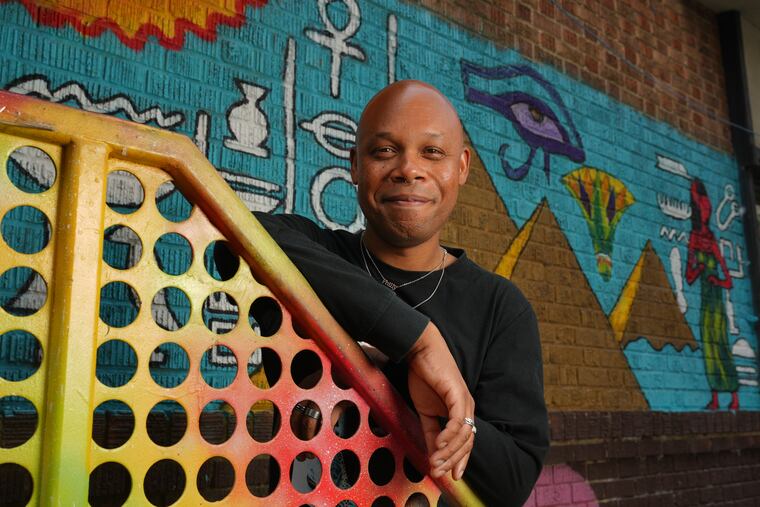
As Philly-based writer Tre Johnson puts it, Black genius isn’t about survival, despite overcoming the odds.
It’s about survival. Period.
To him, Black genius is the corner store, the number hole, the neighborhood bar, grandma’s soft pack of Salem cigarettes, and her weekly trip to Atlantic City. It is thriving as one of a few Black students at a mostly white university.
Black genius is the everyday business of living as a regular shemegular Black person in America. It ignores Black respectability politics and the white gaze, happily existing without either.
“Black genius is about how we [Black people] leverage what might typically be seen as disadvantages — our marginalized, ‘low’ placement in society; our Blackness; our communities — and flip them into a series of superpowers," Johnson writes in his new book, Black Genius: Essays on American Legacy.
“It’s about how despite the cyclical nature of granting then retracting political, social, and financial liberties to Black Americans when it served them (wars, voting, housing, employment rights, etc.) we have managed a series of cultural ingenuities to press forward.”
In this city, it manifests itself in dancing all night to old school hip-hop in the early 2000s at the now-shuttered Fluid Nightclub’s Tasty Treats weekly jammy jam at Fourth and South Street. It shows up when mingling with friends at Odunde under the blazing June sun, watching first-run documentaries by Black filmmakers about Black issues at BlackStar Film Festival, and waiting a half day (and most of the evening) for your favorite act to hit the Roots Picnic stage.
Johnson, who lives in the Spring Garden neighborhood, is a prolific writer who has published cultural analysis in publications like Rolling Stone, Vanity Fair, and Vox. Of note are his Vox essay on Black Panther, his Rolling Stone essays on the importance of Black superheroes, and what Childish Gambino’s “This is America” says about racism in our republic.
A seasoned cultural critic, Johnson’s work is in the same vein as Pulitzer Prize winner and Rutgers University professor Salamishah Tillet and authors and scholars Imani Perry and Ta-Nehisi Coates.
In fact, Black Genius, released in early August by Dutton, an imprint of Penguin Random House, is printed in the same pocket hardcover style as Coates’ seminal works. But while Coates’ essays plead with white America to tap into their shared humanity with Black people, Johnson’s nine intertwined essays ooze with the bliss of unapologetically living the Black experience, especially at the trifecta of Black Philadelphia summer events: Odunde, the Roots Picnic, and BlackStar.
In Philadelphia, he writes, “our mix of festivals, fun, and fast riding displays a multitude of traditions that we use to be in celebration with each other. And nothing showcases our collective and individual genius ability to celebrate more than Philly’s Black Summer.”
Johnson, 47, grew up in Trenton with his mother and sister, the eldest son of divorced parents. He went to a private, Lutheran elementary school before graduating from public high school and the University of Maryland College Park, where he majored in English literature and creative writing.
After his 2000 graduation from the University of Maryland, he joined Teach for America and taught high school English in Houston and Columbia, Md., before moving to Philadelphia in 2006.
Here, he took a series of jobs acting as the liaison between the Black community and public school districts that, he said, didn’t value Black students’ individuality or their survival skills, instead labeling them as troubled.
Their innate genius, Johnson said, was at best ignored, or at worst, stamped out.
In 2012, Johnson became the executive director of Teach for America. He visited Black homes and came face-to-face with Black genius at block parties, back-to-school supply drives, and community haircut programs.
“Black people were sharing resources to make sure everyone in the community had what they needed,” Johnson said, his silver “Philly” necklace sparkling against a long-sleeved Notorious B.I.G. graphic T-shirt.
“They were ingeniously creating systems to take the place of conventional systems that were failing them. … I thought about all the ways my mom helped us get by with her magical ingenious.”
That’s when the idea for Black Genius — a celebration of Black households rather than a celebration of Black household names — was born. Johnson left Teach for America in 2013 and continued to work in various leadership roles in education before becoming a full-time freelancer in 2016 because, ultimately, he always wanted to be a writer.
He began working in earnest on Black Genius in 2021. In celebrating the collective genius of Black Americans, he is celebrating his own genius.
A tattoo on his right thigh reads “Black” and the one on his left thigh says “Genius,” not to brag about his own IQ, but as a symbol of him walking in his truth, grounded by his individuality — his own Black genius.
On a recent muggy Thursday morning, Johnson walked down South Street around the corner from the former Fluid Nightclub, the erstwhile scene of infamous Philly flash mobs. At any moment, a group of young men could noisily roar up and down the street on three-wheeled ATVs.
South Street is where so much Black genius has gathered in the past and will likely gather in the future, Johnson says.
Johnson knows a lot of people don’t see Black genius when they see flash mobs and ATVs. After all, they fly in the face of Black respectability politics. Geniuses are, after all, supposed to behave a certain kind of way.
No, Johnson says.
Geniuses find ways to live on their own terms in spaces that don’t welcome them, even — and especially — if it ruffles feathers.
“At a time when public libraries, recreation centers, and arcades were closing, and the Gallery and Liberty Place were setting curfews for minors — code for excluding Black teens — these kids were coming together to live on their terms as a community," he said. “Genius is giving people the space to take risks, be curious about the world, and try things that may make people upset.”
Johnson is in the midst of a 15-city book tour and he’s working on another nonfiction project and a novel. When our politicians are villainizing Black people and trying to erase Black history, Black Genius might serve as a salve that reminds Black people of our superpowers.
“I’m trying to make a blueprint of how community can take care of each other and give each other permission to unlock our imagination,” Johnson said. “That is what genius is.”