Martha Washington freed people enslaved by her family two years before her husband planned to. James Ijames tells us why.
The legacy of slavery in America's first family, and in Trump's America, gets a comedic turn in ‘The Most Spectacularly Lamentable Trial of Miz Martha Washington.’
Playwright James Ijames remembers the pride he felt in Philadelphia in 2010, when the President’s House opened following a yearslong battle between the National Park Service and Black activists who demanded they recognize the site’s history of slavery.
It was remarkable, he thought, for a city to seriously spotlight enslaved people, particularly those held in bondage by the venerated Founding Father George Washington, right in the center of Independence Mall. The President’s House became an important place for Ijames to bring visiting friends and family as the North Carolina native showcased the breadth of his adopted city.
Around that time, he was working nearby at the National Constitution Center, under longtime local theater educator Nora Quinn, who tasked Ijames with writing mini pop-up plays tied to the exhibit, including one about a Mount Vernon caretaker.
That’s when he learned something curious.
George Washington’s will freed the people he enslaved upon the death of his wife, first lady Martha Washington. She died in 1802 but decided to free them two years earlier. That decision, though, was not because of some generous change of heart — it was out of self-preservation.
“She had this anxiety, because they knew that their freedom was staked on her death, and she was afraid that they might kill her,” said Ijames, who now leads the playwriting program at Columbia University.
He was primarily an actor then, not yet a Pulitzer-winning playwright, but he immediately recognized the potential for a rich story.
“I have a great respect for history, and I think it’s more elastic than we know, because the stories that we’re told are not always the whole truth. So I [followed] that impulse, and my curiosity about these people who were owned by little old Martha Washington,” he said. “What would it look like if they decided one night, ‘Yeah, I’m done, let’s get rid of her’? They would be justified in feeling that.”
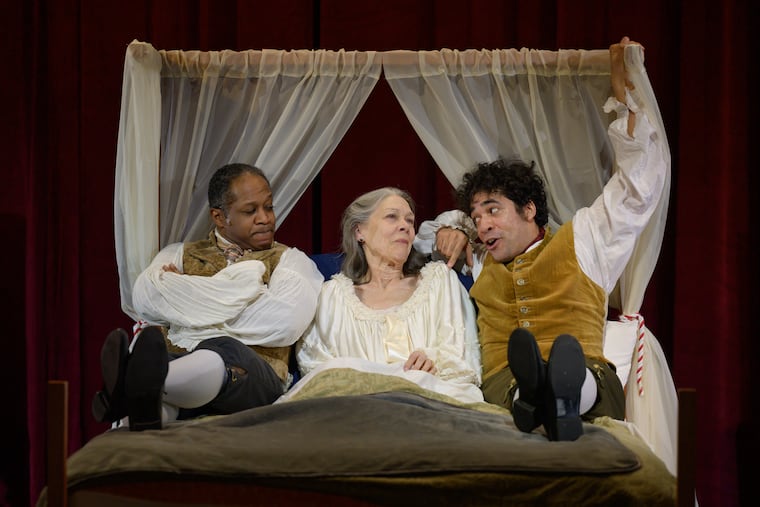
That served as the basis of his 2014 play, The Most Spectacularly Lamentable Trial of Miz Martha Washington, an incisive satire that cemented his talent as a playwright. Now running at the Wilma Theater through April 5, this early Ijames work returns to Philadelphia in the wake of a newer fight over the slavery exhibit at the President’s House — this time because of President Donald Trump.
» READ MORE: Review: James Ijames' 'Good Bones' speaks to the gentrification in Philadelphia and beyond
In January, the Trump administration ordered the Park Service to remove the site’s slavery exhibits as part of a nationwide effort targeting public landmarks that purportedly “inappropriately disparage” the United States. That included the exhibits that memorialized the nine people George Washington enslaved at that home during the nation’s founding. (The family enslaved hundreds of people; by the time George Washington died in 1799, there were 317 enslaved people at Mount Vernon.)
The President’s House displays focus on the history of slavery in America as well as Washington’s legacy as an enslaver and an eventual critic of the institution. The Trump administration’s censorship of more than 400 years of American history led to a national outcry as the city sued the administration and a month later, a federal judge ordered that the displays be restored.
“The thing that’s so terrifying for so many people is the power of the narrative. In the middle of Independence Mall, between the Constitution Center and Independence Hall — the Liberty Bell right there, too — you have a home that was essentially a plantation. It complicates all the symbols,” said Ijames. “When you want to control people, complicated symbols fail. You want things to be clean, neat, and consumable. [The government’s actions] just make me want to continue to complicate the story further.”
In Miz Martha, the playwright aimed to portray complex, layered characters living in a condition they could not control or choose. Typical stories about slavery primarily focus on pain, trauma, and injustice. Ijames doesn’t downplay those realities, but takes an irreverent approach that delivers an unexpectedly comedic experience.
Miz Martha unfolds like a fever dream as the titular Washington experiences a variety show of vignettes with cameos from figures like Thomas Jefferson, Betsy Ross, and Abigail Adams. The tone swings from wacky slapstick to caustic criticism (and back again) swiftly as the cast puts the first lady on trial: “Do you really need 200 slaves?” one character asks.
Especially after the situation at the President’s House, Ijames feels strongly about theater’s ability to “enliven those stories that are left out of the archive or were never recorded in the archive.” He used the names of some people enslaved by the Washingtons in the play, including Davy, Sucky Boy, Doll, and Priscilla, but little other biographical information went into the characters.
“I’ve written enslaved people who are clever, who are conniving in moments. They are funny and resourceful, and they can be menacing — super complex, because they were, they had to be,” he said.
He hopes that audiences in Philadelphia will be inspired to dig deeper into these histories because they are essential to understanding not only the challenges these individuals faced in the past, but the ones we are still grappling with today.
Enslaved people like Ona Judge, who was one of the figures profiled in the torn down-then-restored exhibits, deserve to be recognized as part of this country’s legacy, Ijames added. She escaped the Washingtons after running from the President’s House, boarding a ship, and securing freedom in New Hampshire.
“They’re Americans, and they acted in heroic ways. It’s heroic to run away from slavery,” he said. “We need to know the full scope of the heroism that comes out of this place. That means you’ve got to put Ona Judge right beside Martha and right beside George, because [that’s part of] the forced intimacy of racism in this country … We can’t pretend like that didn’t happen.”
Though Judge doesn’t appear in Miz Martha, Ijames believes her story is worthy of a play.
Instead of a comedy, he would treat it as an intrepid adventure to underscore her triumphant achievement — in spite of the Washingtons’ dogged pursuit to recapture her, or, today, Trump’s attempts to erase her.
“The Most Spectacularly Lamentable Trial of Miz Martha Washington” runs through April 5 at the Wilma Theater, 265 S. Broad St. 215-546-7824 or wilmatheater.org.