Matt Campbell backs College Football Playoff expansion: ‘A tournament is the right way to find a champion’
This year's Big Ten championship will be the last in conference history. While the Penn State head coach supports the change, Campbell said there’s still work to be done to make the new format better.
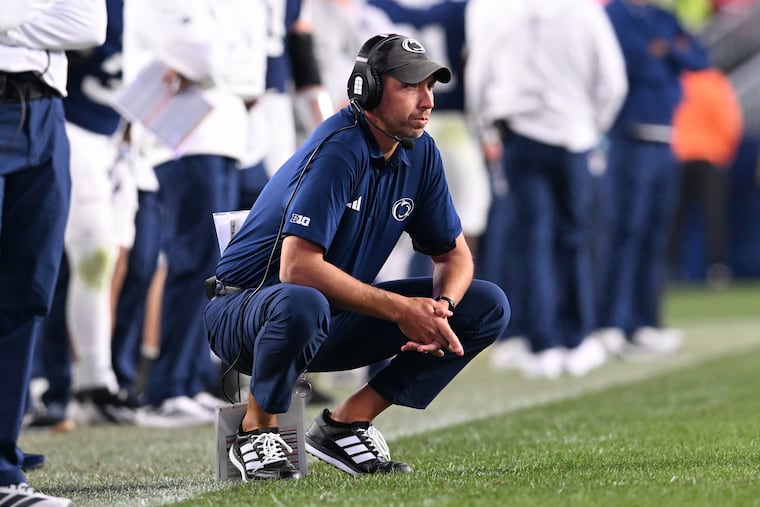
Just two years after the format expanded to 12 teams, the College Football Playoff reached an agreement with ESPN on Monday to make the field 24 teams starting in 2027, another seismic shift in the ever-changing world of college football.
Penn State coach Matt Campbell was asked about the change during his press conference on Wednesday. He voiced his support for it, but also added there’s still work to be done to perfect the format.
“Yes, a tournament is the right way to find the champion, and so I still think there’s so much work to do of how do we actually get this exactly right.” Campbell said. “But I know we got great leadership. We got great leadership in the Big Ten, and we certainly have got elite leadership with our president. So, I certainly trust the work they’re doing.”
» READ MORE: College Football Playoff doubles up, expands to 24 teams beginning next season
Neeli Bendapudi, Penn State’s president, is a member of the CFP Board of Managers alongside 10 other presidents from schools across the country, including Notre Dame, Tulane, Texas Tech, and more. The group’s purpose is to govern the CFP’s “business, property, and affairs,” while also developing and approving annual budgets, policies, and operating guidelines.
Campbell said he hasn’t spoken with Bendapudi regarding the expanded 24-team field, but the two “talked a little bit before the season started.”
“From my end of it, I know just even in our Big Ten meetings this summer, there was so much conversation about where this was possibly going,” Campbell said.
Campbell is familiar with a large playoff field. The Division III championship was decided by a tournament with a 32-team field when he was the offensive coordinator at Mount Union from 2005-06. It has since expanded to 40 teams.
The Purple Raiders won back-to-back national titles in the two years Campbell coached at his alma mater, and he won three Division III titles as a player for Mount Union from 1999 to 2002.
“I come from a background where you were in the college football playoffs in the smaller school divisions, and I just feel like it always gives you an opportunity to unveil exactly who is the champion,” Campbell said.
But the expanded field means this year will be the last Big Ten championship. Penn State, which is 5-4 and 2-4 in the Big Ten, has won one conference title since the Big Ten added a championship game in 2011. Since joining the conference in 1993, Penn State has won two outright titles (1994, 2016) and a share of the Big Ten twice (2005, 2008).
Big Ten commissioner Tony Pettiti announced Monday in an official statement that this season’s Big Ten championship will be the last, as was expected with the first round of the CFP in the expanded playoff field now taking place during conference championship weekend. The SEC, Big 12, and ACC have all done the same.
» READ MORE: Ikaika Malloe’s coaching journey brings him back to Washington, where he learned ‘how to carry yourself
Regardless, Campbell was hired to win the Nittany Lions a national championship. The new format doesn’t change those aspirations.
“Those things are what you’re always after,” Campbell said. “I think the reality is, how do you build a program that gives you the ability to do it not just once, but how do you build a program that’s got sustainable success? And I think that in college football, as we’re finding, can be a challenge, and the unique reality we have is we get to lay a foundation to that this year, and then have the opportunity to build ourselves forward as kind of the rules and regulations around us continue to change.”