Amid record-low violence, Mayor Parker’s policing budget invests in more technology, funds sexual assault center
The Philadelphia Sexual Assault Response Center could receive city funding for the first time, as reported rapes are on the rise.
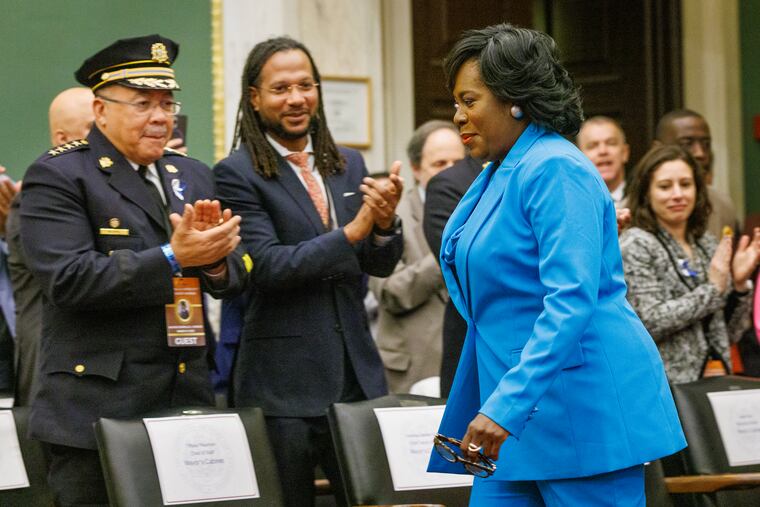
Mayor Cherelle L. Parker on Thursday proposed a public safety budget that would sustain investment in drones, forensic technology, and community programs credited with driving down violent crime — and, for the first time, allocate city funding to the Philadelphia Sexual Assault Response Center.
Parker’s third city budget included $934 million for the police department — about 7% more than last year — to cover contractually obligated pay raises and fund technology like body-worn cameras and the future forensics lab.
In her more than two-hour address, Parker largely focused on an economic mobility agenda for Philadelphia businesses and families. But she dedicated a portion of her speech to public safety initiatives, growing animated when she introduced anti-violence advocates in the audience whom she said she relies on.
The proposal comes as violence in the city has reached lows not seen in recent memory, a decline that began in 2023 and has accelerated since. As of Thursday, 19 people had been killed in homicides this year — a number that, while likely influenced by the uncharacteristically cold winter, could put Philadelphia on track to see fewer than 100 homicides for the first time in modern history.
“We are on our way, Philadelphia,” Parker said to applause.
In a significant new step, Parker suggested “fully funding” the Philadelphia Sexual Assault Response Center with $300,000 annually. The money comes after the center said it has struggled to survive with limited funding — none of it from city coffers — and after the number of reported rapes increased last year.
City Council will negotiate with the administration over the next few months, and must approve a budget before it takes effect in July.
Here is what Parker proposes.
Drones and cameras
Parker has proposed a nearly $1 billion budget for the police department. The approximately $60 million in additional funds this fiscal year is largely in line with recent year-over-year increases for contractually mandated pay raises and other adjustments.
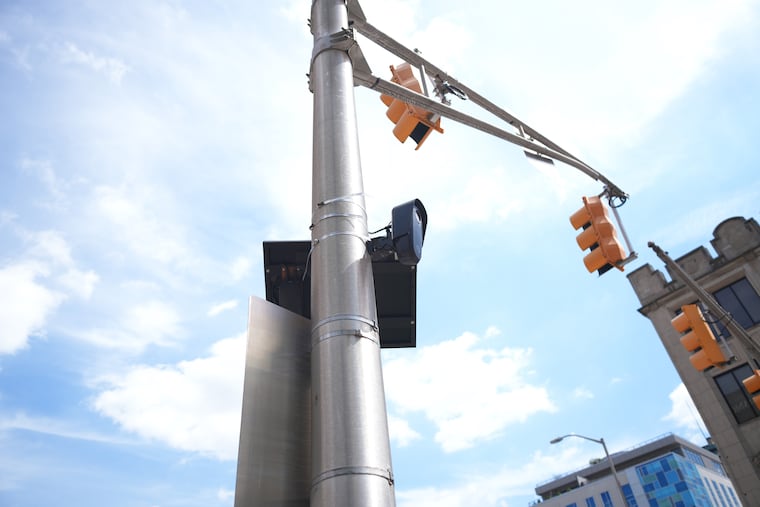
The mayor has also proposed about $5 million to increase the department’s drone and body-worn camera fleets. Every patrol officer is now equipped with a body cam, she said Thursday, while only about 50% of the department’s uniformed officers had one four years ago.
She also suggested spending about $2 million in capital funds on security improvements and renovations to police buildings. Police Commissioner Kevin Bethel has said some police stations are dilapidated and in need of significant updates.
Parker said Thursday that while campaigning to be mayor, she learned that “it wasn’t popular to talk about the need to support community policing in the city of Philadelphia.”
Now, she said, those efforts under Bethel’s leadership are well underway — and working.
Parker has also proposed sustaining $25 million in annual anti-violence grants for community organizations through the Philadelphia Office of Public Safety.
Body cams for the prisons
Parker has proposed $5.6 million in funding to complete the rollout of body-worn cameras among correctional staff within Philadelphia’s prisons — an initiative that started last year.
The Philadelphia Department of Prisons recently completed training its staff on the technology and, by the summer, expects all correctional officers in the city jails to be equipped with a body cam for the first time.
Noah Barth, prison monitoring director for the Pennsylvania Prison Society, said he was encouraged by the investment. He said he hopes the new Philadelphia Office of Prison Oversight would have “unrestricted access to any footage to ensure transparency.”
Parker also wants to invest in supporting the secure detention unit at Jefferson Frankford Hospital, where incarcerated people have been brought when in need of hospital care since 2024.
Officials said police are increasingly arresting people who must be hospitalized for addiction withdrawal symptoms. With additional funding, prison staff will take over monitoring those in custody at the hospital sooner, allowing officers to return to patrol more quickly.
The unit is not expected to grow.
‘Fully funding’ the Sexual Assault Response Center
Parker’s proposal to provide $300,000 to the Philadelphia Sexual Assault Response Center comes at a pivotal moment for the nonprofit, which has faced persistent financial instability since it opened in 2011.
The center, in North Philadelphia, conducts more than 300 sexual assault exams annually and administers rape kits for police. But its leaders have warned for years that the need for exams far outpaces the center’s financial resources.
The center has relied largely on funding from Drexel University, which oversees it, and also on state reimbursements for services. But that support is “nowhere near the amount of money needed to take care of patients,” its former clinical director, Allison Denman, told The Inquirer in 2024.
Last summer, Drexel said it would fund the center only through June 30, putting it at risk of closing without swift intervention, Lila Slovak, director of the Philadelphia office of the Women’s Law Project, said last week in testimony before a City Council committee.
On Thursday, Slovak said a funding commitment from the city would be “a powerful statement that the lives and experiences of survivors of sexual violence matter in Philadelphia.”
The number of reported rapes increased last year for the first time in four years. Police data shows that 524 rapes were reported in 2025, an 8% increase over the year before.
Meanwhile, only 21% of sexual assaults reported to the police resulted in an arrest last year, the city said in its five-year budget plan.