Tight end in the new Eagles offense is a ‘blue collar job’ that will be key to the team’s success in 2026
The tight end position will be critical in Sean Mannion's offense going where it needs this season.
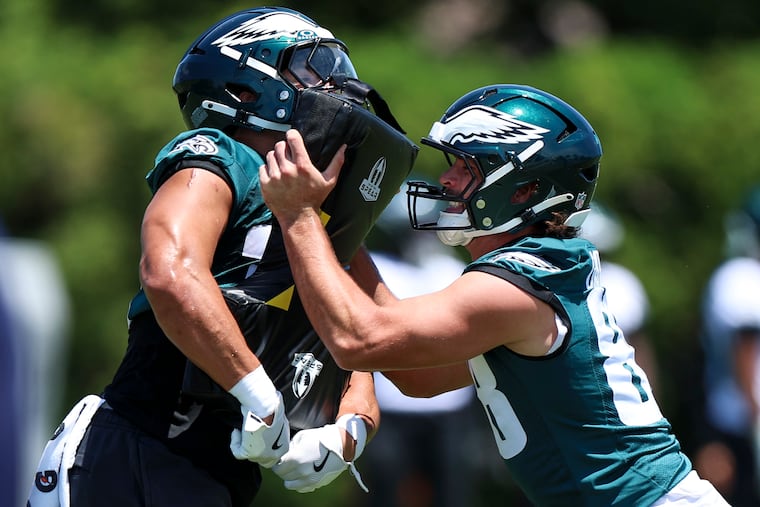
New Eagles tight end Johnny Mundt likens his occupation as a tight end in the NFL to “a blue collar job.”
“Getting it done in the trenches next to the big guys is something I take pride in,” Mundt said after a recent Eagles practice.
It is why the Eagles signed the 31-year-old veteran. Their tight end corps lacked a requisite handyman in 2025. Dallas Goedert was his normal self as a weapon in the passing game, but his effectiveness as a blocker took a step back. Grant Calcaterra, meanwhile, is most useful as a pass catcher and not doing the dirty work in the trenches.
New offense, new tight end.
» READ MORE: How a friendly offseason wager with Vic Fangio transformed Eagles defensive tackle Jalen Carter
But the merit in Mundt’s signing was twofold. Not only has he been one of the better blocking tight ends in recent seasons, but he also broke into the NFL playing in Sean McVay’s offense and learned how to become a multifaceted tight end in a style of offense — the Kyle Shanahan-McVay system — that the Eagles are adopting under first-year offensive coordinator Sean Mannion.
How will the Eagles replace A.J. Brown’s production? Will the offensive line be healthy enough? Can Jalen Hurts learn a new system and thrive? Those are worthy questions to contemplate when trying to evaluate what happens next with the 2026 offense, but the tight end position will be an underrated element to the engine.
The Eagles are asking their tight ends to do new things. The tight end in the wide zone running scheme is a critical cog, and Goedert, for example, will be asked to block at the point of attack more than he ever has. Tight ends have been crucial to executing the Shanahan-McVay scheme successfully.
Nick Sirianni has used the term “marrying the run and pass” so often that he’s probably at this point ordained to officiate a wedding.
“We’re huge in that,” Mundt said. “Being attached to the line of scrimmage, being the point of attack on a lot of these blocks, you can do a lot of play-action stuff off that. The marriage of the run and the pass has been core to this offense ever since its start.”
» READ MORE: Two (deep and arguably arcane) underrated numbers that matter for the Eagles in 2026
Attached at the hip
The Eagles are installing an offense with more motion and play action. They are shifting from an offense that got to the line of scrimmage, read the defense, and tried to play chess to one that gets to the line of scrimmage and tries to attack.
In the new scheme, Shawn Syed of SumerSports calls the outside or wide zone run “home base.” It is effectively the starting point. The Eagles were formerly a running offense that utilized a lot of inside zone and gap scheme runs. Now, they’ll be implementing more outside or wide runs that aim to stretch the defense horizontally.
The Eagles have athletic tackles in Jordan Mailata and Lane Johnson, but the tight end is a key part of outside running success. Assuming a run is going to the strong side, the back will set his running track to the outside hip of the tight end while starting to read the defense. A run to the strong side requires the tight end to block at the point of attack and seal off the edge.
“Our aiming points have changed, the back path has changed,” Goedert said recently. “Still trying to get comfortable with it, but I’ve been enjoying it. I think it makes our job as tight ends easier, being able to use the path of the running backs to help stretch the defense and trusting that the running back is going to make us right is a big piece of it.”
Sometimes, sealing an edge means going up against a bigger edge defender. Tight ends in this scheme sometimes motion into the backfield before a snap. Sometimes they line up at fullback. They’re then sometimes asked to execute a wham block against an interior defensive lineman, some of whom are more than 300 pounds.
“It’s sometimes a mismatch, but with the right technique and leverage, you can take care of it,” Mundt said.
“If you trust what you’re coached to do and you can win the first half of the snap, you’re going to put yourself in a better position to have success. It comes down to technique and attitude and effort.”
Personnel packages
It’s important to note that there’s no one-size-fits-all rule for the offense when it comes to personnel deployment.
Last year San Francisco under Shanahan, and Miami under Shanahan disciple Mike McDaniel ran more 21 personnel (two running backs, one tight end) than any other team in the league. Both teams had a versatile fullback. But Shanahan’s offense in Atlanta ran a lot of 13 personnel (one running back, three tight ends).
McVay also has deployed different personnel packages that suited his roster. A few seasons ago, when the Rams had Cooper Kupp and Puka Nacua, two of the best blocking receivers in the league, the Rams ran the highest rate of 11 personnel (one back, one tight end, three receivers) in the league. They used condensed sets and had receivers lined up close to the offensive line.
But with Kupp on a different team, the Rams last season used 13 personnel on a league-high 30.5% of their offensive plays, according to SumerSports. That was more than double the rate of the team (Pittsburgh) with the second-highest usage rate of 13.
Green Bay, meanwhile, ran the fifth-highest rate of 12 personnel (one back, two tight ends), which the Packers deployed on 33.8% of their offensive snaps, and used 11 personnel on 55.6% of their snaps.
Moral of the story: teams adapt their formations to the makeup of their roster.
What does that mean for the Eagles?
It remains to be seen how the Eagles deploy their personnel. Given their roster, 12 personnel seems like a pretty friendly position grouping that will keep Mundt on the field as a blocker and allow Goedert to use his versatile skill set to impact both the blocking and passing game. They also have a few receivers who can block in Darius Cooper and Makai Lemon, though both are inexperienced at the NFL level.
Perhaps there’s a world where second-round pick Eli Stowers, who has been open about his struggles adapting to the NFL game during camp, gets on the field and the Eagles deploy some 13 personnel. There’s also Cameron Latu, who can play fullback if needed. Calcaterra, meanwhile, is back with the Eagles and has gotten some recent first-team reps. The likeliest scenario has the Eagles keeping four tight ends on the initial 53-man roster: Goedert, Mundt, Stowers, and Latu.
» READ MORE: Helmet cams and VR sets: Eagles quarterbacks use different tools as they learn a new offense
‘A workmanlike mentality’
Eagles tight ends coach Ryan Mahaffey was a college tight end who made the transition to fullback. Mahaffey worked with Mannion in Green Bay and also has the title in Philadelphia of run game coordinator.
Mahaffey said in the spring that tight end is a “unique” position at the “cross section” of the offense being part of the passing game, the running game, and being involved in pass protection.
“I think tight ends, generally speaking, they’re intellectual guys,” Mahaffey said. “They got a little bit of a lineman mindset to them where they’ve got a workmanlike mentality and then you also get the pass-catching aspect of things.”
A lot has been made about the new blocking technique being asked of Goedert, but it’s not hard to imagine him having a major role in the passing game. Without Brown, the Eagles have DeVonta Smith and then some question marks behind him when it comes to who Hurts will be able to rely on to consistently make plays.
The new offense utilizing more under-center play action should create opportunities for Goedert to impact the offense with his hands. George Kittle has long dominated in the 49ers’ offense as a tight end who blocks well in the running game and gets open in the passing game. Green Bay often found ways to get Tucker Kraft the ball. And the Rams had three tight ends with at least 24 catches last season.
The Eagles are in the early stages of putting it all together, and there’s still so much more of the offense that hasn’t been shown during the practices open to media.
Mundt so far has acted like a translator of sorts during camp.
“I’ve taken a few guys and taken a play and said, ‘This is how I look at it,’ and it marries well to how we’re coaching it,” he said.
He arrived in Los Angeles in 2017 as an undrafted free agent out of Oregon who viewed himself as a pass-catching tight end. The Rams, he said, taught him how to get hands on defenders and take the steam out of a pass rusher. He morphed into a reliable blocker who had just 13 targets in his first four NFL seasons. Mundt overlapped with Mannion when the two played for Minnesota under former McVay assistant Kevin O’Connell. He was used more there in the passing game, and all four of his NFL touchdowns came with the Vikings. But he had just nine catches last year under Liam Coen — another former McVay assistant — in Jacksonville.
Mundt signed a one-year deal with the Eagles worth just $1.5 million. He said he was happy to be able to join a franchise that always seems to be competing for a championship. The Eagles were looking for some value and to upgrade their blocking chops at the tight end spot. The fit has been a good one so far.
“It’s a lot of what I’ve been brought up doing, a lot of point-of-attack blocking, making plays in the pass game, just being a multidimensional tight end and helping out any way I can,” Mundt said.

Earlier this year, the scenario seemed far-fetched, especially after the Eagles used a second-round draft pick on a tight end. Zach Ertz overcoming a serious injury to make a nostalgic return? It just didn’t feel like a possibility. Then rookie Eli Stowers got hurt in the preseason, and starter Dallas Goedert went down Week 2 vs. Tennessee. All of a sudden, the Eagles had a need. Now, the 35-year old Ertz has been tapped to fill it. The Inquirer's Jeff McLane explains how an unlikely reunion between Ertz and the Eagles came together, why both sides are hoping for more than a feel-good story, and which player on the roster could be affected by this move the most. Listen here.
Listen to all episodes here or wherever you get your podcasts.