Helmet cams and VR sets: Eagles quarterbacks use different tools as they learn a new offense
With four QBs in camp, the Eagles have found complementary methods to help them study a new offense.
The Eagles have four quarterbacks in training camp, and when you’re the fourth man on the totem pole like rookie fifth-round pick Cole Payton, getting on the field for extensive work during 11-on-11 team drills can occasionally be difficult.
The team is committed to Payton’s development, but they’re also learning a new offense under first-year coordinator Sean Mannion. Jalen Hurts and the first-team offense need as many reps as possible, as do potential backup quarterbacks Andy Dalton and Tanner McKee.
So Payton, a dual-threat quarterback out of North Dakota State, often is on the field late, after practice ends, working with quarterbacks coach Parks Frazier and sometimes Mannion on his footwork and technique. Payton called those post-practice sessions “huge,” but the on-field portion of camp is only part of the on-the-job training Payton is going through as he navigates his first NFL training camp.
The Eagles were off Sunday, but Payton said he has spent some off days strapping a virtual reality headset on to get “mental visualization reps.” The tool, Payton said, was introduced to him by Frazier, who last year was the pass game coordinator and this year moved to quarterbacks coach. The Eagles, Payton said, had the sets last year, too.
Payton can turn on the VR, select any stadium, go through his play calls, break the huddle, and simulate a real play.
“It’s not live footage, it’s animated, but it’s a really good tool to visualize and see things,” Payton said Saturday.
» READ MORE: Eagles practice observations: Lane Johnson’s heir apparent; Jihaad Campbell pops; Moro Ojomo’s pressures
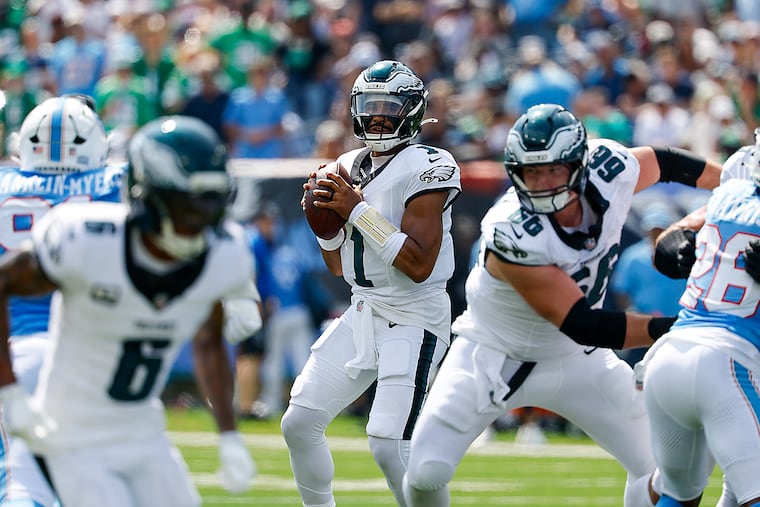
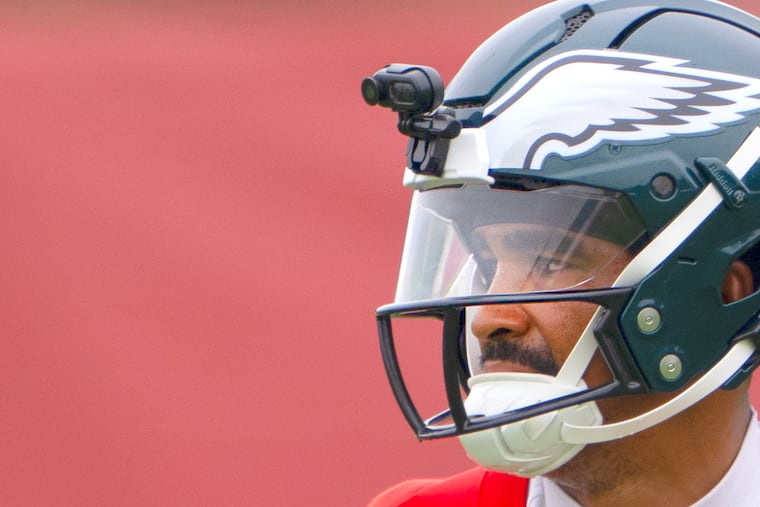
The VR sets are only part of the visualization tools the Eagles are using as they install Mannion’s new scheme. All through the offseason, Eagles quarterbacks have had an extra piece of hardware affixed to their helmets, giving a first-person view of what each player is seeing on the field. That extra footage is yet another angle for the quarterbacks and the coaching staff to analyze in the meeting rooms.
Hurts said on Wednesday that the cameras provide “insight and accountability in the huddle” and said “there’s an aspect of that that is very valuable.”
Accountability because the camera is recording sound, too. Wide camera angles of the field often used for film review can’t get inside the huddle to hear the way a quarterback calls a play or what he’s seeing when he makes a check at the line of scrimmage, but the helmet cams can.
“It’s been really cool,” Payton said, “not only for myself but just to hear what Jalen is saying in the huddle, what Andy is saying in the huddle, and Tanner, and the reminders they’re giving to the guys and just how crisp and clean the operation needs to be. We’re working and we’re building.”
» READ MORE: More than a week into Eagles training camp, Jalen Hurts and the new-look offense are ‘calibrating’
The Eagles aren’t the first team to use either technology, despite the tools being new to the building. HBO’s Hard Knocks provided a look at Tua Tagovailoa utilizing the helmet camera technology two seasons ago. Russell Wilson wore one at times when he played in Seattle, as did Kenny Pickett in Pittsburgh. There are other examples, too. The Arena Football League introduced helmet cameras in 2014, and while that usage was mostly for entertainment purposes for the viewing audience, other NFL teams and college programs have been using the cameras for teaching purposes for years.
“I think it was more for the coaches to see where your eyes are at,” Nathan Peterman, who used the technology in college and the NFL, told ESPN in 2023. “And also, some of it, was to get a feel for what goes on in the huddle, for the coaches to see the communication of how things are going. That’s what I know [then-Raiders coach Jon] Gruden was looking at, to see the communication in the huddle and checks at the line.”
Like helmet cameras, the use of virtual reality among quarterbacks has been going on. Tom Brady, for example, used VR when he played for Tampa Bay. Penn State quarterbacks use them. And the latest season of the Netflix docuseries Quarterback gave some insight into Jayden Daniels’ use of the technology, which the Washington Commanders quarterback was open about during his standout rookie season in 2024.
Daniels first started using VR in college at LSU, and he would routinely turn the speed up to force himself to process plays even faster.
“It moves faster within the VR than actual human beings,” Daniels told reporters in 2024. “Once you get out there, everything slows down. I know this is coming. I’ve seen this before, [and] it moved more than 20 times faster in VR.”
His former offensive coordinator Kliff Kingsbury embraced the technology, having used versions of virtual reality while coaching at Texas Tech dating back to 2016. According to The Athletic, Kingsbury changed his daily schedule with the Commanders to spend up to an hour narrating play calls into a recorder so Daniels could hear Kingsbury’s voice in the VR headset.
“[Pilots] don’t go get trained in real planes,” Kingsbury told The Athletic. “They do their flight simulators. … [Jayden] has that thing on all the time. He can see our reads and routes and hears my voice in it. It’s as real as you can [get to] getting game reps, and your mind doesn’t know the difference. Your mind thinks you’re doing it.”
This offseason, the Commanders, like the Eagles, added the helmet cameras to their toolbox as they implemented a new offense under first-year coordinator David Blough.
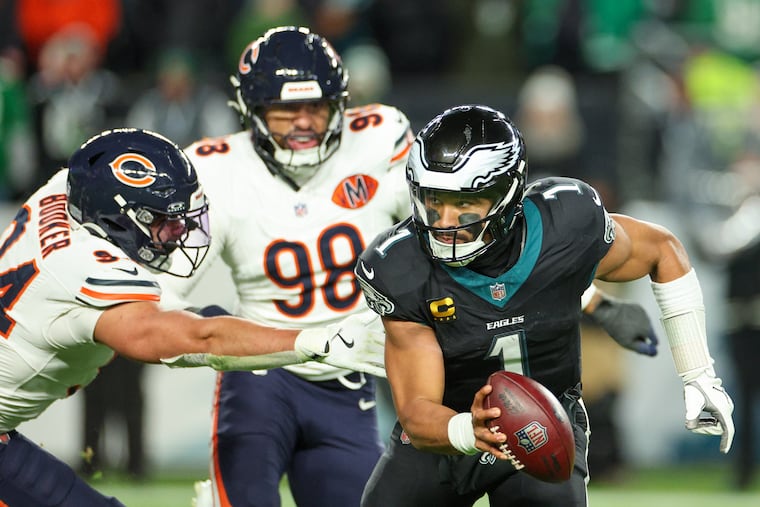
In Philadelphia, the helmets are another layer of learning. Hurts hasn’t often taken snaps from under center, but this offense will ask him to utilize play action from under center, which means his back will briefly turn to the line of scrimmage before he gets into position to read the field. The cameras, then, could help Hurts train his eyes to be looking in the optimal spot after the handoff fake.
For Payton, the point-of-view angles could help the rookie continue to work through the struggles of his first training camp. On Saturday, a throw to the sideline that may have been a throwaway attempt resulted in Payton’s fifth interception of camp. Perhaps the camera later would show what Payton saw when he released the ball.
As long as the camera hadn’t been knocked off focus.
“Sometimes the angle is funny,” said Payton, who is wearing a helmet camera for the first time. “You’re seeing the clouds or you’re seeing our feet. When the angle is right, I think it’s beneficial.
“It’s a cool tool to have.”