Thumbs up or down: Eagles beat reporters weigh in on the Haason Reddick trade
Trading away Reddick is a risk the Eagles were willing to take. How do our beat writers see it?
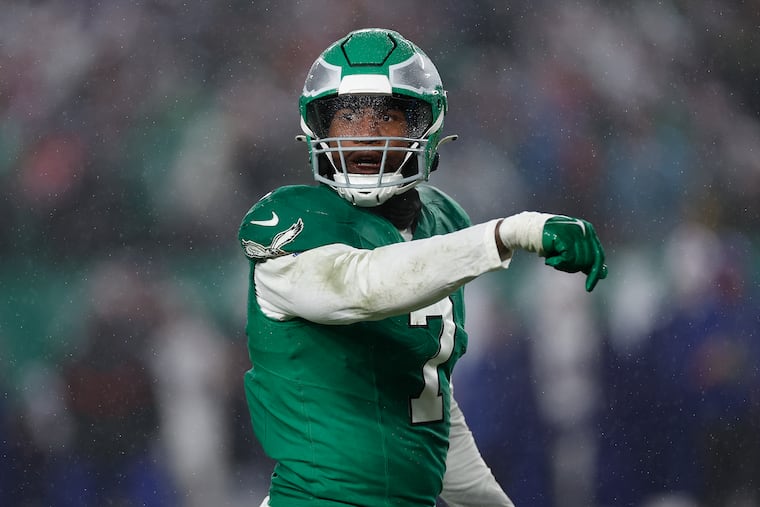
The Eagles traded Haason Reddick to the New York Jets on Monday, acquiring a 2026 conditional third-round draft pick from the Jets.
“It’s a business and sometimes hard decisions got to be made, even if you don’t like them,” Reddick told reporters.
For the Eagles, here’s how we see the trade:
Olivia Reiner: 👎🏻
The Eagles did not get better by trading away Reddick. There’s no sugarcoating it. He’s been one of their best defensive players for the last two years, even though his production tailed off at the end of the 2023 season. In fairness, the entire defense struggled at the conclusion of the year, coinciding with the switch to Matt Patricia as the defensive play-caller. Despite the disappointment that characterized last season’s defense as a whole, Reddick still led the team with 11 sacks in 17 games, eclipsing the double-digit marker for a fourth consecutive season.
The counterpoint to the arguments against trading Reddick is that the pass rusher is 29 years old, going on 30 in September, and he has been looking for a new multiyear deal that would presumably put him at a compensation level in the neighborhood of the position’s upper echelon. The Eagles, evidently, weren’t willing to commit the term and resources to Reddick that he was looking for at his age, leading to his trade to the Jets. According to the NFL Network, the Jets are expected to give Reddick a new contract.
In essence, the Eagles and Jets have swapped edge rushers Reddick and Bryce Huff, with the Eagles also acquiring a 2026 conditional third-round pick. Both players are at vastly different points in their careers. Huff is 25 years old, 26 in roughly two weeks, and is coming off a 10-sack season in 17 games in which he played just 42% of the defensive snaps. He was a situational pass rusher in New York, playing behind starters Jermaine Johnson and John Franklin-Myers. The Eagles are projecting Huff, who has never played more than 51% of the snaps in a single season, into a role with an increased workload. At the NFL annual meetings last week, Howie Roseman said that Huff has the “tools in his body to make a difference” and be an every-down player.
» READ MORE: NFL draft: Breaking down the edge rushers class and potential fits for the Eagles
Not only will this trade open up more playing time for Huff, but also it will allow Nolan Smith to see the field more often in his second year. Plus, it could also increase the likelihood that the Eagles pick up an edge rusher in this year’s draft, although it really isn’t a Roseman draft without him adding to the position at some point.
By moving on from Reddick now and acquiring a draft pick in the process, the Eagles avoid hoping that the stars would have aligned to receive a 2026 compensatory pick for Reddick’s departure in free agency in 2025 (Sumer Sports did a nice job of explaining why compensatory picks aren’t sure things). Time will tell if the Eagles are right about Huff and if they’re smart to move on from Reddick early.
» READ MORE: Trading Haason Reddick is a risk for the Eagles. Bryce Huff is the key.
EJ Smith: 👎🏽
When assessing the Eagles’ decision to trade Reddick, it’s hard to ignore the dissonance from a team that should be in “win-now” mode moving on from one of its most productive players still in his prime.
It was all but a foregone conclusion that Reddick would be dealt once the Eagles signed Huff in free agency and restructured Josh Sweat’s contract. Reddick was entering the final year of a deal that he outperformed and will reportedly work toward the lucrative extension he has been after with the Jets.
The Eagles may have avoided overpaying for past production in future years by moving Reddick, but trading the 29-year-old edge rusher won’t make the Eagles better in 2024. He led the team in sacks each of the last two seasons and has been one of the most productive pass rushers in the NFL for several years now, which is why the Jets were willing to part with a conditional 2026 third-round pick for him.
The seemingly modest return is in line with what we’ve seen productive veteran players go for this offseason. Although both were on the franchise tag rather than an expiring contract like Reddick, both Brian Burns and L’Jarius Sneed went for slightly less in trades than what past precedent may have suggested. Roseman’s relatively increased valuation of future picks also makes sense, especially considering his job security.
Still, this trade befits a rebuilding team more than one trying to contend next year. The Eagles lacked young cornerstones on defense going into this offseason, but swapping one of the best players on last season’s unit for Huff is a risky proposition at a premium position regardless of how you view Huff or second-year edge rusher Smith.
Huff was consistently one of the league’s most efficient pass rushers with the Jets and will now get a chance to show what he’s capable of in an expanded role. The Eagles signed him for $17 million a year, well below the top-market deals at the position that sit well above the $24 million range that Reddick could command. Smith also figures to get more playing time after going virtually unused on the edge as a rookie.
If Huff, 25, continues to ascend, the notion that the Eagles essentially swapped Reddick for Huff and a pick will look significantly better. If Huff’s efficiency tails off with a greater sample size and Smith continues to develop slowly, it will leave the Eagles weakened at one of the most important positions on the roster. That’s a significant roll of the dice, especially for a team that has enough talent to win a championship in the short term.
Jeff McLane 🤷🏻♂️
It’s difficult to give a final take on the Reddick trade without knowing the details of his new deal with the Jets, if/when he signs one. I took a fair amount of grief back in training camp when I asked the then-Eagles linebacker about wanting a new contract. I only asked because I had heard from reliable sources that he wasn’t happy and that he was staging a quasi-holdout by not practicing. Reddick danced around the question, but he had a valid claim. He was coming off a season in which he recorded 19½ sacks in 20 games, including the postseason, and finished fourth in defensive player of the year voting. Reddick had maybe the most important play of the playoffs when he knocked 49ers quarterback Brock Purdy out of the NFC championship with a strip-sack.
» READ MORE: Is Haason Reddick underpaid by the Eagles? The sack leader responds: ‘Y’all know what’s going on’
His average salary placed him somewhere in the mid-teens among edge rushers and he felt he should have been paid among the top five entering last season. The Eagles drew a hard line and Reddick bided his time. Thumb surgery slowed him in the first few games, but he notched 11 sacks over a 10-game stretch in the middle of the season. Reddick was the most productive pass rusher on a defense that finished with 27 fewer sacks than it did when it set a franchise record with 70 in 2022. He struggled down the stretch and failed to get to the quarterback in the final five games plus the first-round exit from the playoffs. But he wasn’t alone as the Eagles collapsed. Reddick dropped into coverage slightly more under Matt Patricia than he did under Sean Desai, but he still had plenty of opportunities to affect the game. He wasn’t signed for his setting-edge abilities, but stopping the run was far from a strength and he selfishly chased sacks at times.
The Eagles gave Reddick permission to seek a trade when the offseason opened, but they weren’t going to bring him back with a near $21.5 million salary cap hit in the final year of his contract. And when free agency opened they inked Huff to a three-year, $51.5 million contract. Roseman didn’t necessarily move on. But when Sweat, who had also been given freedom to shop his services, took essentially a pay cut to return, Reddick’s departure was inevitable. So the question becomes: Was the compensation — a 2026 third-rounder that could become a second-rounder — worth it? The Eagles don’t exactly save much, unless there’s offset language in Reddick’s contract. They may be able to kick some of his dead money into next year, but that’s still a significant charge for someone who isn’t on the roster.
The Eagles are in essence projecting that the 25-year-old Huff is trending up, while the 29-year-old Reddick is on the decline. And they’re willing to take the cap hit in exchange for a future second-day pick. Roseman has the luxury of waiting because of his stability. But has he upgraded the edge-rusher position for next season? I’m not so sure.