A Roxborough magnet middle school is targeted for closure. Families don’t understand why.
AMY Northwest is one of 18 schools the Philadelphia School District has proposed closing as part of a sweeping facilities master plan.
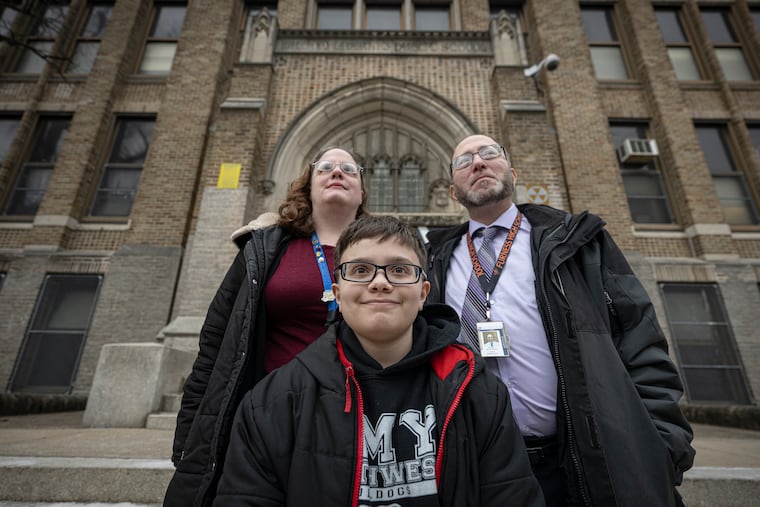
AMY Northwest parent Michelle Riccobono will never forget the day in 2024 she brought her son, Joseph, then a rising sixth grader, to visit the Roxborough magnet middle school.
“He really didn’t want to come,” Riccobono said. “Then, principal [Jodan] Floyd walked in and started speaking, and I watched him sit up, his hoodie came off, he started raising his hands and answering questions. The sense of community was strong. I could feel it. My son could feel it.”
Joseph, who has autism, has excelled in his first year at the school. Six months into sixth grade, he is engaged in all of his classes, including the ones hardest for him: math and gym. Thanks to AMY Northwest’s teachers, Riccobono said, her son no longer shuts down when he is afraid or challenged. He has become more outgoing and friendly, chatty even.
“They know my child,” she said. “Everyone in that building knows my child.”
Among the smallest middle schools in the district, AMY NW is seen as a gem by parents like Riccobono and teachers who value the culture they say it has fostered.
If there is an issue in the school, teachers know about it immediately, they say.
“We have an AMY WhatsApp,” social studies teacher Kenneth Bernstein explained one recent Friday morning.
Yet AMY’s size, in tandem with other factors — including the poor condition of its 102-year-old building and a district plan to phase out middle schools in favor of K-8 facilities — has put it in limbo and facing closure.
The school board will soon decide whether to green-light a facilities plan that would shutter the magnet along with 17 others, including five other middle schools and many others that, like AMY, are under-enrolled and are valued by the community for that very reason.

Wholesale changes are coming to the Philadelphia School District, with the school board passing a $3 billion facilties plan that aims to close 17 schools permanently, and renovate 169.
Superintendent Tony B. Watlington Sr. presented the plan to the school board Feb. 26 and it immediately faced strong opposition. After some amendments, the board passed the plan April 30. Here's what we do and don't know about it.
And to see the proposed list school closures and check how your school could be impacted, use our interactive charts.
Each of the schools proposed for closure has its own story. Find them all here.
The plan to close the school, which outperforms the district average on state reading and math exams, has roiled its community. Parents and staff are angry, hurt, and insulted. They don’t want to break up a tight-knit community that they spent years building and has a reputation for good beyond the school’s 19th-century walls.
Floyd, the principal, points to AMY Northwest’s well-being survey as evidence of why the school should stay open. One hundred percent of AMY students, she said, reported they feel respected by their teachers. A whopping 85% say there is an adult they can talk to, while 90% say adults really try to know them and 92% say adults at AMY Northwest really care about them.
“As of February, 79% of kids are attending 90% of school days,” said Floyd, who has been AMY Northwest’s principal for 13 years, “while the district average is 65.9%.”
Still, AMY Northwest’s staff and students use less than 22% of the cavernous, three-story building the school occupies, and district officials say it needs millions of dollars in repairs and modernizations. The school, for instance, does not have air-conditioning.
“I have to own that,” Superintendent Tony B. Watlington Sr. said in an online video conference, referring to years of deferred maintenance and underinvestment.
None of that, however, comforts students and families facing the loss of their community.
“It’s not one of the most competitive schools,” said Evan Moore, an AMY Northwest eighth grader. “But it’s a good school because it does have criteria. There are a lot of students who don’t have the eligibility to get into the best, best school, but still want and need something more than their neighborhood school. Having a school like that here is really important.”
Small class sizes are even more important to AMY parents, they say, because their children are at the delicate age when they are discovering themselves and need the extra attention to figure out who they are and what kind of students they want to be.
“At AMY, my daughter learned how to stand up for herself,” said Megan Acedo, whose daughter, Naomi Acedo Moorhead, is in sixth grade.
The school district has not decided whether it would keep the building or sell it. As of now there are no plans to move the AMY Northwest community to another building.
In the meantime, Floyd said, she is trying to carry on with business as usual. With the 2027-28 sixth-grade class — set to be the school’s final addition — there will be 180 students at AMY Northwest, she said.
Yet when the 2028-29 class graduates, there will be fewer than 100 students. In such a vast building, these kids’ eighth-grade experience will be like learning in a ghost town.
“I wanted my daughter to have the opportunity to have a middle school experience,” Acedo said. “And I wanted other Philadelphia students to have a similar experience. … Now we will all just be watching a slow death.”