As Philly prepares to close schools, this group cautions: Don’t tear down schools
The Preservation Alliance called on the Philly district to protect historic buildings rather than tear them down.
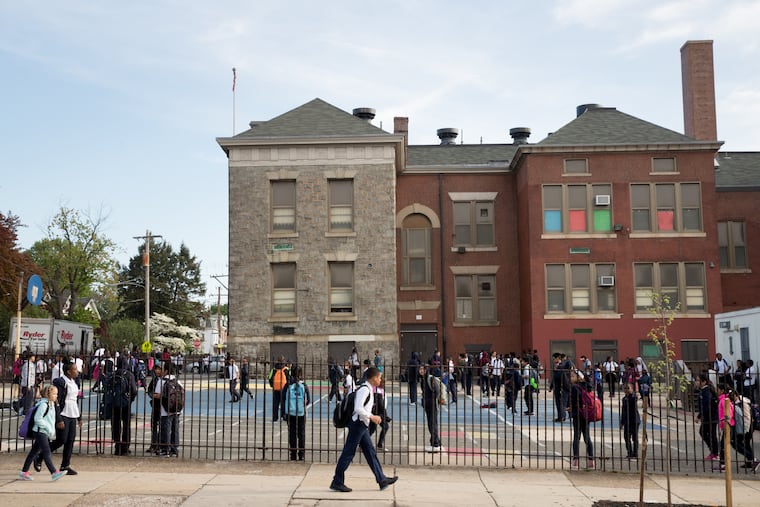
Save as many of the city’s historic school buildings as possible, a local nonprofit is urging the Philadelphia School District as it nears a deadline to decide which of its 200-plus school buildings it will keep and which it will close.
The oldest currently operating district school, Francis Scott Key Elementary in South Philadelphia, was built in 1889. The average Philadelphia school building is about 75 years old and, due to years of underfunding, deferred maintenance, and environmental hazards, many schools are in poor condition.
Still, the Preservation Alliance for Greater Philadelphia said in a report issued Wednesday, the district is at a critical point to consider modernizing historic buildings, rather than tearing them down or building new ones.
In the last few years, the district has demolished two schools listed on the National Register of Historic Places — the old Cassidy Elementary in West Philadelphia and AMY at James Martin, a middle school in Port Richmond.
“It is a fact that we will never build buildings like these again, in terms of their materials, craftsmanship, and style, in terms of things like the brick and the stone, hardwood floors, plaster walls, carved wooden paneling, high ceilings, and large windows,” said Paul Steinke, the Preservation Alliance’s executive director. “Once they’re gone, they’re gone.”
‘Mounting risks’
Philadelphia’s school system dates back to 1818; by 1867, a “Superintendent of Buildings” position was established. These days, the district operates 218 schools but is responsible for roughly 300 buildings.
The report identified “mounting risks” to historic school buildings — according to the school system’s own data, about half its schools are in poor condition. And usage is uneven; some schools are overcrowded, particularly in the Northeast, but citywide there are about 70,000 empty seats in district schools.
It also noted that the district has policy gaps.
“Current SDP deaccession policies do not prioritize adaptive reuse over demolition,” the report said.
Steinke recommended the district arrive at “mothballing” protocols so if schools are decommissioned, they are preserved for possible adaptive reuse.
Which district schools are considered historic?
According to data compiled by the Preservation Alliance, about 100 district schools or charters operating in district buildings have some kind of historic designation.
Who designates a school as historic matters. School buildings on the National Register of Historic Places qualify for financial incentives, such as grants and tax breaks, but that designation does not prevent structures from being torn down.
Buildings on Philadelphia’s local historic register have more protections — they cannot be demolished.
The designations “acknowledge that schools are more than functional buildings, but rather neighborhood landmarks, reflections of the city’s educational legacy, and often examples of notable designs,” the report said.
Ten district-owned buildings are on the local register and cannot be torn down. Nine are operating as schools.
The current schools include Philadelphia High School for Creative and Performing Arts, Franklin Learning Center, McCall Elementary, GAMP, E.M. Stanton Elementary, Masterman, Vare-Washington Elementary, AMY Northwest, and Waring Elementary. (The other building is the former Powel Elementary.)
An additional 150 current or former schools are on the National Register of Historic Places. About 75 operate as district-run schools, with some city charters also in historic buildings.
Cost savings?
Preserving a building is often cheaper than tearing a historic one down and building anew, the report found.
A recent object lesson: Frankford High, closed in 2023 because of damaged asbestos. District leaders initially said they were strongly considering razing the massive Gothic Revival building on Oxford Avenue and constructing a new Frankford.
» READ MORE: Historic Frankford High building, closed for years because of asbestos, reopens after a $30M refresh
But the costs proved too high — it would have cost an estimated $300 million to knock down the old Frankford, built in 1912, and construct a new one.
This week, Frankford reopened with $30 million of repairs complete. More than 900 students are set to start classes there on Monday.
Using district data, the Preservation Alliance identified seven historic schools and analyzed estimated costs to repair the old buildings vs. replacing them. Repairing Fitler, Bache-Martin, Cassidy, Emlen, Richmond, Ethan Allen, and Dunbar would save $50 million, the group calculated.
“Think about how far that money can go,” said Hanna Stark, the Preservation Alliance’s director of policy and communications. “We think demolition wastes opportunity.”
Though some community members wish the district would close no schools at all, Preservation Alliance officials acknowledged that decommissioning some schools is likely necessary.
“We are not blind to the current challenges that many of these schools represent, chief among them deferred maintenance that has rendered many of them in poor condition, with hazardous materials like asbestos, outdated building systems, nonexistent or inadequate climate-control systems,” Stark said.
But when closures are necessary, instead of being torn down — which sends materials into landfills — those buildings should become affordable housing, senior centers, or other community hubs, she said.
Steinke and Stark highlighted two closed schools as good examples of what is possible: The old West Philadelphia High was shut down by the district and replaced with a new school a few blocks away, but the building was preserved, then sold, and now houses apartments.
And the old Bok High School, in South Philadelphia, got new life as a hub for small businesses and artists.
Neighborhood anchors
School closings often disproportionately target distressed communities, where taking neighborhood anchors offline is particularly devastating, Steinke and Stark said.
School system officials have said they will release recommendations for closings, new construction, colocations, and major renovations sometime this fall, with a final vote on the plan scheduled by the end of the year.
The decisions are enormously important, Steinke said.
School buildings are “reservoirs of community memory,” he said. “They are meaningful, these buildings, to the communities that they serve.”