Philly once had the ‘most interesting high school in the U.S.’ Now the district is closing two of the remaining Parkway schools.
Parkway West and Parkway Northwest, two high schools slated to close under the school district's facilities plan, are the remnants of an innovative program that drew international attention.
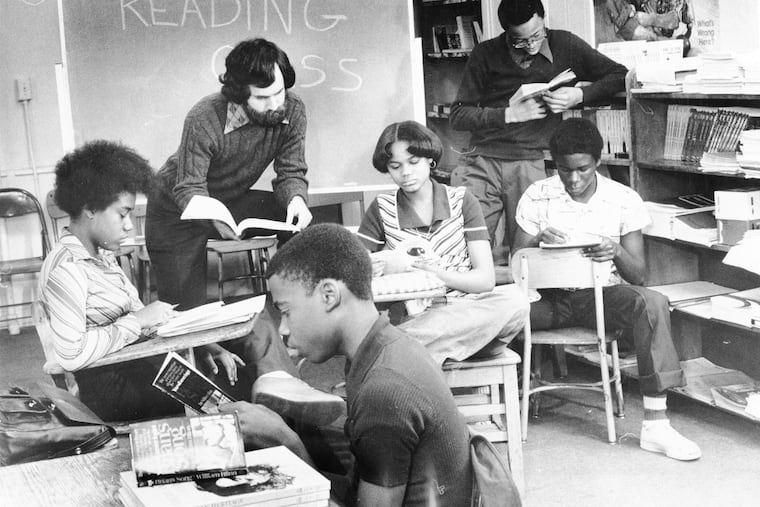
Philadelphia was once considered a center of educational innovation, thanks to a “school without walls.”
With the Philadelphia School District’s Parkway Program, students designed their own schedules, mixing courses and real-world experiences in locations all over the city.
Shortly after Parkway opened, a 1970 Time magazine cover proclaimed it “the most interesting high school in the U.S.” Educators and researchers from around the world visited to study, write about, and replicate its methods, and its notable alumni include Mayor Cherelle L. Parker and actor Kevin Bacon.
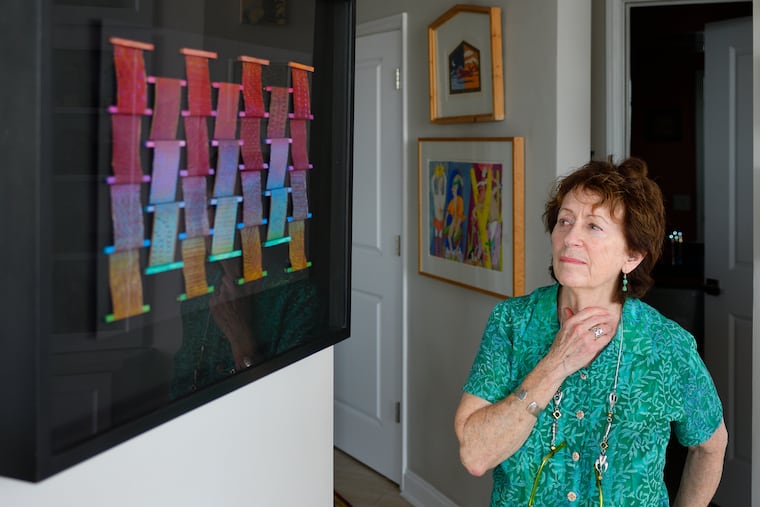
Ellen Sklar, a 1973 graduate of the Parkway Beta program, took a chance on a new kind of high school because “I liked the fact that it was less regimented, and that I would get to have some interesting experiences.”
She did.
Sklar, like all Parkway students, called her teachers by their first names. She smoked cigarettes and drank coffee during lessons, took classes at Drexel University, a Christian Science center, the Fleisher Art Memorial, and a teacher’s house. She and another student were interested in printmaking, so they spent time at a printmaker’s house to learn his trade.
“We were everywhere — all over the city,” said Sklar, who went on to work as a graphic designer and then a nurse before retirement. “Anything that you were interested in, you could find a way to take a class.”
Eventually, the program grew to five different “units,” or schools without walls, before shifting into more traditional high schools by the late 1970s. Now, two of the three remaining schools bearing the Parkway name are poised to close in 2027 as part of the district’s facilities plan. But students and staff from the school’s heyday say they hope lessons from the school’s history are not lost.
James “Torch” Lytle, Parkway’s first principal, said he believes many issues that modern schools now face can be improved with the Parkway method.
Parkway showed the benefits of “getting the community involved, agreeing that it’s to everyone’s benefit if we get high school students involved in their work,” he said.
A life-changing experience
At first, Parkway’s founders had to sell the school to parents and students unfamiliar with new concept.
But eventually, it began to gain steam, adding units of about 225 students selected by lottery in 1969.
Lance Fountain enrolled in Parkway’s Gamma Unit in 1973 — a “life-saving, life-changing experience for me,” Fountain said.
Fountain was mischievous, he said, and “traditional schools just didn’t seem to work for me.” But he relished taking courses at Drexel University, learning about computers inside a University of Pennsylvania lab, crossing the city on foot and by bus, visiting the Franklin Institute and the Philadelphia Museum of Art.
Mastering algebra was difficult for Fountain, but he said his math teacher spent extra time working with him one-on-one until he understood concepts.
Parkway leaders believed that every teacher should have at least one class a day that reflected their own passions — Jeanette Jimenez, an English teacher, leaned into theater. She taught tennis. Others walked students across the Ben Franklin Bridge for exercise; they talked about classical music, gay rights, and more.
“It was extremely dynamic; it was joyful,” Jimenez said. “We tried to make it a meaningful experience, every day, every minute. Teachers were tested to make sure they had a way to present information different than the same old, same old.”
Jimenez’s students performed plays at the Society Hill Playhouse. They created their own books, dived deep into meaningful texts, made murals, and gave poetry readings. Jimenez got rid of traditional desks and set her classroom up like a living room, a place that students did not want to leave.
The mayor, Jimenez’s most famous pupil, has credited Jimenez with helping her “turn pain into power” on the path to winning a citywide oratorical competition and launching a political career.
At Parkway, “everything was about the experience,” said Robin Cooper, a 1987 graduate of what became Parkway Center City. Cooper, who is now the president of the district’s principals’ union, worked as a candy striper at Temple University Hospital for her health credits and learned about Shakespeare at a church.
“I can remember it like it was yesterday,” Cooper said. “It totally prepared me for life. It just worked for me; I needed to go and do and be.”
‘It taught us to be bigger than ourselves’
Parkway students had significant freedom in building their schedules and making their way around the city, “but there were essentially never any serious discipline problems,” said Lytle, who spent decades as a top administrator before becoming a professor at Penn’s Graduate School of Education.
Parkway units had staff whose job it was just to make community connections. And they were deliberately kept small enough that students were well-known by all the adults in the program.
“The students really valued the way that the teachers connected to them, and had regard for them. And the faculty thought they were in heaven — it was a school, it was not a holding tank,” Lytle said.
Over the years, Parkway became less experimental, losing the early informality and city-as-classroom vibe. As the district’s administration shifted, the program fell out of favor and its schools eventually became traditional ones, with mostly the same classes and schedules as other district schools.
The three remaining Parkway programs — Parkway Center City, Parkway West, and Parkway Northwest — became standalone high schools in the small-schools boom of the early 2000s under former schools CEO Paul Vallas.
But as the district confronts decades of underfunding and the 70,000 unfilled seats citywide, it is closing 17 schools — including Parkway West and Parkway Northwest. (Parkway Center City, which is now a middle college, where students are able to complete associate’s degrees along with high school diplomas, will remain open.)
Parkway West, which has developed an early childhood career and technical education program, and Parkway Northwest, which has a peace and social justice focus, are both small — with 151 and 239 students, respectively.

Wholesale changes are coming to the Philadelphia School District, with the school board passing a $3 billion facilties plan that aims to close 17 schools permanently, and renovate 169.
Superintendent Tony B. Watlington Sr. presented the plan to the school board Feb. 26 and it immediately faced strong opposition. After some amendments, the board passed the plan April 30. Here's what we do and don't know about it.
And to see the proposed list school closures and check how your school could be impacted, use our interactive charts.
Each of the schools proposed for closure has its own story. Find them all here.
The school board voted this month to move ahead with the closures, which will take effect after next school year.
Lytle is dismayed at the loss of the Parkway history and name. (Both Parkway programs slated for closure would fold into other schools — Science Leadership Academy at Beeber for Parkway West, and Martin Luther King High for Parkway Northwest.)
“The reason for considering cutting them seems to be completely budget based,” Lytle said. “There’s an acknowledgment that these are little sweet spots, but that doesn’t seem material.”
Superintendent Tony B. Watlington Sr. has said the aim of the facilities plan, which includes 169 school modernization projects in addition to the closures, is to improve academic and extracurricular opportunities for all. Leaders have indicated the district’s current building footprint is too big.
But to Cooper, whose work as a union leader takes her all over the city and state, closing two Parkway programs is a major loss.
Officials “make these cookie-cutter models without really understanding what the schools were about,” Cooper said. “Parkway was the most unique place — it taught us to be bigger than ourselves.”