Penn Treaty High is slated for closure — after years of being treated like Philly School District ‘pawn,’ supporters say
Superintendent Tony B. Watlington Sr. has proposed closing Penn Treaty High to neighborhood students, then fixing up the building for a relocated Bodine High, a magnet.
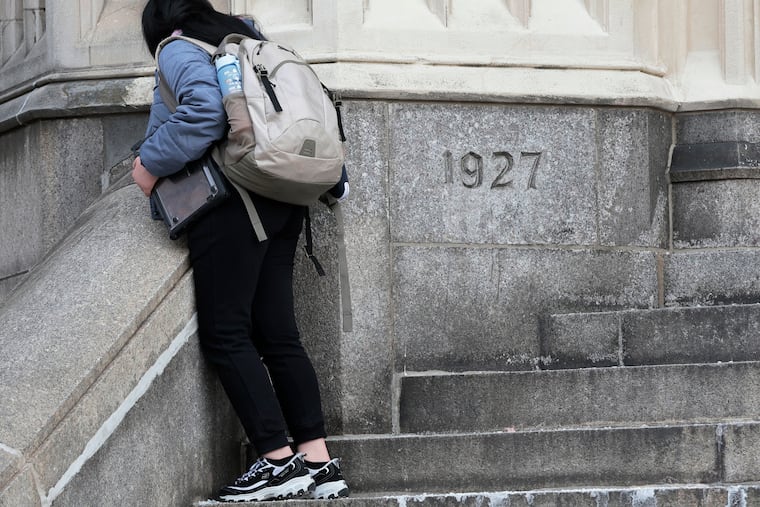
Strengthening neighborhood high schools is a key tenet of Superintendent Tony B. Watlington Sr.’s facilities plan, which includes closing 18 schools and modernizing 159.
The exception is Penn Treaty School — a neighborhood high school in Fishtown that is slated for closure. Watlington has proposed renovating the Penn Treaty building, which is on the National Register of Historic Places, to become a new location for Bodine High School, a magnet.
To Joshua Delp, a Penn Treaty English teacher, that’s unfair.
Current students “hear that they are simultaneously not good enough to go there, and what has been good enough for them is not good enough for Bodine kids,” he said.
Change is not new for Penn Treaty, which has faced several major shifts in the last few decades.
Brooke Hoffman, a Rowan University education professor and former Penn Treaty teacher who helps run a nonprofit supporting the school, said the district often foists significant change on Penn Treaty without adequate resources or support, and the school’s staff figure it out.
“Penn Treaty has been treated like a School District of Philadelphia pawn for a long time,” Hoffman said. “In fact, this is nothing new, but how can a school focus on building a strong, effective, sustainable educational program when every five or so years, there is a major change?”
The Philadelphia School District gave what was then Penn Treaty Middle School to for-profit Edison Schools Inc. to run in the early 2000s, then took it back when Edison failed to deliver on its quick-turnaround promises.
After the system’s 2013 mass school closures, Penn Treaty was converted into a 6-12 school, absorbing students from the former Douglass and Carroll High Schools.
In recent years, the changes have been shifts in feeder school patterns, requiring recalibration, resources, energy for an increasingly complex student body — but Hoffman said staff always figured it out because the kids needed them.
District officials say their aim in closing Penn Treaty and other schools is to improve academic achievement and opportunities for all students, and to do that, they cannot maintain their current building footprint. The school system has 70,000 empty seats in schools citywide.
“We can’t keep all the small boutique high schools and the neighborhood high schools,” Watlington said at a City Council hearing on the facilities plan last month. “We don’t have the resources to do all of it.”
Penn Treaty enrolls just 400 students in grades six through 12 — and most of them come from outside the school’s catchment, choosing to travel from other parts of the city to attend the school. Nearly half — 43% — require special-education services.
Watlington’s plan calls for Penn Treaty to phase out over four years.
Middle-grades students who live in the current Penn Treaty catchment would attend a newly reconfigured Moffet School for middle grades, and for high school, they would choose among Kensington High, Kensington High School for the Creative and Performing Arts, and Kensington Health Sciences Academy. Students from other neighborhoods would have to find other options.

Wholesale changes are coming to the Philadelphia School District, with the school board passing a $3 billion facilties plan that aims to close 17 schools permanently, and renovate 169.
Superintendent Tony B. Watlington Sr. presented the plan to the school board Feb. 26 and it immediately faced strong opposition. After some amendments, the board passed the plan April 30. Here's what we do and don't know about it.
And to see the proposed list school closures and check how your school could be impacted, use our interactive charts.
Each of the schools proposed for closure has its own story. Find them all here.
A small community with ‘true ideals’
Many choose Penn Treaty because of its size.
But that small size worked against Penn Treaty when the district began to scrutinize buildings in its efforts to develop a facilities plan. Penn Treaty’s huge building on East Thompson Street is half empty, “severely underutilized” by the district’s calculus. And it has an “unsatisfactory” program alignment, a measure of its ability to offer career and technical education, Advanced Placement classes, and more.
Still, Penn Treaty is a special place, said Delp, who worked as a substitute in multiple Philadelphia schools to try to find a good fit, a place to plant roots.
In 2017, he subbed at Penn Treaty — and kept coming back. Delp loved it so much he talked himself into a permanent job in what felt like an ideal neighborhood school.
“There was no other school in the district where I saw students of every class, race, background, all unified in this honestly shocking harmoniousness,” said Delp, who bought a house within walking distance. “It was exactly what those of us who believe in the true ideals of America would want to see in a diverse school.”
“The teachers know all the students in the building,” Delp said. “They have personal relationships with all of those students. And students blossom in that environment.”
Because of Penn Treaty students’ geographic diversity, they don’t have a natural base of advocates to stand up for them, Delp said.
Frankly, Delp said, conversations around a possible Penn Treaty closure when another district facilities planning process was attempted and abandoned in 2017 showed that some neighbors “did not appreciate having a diverse school,” Delp said.
Students with different needs
It’s notable that many Penn Treaty kids travel to get to the school, said Zak Krone, another Penn Treaty English teacher.
“If 35% of our kids are from the catchment and this is a neighborhood school, what does that tell you about the need, the yearning that families have to send their kids to places that can meet their kids where they are?” Krone said. “What does that tell you about the accessibility of citywide and special-admit schools in the district?”
Penn Treaty’s students need significant support, Krone said, and they get it.
Certain students get lost in large neighborhood schools, Krone said.
“It’s not that they don’t go to citywide or special-admit schools because they don’t care about their futures,” Krone said. “It’s that they have different needs, and meeting those needs is not possible in a larger school.”
Kerri Todd had envisioned herself a Penn Treaty lifer. She is from the neighborhood, and has taught at the school for 24 years.
When Penn Treaty initially added high school grades, “it was a disaster for three years — fistfights out the wazoo” said Todd, a Lindback Award winner. “We had a bad rap because there was a lot of animosity — it was always a brand-new start.”
The district made Penn Treaty a 6-12 school “and we got nothing,” Todd said. “We didn’t even get paper. They just kept telling us, ‘Ask Masterman how they did it.’”