Philly City Council wants to consider having an elected school board following showdown over closing 17 schools
Councilmember Isaiah Thomas said the school board should be held accountable to the public, especially after a controversial vote last week on a school facilities plan that would close 17 schools.
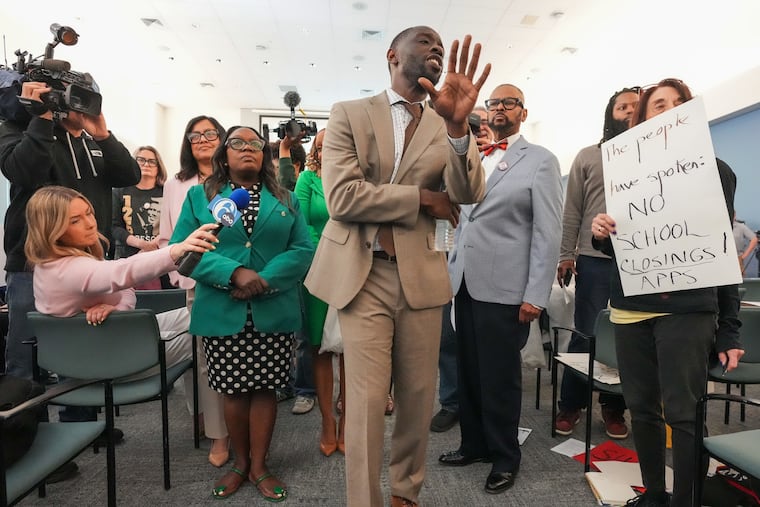
After an extraordinary public rift with the Philadelphia school board over 17 school closings, City Council’s education committee chair is calling for hearings on how the school system is governed.
Councilmember Isaiah Thomas, who led efforts to disrupt last week’s school-closing vote, introduced a resolution at Council’s meeting Thursday. The measure passed unanimously.
Thomas, in an interview after the meeting, also revealed new details about Council’s attempts to prevent the school board showdown — including a proposed compromise to shut 15 schools, not 17, that ultimately died.
“In its current form, the board is not directly accountable to the public, and is rather entirely appointed by the mayor and confirmed by Council,” Thomas said. “This committee hearing would explore alternative governance models for the board — namely a fully elected or hybrid elected-appointed board.”
» READ MORE: This West Philly teacher just won a national honor. Because his school is closing, it’s bittersweet.
The mayor currently appoints the nine school board members, who are then approved by Council.
Philadelphia is alone in Pennsylvania in that structure. All other municipalities have elected school boards.
The school board on April 30 voted 6-3 to close 17 schools and renovate 169. The vote capped a yearslong process — and came after Council criticized the district for years for not having a plan to care for its aging buildings.
Thomas and other Council members said the district did not provide enough data around its decisions, and said it was moving too quickly and without meaningfully listening to the public, or giving it opportunities to fully understand the plan before a vote.
A majority of Council demanded the school board remove Lankenau and Robeson High Schools from the closing list, but the board declined to do. (Superintendent Tony B. Watlington Sr. removed three schools — Conwell Middle School, Motivation High and Ludlow Elementary — from the closing list in months prior.)
The school system has a 70,000 empty seats in its stock of more than 300 aging buildings. Officials said the closings were meant to drive better academic and extracurricular opportunities and more equity, and that they could not drive faster improvement without shrinking its capital footprint.
The resolution said the school board “has been unwilling to discuss how the facilities plan would integrate into a range of other city and Council district needs.”
The school-closing vote begs the question, the resolution states: “Considering a more traditional elected or hybrid model of governance may compel the board to be more responsive to students and families’ concerns than the board has proven to be.”
A compromise rebuffed
Thomas and other Council members continued to unload on the school board Thursday, insisting they tried to find a compromise before the heated school board meeting.
Thomas said he and the Council members offered to get behind the district’s facilities plan if it limited the closure list to 15 schools.
The lawmakers wanted Lankenau removed from the list, and asked the district to negotiate with Councilmember Jamie Gauthier over the neighborhood schools up for closure in her West Philadelphia district, including Robeson and Blankenburg Elementary.
“We said, ‘We’ll figure it out throughout the course of deliberation … we’ll live with it for now and figure it out later,’” Thomas said.
Thomas said he also warned Mayor Cherelle L. Parker’s administration that there would be a public fight.
In an interview after the Council meeting Thursday, he read a message that he said he sent to a senior Parker administration official last week.
It read: “Just an FYI so nobody is surprised, if the school board doesn’t bend on this facilities plan tomorrow, it’s going to be a very long day.”
Thomas said no one from the Parker administration called him after that message.
And he said the school board’s president, Reginald Streater, “has been ignoring me.”
“I reached out to them, I reached out to Streater, I reached out to Watlington myself,” he said. “I did not want to do this. I said, ‘Please, y’all, don’t make us do this,’” Thomas said.
Even the typically subdued Council President Kenyatta Johnson expressed some frustration Thursday, saying it is “very rare” for a governing body in the city to ignore pleas from other elected officials to slow down a process.
“They pretty much said, ‘Whatever, we’re still going to continue to move forward,’” Johnson said. “And I think that’s rare and it’s never been seen, at least in my lifetime in terms of me being an advocate around public education [and] me being an elected official.”
Gauthier said in a speech on Council’s floor Thursday that it was last week, when the school board went into a private room and voted to close 17 schools, that she “understood in real time why we need an elected school board.”
She said she and her community felt “disrespected.”
“We have to take a look at this governance structure to ensure that it really reflects the needs and the desires of the people,” said Gauthier.
The school board president responds
Changing the district’s governance model would require a lengthy process, including a two-thirds vote by Council approving an ordinance calling for a charter amendment. Then the proposal would be up for a citywide ballot question asking for a city charter change. A majority of voters would have to approve that question for the change to take effect.
Thursday’s resolution was co-sponsored by Councilmembers Nina Ahmad, Kendra Brooks, Jamie Gauthier, Jim Harrity, Quetcy Lozada, Nicolas O’Rourke, and Mark Squilla.
It’s not the first time Thomas has attempted to call the question. In 2024, Thomas made a similar request, which did not yield change. That call was prompted by Parker’s move to seat Joyce Wilkerson on the board, despite Council’s objections to her candidacy.
Wilkerson, a former School Reform Commission chair and school board president, was never confirmed by Council, but continues to serve because no replacement for her has been put forth by Parker. Her school board seat has been questioned in a lawsuit that is ongoing.
Streater, in a statement, did not specifically address the call to change the district’s governance model, but said the board’s school-closing vote was “an incredibly difficult but necessary decision to address decades of systemic underfunding and longstanding structural challenges that we simply can’t ignore.”
Streater said the board acted in the best interest of all students, and to make the school system more sustainable.
“As a board,” Streater said, “we will continue to call on our city and state partners to work alongside us to ensure that every student receives the investment and support they deserve.”

