Philly School District will not make 340 classroom job cuts after all, mayor announces
Money from the city budget will go to preserving the classroom positions, the mayor and other officials announced.
Philadelphia School District officials are restoring 340 classroom-based jobs that were slated to be cut, despite top district leaders saying last week that they did not have the recurring funding needed to keep the positions.
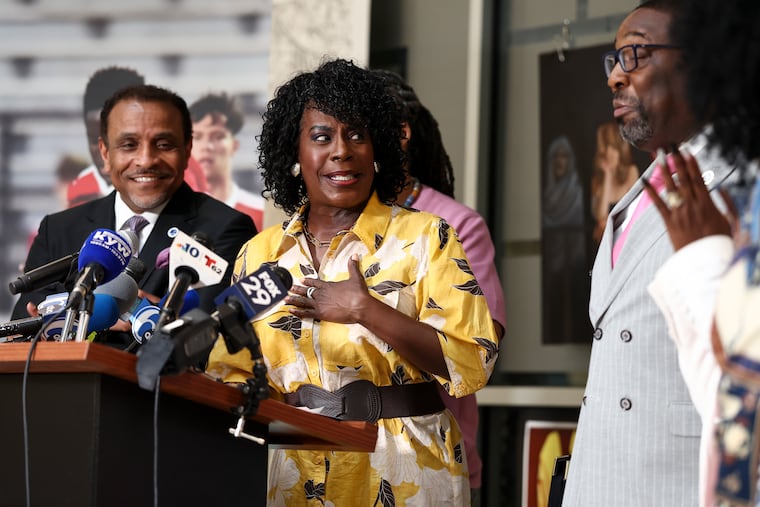
In a surprise, dramatic announcement late Wednesday, Mayor Cherelle L. Parker — flanked by Superintendent Tony B. Watlington Sr., school board president Reginald Streater, and Council President Kenyatta Johnson — said the city had identified enough money in the existing budget to stave off the cuts.
“We have delivered for the School District of Philadelphia today,” Parker said. The mayor added that the city “made some tough decisions” to save the positions of 149 teachers, 130 climate staff, and 23 counselors.
Parker and Johnson pledged $216 million over five years to keep funding the school workers.
Officials said the $48 million in new money the city is providing for the 2026-27 school year is the floor, and not a one-time fix.
The administration will look to new, recurring revenue sources in the future, Parker and Johnson said, but if those are not found, the money will come from the city’s capital spending and other areas the mayor said she would release Thursday.
“Everything is on the table” for those new funding streams, Parker said, though she did say that raising property taxes was a nonstarter.
The mood at district headquarters, where leaders gathered for a hastily arranged news conference, was positively jubilant.
“It’s Christmas in June,” Johnson said. Thursday is the last day of school for district students, and Johnson said he was thrilled that teachers and staff “will have an opportunity to remain in the schools that will continue next year, in the years beyond, to support our young people.”
“I can’t stop smiling,” Streater said.
An about-face
The move was an about-face from last week, when Watlington wrote in a letter to Council that the system — which is facing a longstanding $300 million structural deficit — could not restore the 340 positions “without a commitment to recurring and predictable funding over multiple years.”
» READ MORE: Philly teachers union and advocates implore school officials to restore 340 classroom positions
After that grim moment, Parker said, members of her team, Johnson’s office, and district officials worked “around the clock” to find a way to cobble funds together to save the jobs, which were imperiled amid a $300 million district budget deficit. City Council last week rejected Parker’s proposed $1-per-ride tax on rideshare services like Uber and Lyft, which she said would generate about $48 million a year in revenue for the district to cover the classroom cuts.
Instead, legislators and the mayor’s administration agreed last week to use money in the existing budget to increase the city’s annual contribution to the school district by $48 million this year.
Council members gave initial approval to that plan last week and are expected to take a final vote on the budget on Thursday.
After Parker’s tax plan collapsed, she held a fiery news conference, casting one-time money for the city’s public schools as a Band-Aid and saying that the lawmakers did not “offer an alternative plan for recurring revenue.”
“Our children deserve better. They deserve more,” Parker said. “We didn’t meet the moment here in the city of Philadelphia.”
But Council members, already frustrated with the school board for voting in April to advance a plan to close 17 schools, were up in arms.
Council leaders said that they had been under the impression that the school district would not make the job cuts if the city came through with an additional $48 million this year, regardless of whether the money came from a new tax or the city’s existing coffers.
“We wouldn’t have gone to the lengths that we went to to come up to what we thought was an agreement with the administration for the district to then say that was not adequate,” Majority Leader Katherine Gilmore Richardson said in an interview Friday.
The union that represents Philadelphia teachers and other schools advocates also implored Watlington to change course. Arthur Steinberg, president of the Philadelphia Federation of Teachers, said last week that it was “deplorable and really absurd” that the district was opting to move forward with staff cuts despite getting $48 million in new money from the city.
No ‘tricky math’
Parker on Wednesday said she did not regret waiting for a guarantee on paying for the positions going forward.
“I don’t know how they do math in other cities, Mr. President, but I know here in the city of Philadelphia, we can’t have tricky math,” the mayor said, addressing Johnson. But, she said, “we were committed to ensuring that politics of any kind were not going to stand in the way of us doing what we’re supposed to do as elected representatives for the city, and that is delivering for our school district.”
The district must now shift immediately to figuring out how to restore the 340 positions. Schools built their budgets based on the cuts, and the teachers, counselors, and climate staff who believed their positions were ending either found new jobs or, in the cases of some, left the district altogether in what has been an especially chaotic school-hiring season.
It was not immediately clear what would happen, logistically, with the positions, but Watlington said he would be delighted to figure it out with representatives of the Philadelphia Federation of Teachers and the principals union.
“I can guarantee you’re going to work through all those issues,” Watlington said. “It’s not a problem.”