Philly City Council rejected Mayor Parker’s proposed taxes on Uber and Airbnb while advancing a $7.1 billion city budget
The mayor had pushed for added levies on firms like Uber and Airbnb to help fund schools. Lawmakers has other ideas.
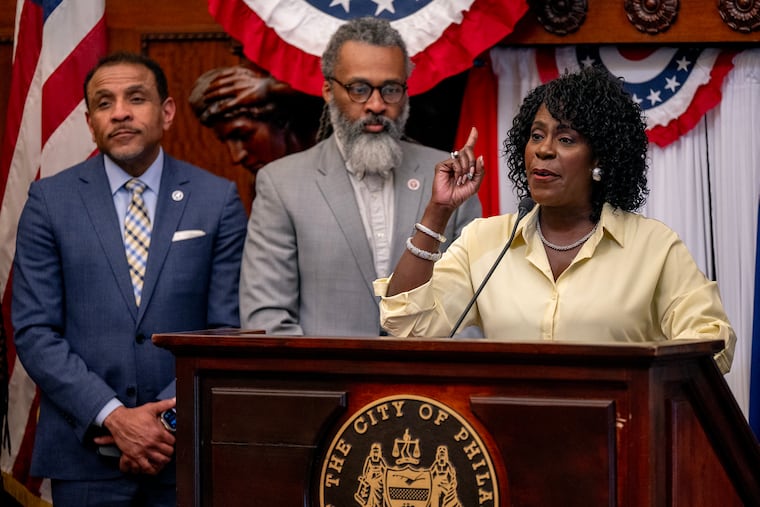
Philadelphia Mayor Cherelle L. Parker picked a fight with big tech companies.
In the end, the tech companies won.
City Council gave preliminary approval Thursday to a more than $7.1 billion budget for the fiscal year that begins July 1. The plan does not include the mayor’s tax proposals meant to squeeze revenue out of gig economy companies like Lyft, Uber, Airbnb, and DoorDash.
“Billionaire big tech companies just won round one in this process,” Parker said, adding that the firms spent big on lobbying and public advertising to defeat the proposals and that they “control algorithms and what we see on social media.”
“I won’t give up,” Parker said. “Our children deserve better. They deserve more. … We didn’t meet the moment here in the city of Philadelphia.”
To plug the Philadelphia School District’s budget shortfall — which Parker hoped to help fund with a controversial $1-per-ride tax on rideshare services — Council instead amended the city budget to allocate an additional $48 million to the district this year. Those one-time dollars are coming from a grab bag of extra savings from a variety of departments, including $10 million from the commerce department’s contracts with outside vendors and a $9 million savings in debt service.
Superintendent Tony B. Watlington Sr., however, sent city officials a letter Thursday saying the school district’s cuts would go forward regardless because the new funding is not recurring revenue, meaning the district cannot count on it beyond the coming years. His letter sparked intense criticism from Council leaders, with lawmakers saying they did their part to stave off the reductions.
» READ MORE: Philly school officials say they may still cut 340 classroom jobs despite getting more funding from City Council
“For them to make a decision and say, ‘Oh, no, we’re not going to restore the cuts,’ it’s just short-sighted,” Council President Kenyatta Johnson told reporters after the letter was sent. “The question should be to them: ‘What are you going to do with the $50 million? Why not save the positions?’ I think that’s what the parents should be asking the Philadelphia School District.”
Council members also rejected Parker’s plan to increase funding for pothole repairs by imposing a 25-cent-per-order tax on retail delivery services like GoPuff and Amazon, and they killed her plan to increase the city hotel tax and a tax on short-term rentals like Airbnb and Vrbo to fund homeless prevention services.
Council did agree to pass one tax change proposed by Parker: applying the use-and-occupancy tax to cell phone towers, a move that is expected to generate about $2.4 million annually in additional revenue for the school district.
The Committee of the Whole, which includes all 17 members and considers budget legislation, approved Council’s version of the taxing and spending measures in a series of unanimous voice votes Thursday. Councilmember Brian O’Neill, the only Republican on Council, was absent.
The budget package is now on schedule to be approved at Council’s June 11 meeting, the final session before lawmakers adjourn for summer recess.
Council deals Parker a setback
This is Parker’s third city budget since she took office in January 2024, and Council’s near-wholesale rejection of her tax proposals marks her most significant legislative defeat to date.
That came at a cost for some members. Typically, in the final rounds of budget negotiations, the administration agrees to a laundry list of small funding allocations for pet projects proposed by individual Council members and compiled by the Council president, such as extra funding for a specific neighborhood recreation center or favored nonprofit.
Because Council largely rejected Parker’s tax agenda this year, the administration did not agree to any last-minute line items for new funding requests from lawmakers, according two Council sources who spoke on the condition of anonymity because they were not permitted to discuss private dealings.
The at-times divisive budget process was the latest example of Parker’s unbending approach to negotiations in City Hall.
After initially pitching a 20-cent-per-ride rideshare tax, Parker amended her proposal to the $1 surcharge, and Council members were immediately skeptical. But the mayor showed little desire to change course, saying the school district needed the recurring revenue as it faces a $300 million structural deficit and plans to cut more than 300 staff positions.
Parker had insisted for weeks that her proposed $1-per-ride tax on rideshare services was the best way to generate the nearly $50 million that the district needed this year. Council members and Uber lobbyists floated several alternatives, including increasing the existing 1.4% state tax on rideshare, that the mayor rejected as inadequate funding streams.
However, her plans began to collapse late Tuesday when state lawmakers signaled that there was little appetite in Harrisburg to raise taxes associated with Parker’s budget plan. That doomed the mayor’s proposed increase to the tax on hotels and short-term rentals, which would have required the General Assembly to pass and Gov. Josh Shapiro to sign authorizing legislation.
» READ MORE: Pa. state lawmakers won’t back Mayor Parker’s tax hikes, jeopardizing key pieces of her budget proposal
The mayor was attempting to win support for the rideshare tax through much of the day and into the night Wednesday, including by personally lobbying Council members. Ryan N. Boyer, the head of the politically powerful Philadelphia Building and Construction Trades Council and a close Parker ally, also lobbied Council members personally, but to no avail.
Ultimately, Council members were convinced — in part by Uber’s aggressive lobbying and public relations campaign — that the rideshare tax was politically unpopular and could exacerbate constituent concerns about the high cost of living.
Johnson said that negotiations are “never going to just be one way” and that, in asserting lawmakers did not want to impose new taxes, Council was doing its due diligence.
“Our constituents said we do not want another tax,” he said. “We felt as a body we do not want to continue putting a heavy burden while we’re dealing with the issue of affordability here in the city of Philadelphia.”
Parker pushed back on the notion that she was inflexible in negotiations.
“If anyone says to you that Mayor Parker and her team refused to move and they drew a line in the sand, it is a bald-faced lie,” she said at a news conference Thursday. “My administration did everything in our power to figure out how to get to yes, to get to [a majority] so that we can ensure those billion-dollar tech companies contribute their fair share.”
In a statement, Uber spokesperson Jazmin Kay thanked Council “for rejecting the Mayor’s proposed $1 rideshare tax and standing up for affordability for the hundreds of thousands of Philadelphia riders and drivers who spoke out against it.”
“Philadelphians want affordable transportation options and oppose higher costs on working families,” Kay added.
School district funding issues continue
Watlington has made clear that he is not attached to the Uber tax or any other funding stream, per se — just the money the Parker administration promised it would produce.
“While I’m agnostic to how we get the dollars, I want to note that we desperately need additional revenue,” the superintendent said at a school board meeting last week.
The school system stands to lose 340 school-based positions as a result of its $300 million budget deficit, caused by the end of federal COVID-19 dollars and rising benefit and charter school costs.
In addition to the classroom positions set to be eliminated, Watlington plans $169 million in central office cuts, including slashing contracts and not filling open positions.
But the school-based cuts have drawn the most attention and outcry, with parents, principals, and teachers pointing to on-the-ground impact the reductions would have — larger class sizes, less secure hallways and schoolyards, fewer supports for struggling students in a district already bracing for 17 school closures.
“We know that losing school staff will devastate school communities,” Moira Hull, a first-grade teacher at Hancock Elementary in the Northeast, said at a rally at City Hall on Tuesday.
The district already passed its own $4.6 billion spending plan — it is required to do so by the end of May — and schools were ordered to build budgets that account for the cuts, which has led to a chaotic teacher-hiring season.
On Thursday, Johnson introduced a resolution “to conduct hearings to explore new revenue proposals to address the School District of Philadelphia’s historic underfunding.”
Coincidentally, Council during its meeting on Thursday also passed a resolution honoring the Philadelphia Federation of Teachers’ 85th anniversary. Art Steinberg, the union’s president, used the opportunity to encourage lawmakers to find a sustainable funding solution for the district.
“The district needs new recurring revenue sources to address the structural deficit,” Steinberg said in his speech accepting the recognition. “Not providing this will accelerate the exodus of teachers and exacerbate the shortage. One-time fixes will not cut it.”