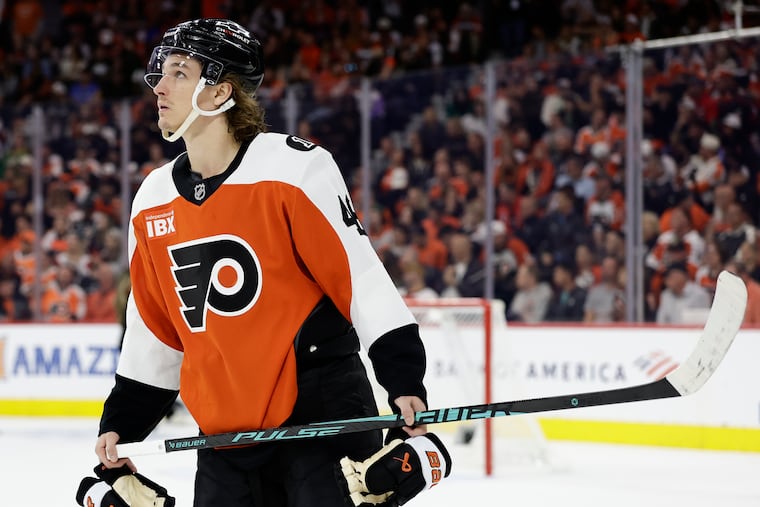
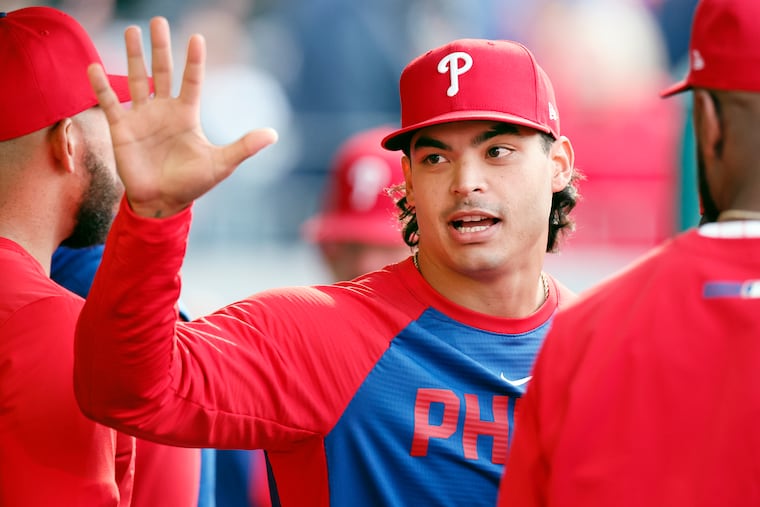
Matvei Michkov symbolizes the steps forward the Flyers can take in 2026-27
He's still just 21 and full of talent and promise. The franchise is counting on him, and players like Trevor Zegras, Porter Martone, and Jamie Drysdale doing one simple thing: improving.

One day last spring, just after the Flyers had finished an off-day practice in Raleigh during the Eastern Conference semifinals against the Carolina Hurricanes, Matvei Michkov lingered in the locker room, the only player there.
Two or three media members were hanging out, too, chatting with him about soccer, Michkov chatting back in splintered English. There was no tension. He was not sullen. If anything, he was effervescent: smiling, happy to engage. He did not in any way appear to be shattered by the hard but necessary treatment he had been receiving from head coach Rick Tocchet — limited ice time, often on the team’s third line — and would continue to receive. In just a few days, Tocchet would bench him for Game 4 of the Hurricanes’ series, the overtime loss that ended the Flyers’ season.
» READ MORE: Danny Brière wants to swing big to turn the Flyers into contenders. He might face a happy problem.
Now here we are, on the precipice of a Flyers season unlike any in the franchise in at least a decade, and Michkov is a reason, maybe the primary reason, for the welcome-if-unfamiliar atmosphere around the team. After the progress that the Flyers made last season — qualifying for the playoffs and winning a series for the first time since 2020, reassuring their fans that the team was, in fact, improving — they’re back to being a team on the rise again. It probably goes too far to say that expectations are or should be high for them, but there is certainly cause for cautious optimism.
Michkov is at the core of both that caution and those good feelings. His struggles, the fits and starts in his maturation, have been well documented. Considering how long it has been since the Flyers have drafted and developed a bona fide superstar, how often their fans and followers have been sold or were eager to buy bills of goods that turned out to be worthless, it was understandable that people might be concerned that Tocchet was hindering Michkov’s growth, if not stopping it altogether.
The subsequent four months, and some perspective, should have tempered that worry. Michkov had acknowledged that he was out of shape throughout last season; over the offseason, he said, he improved his diet and lost 29 pounds. And for all the complaints that Tocchet should have just thrown Michkov on the ice more often to sink or skate, for all the tongue-holding that the head coach did and failed to do, in 81 games Michkov still scored 20 goals and put up 51 points, the third-most on the team. If that measure of production constitutes a disastrous season, then the Flyers will happily take their chances on a lighter, presumably faster, revitalized Michkov. He is 21. Nothing is settled or ruined for him.
That relative gamble (what, were they really going to give up on another highly drafted player and trade him after one suspect season?) is emblematic of the approach that the Flyers took all offseason. Yes, they shocked the NHL with their eye-popping offer sheet to Leo Carlsson, but if you focus on the moves that they made (not the one they couldn’t quite pull off), it’s easy to see that they’ve made similar bets up and down their roster.
They re-signed Tyson Foerster to an eight-year, $56.8-million contract on the belief that an excellent two-way player who hasn’t scored more than 25 goals in a full season can be the kind of player who scores 40. They re-signed Trevor Zegras to a four-year, $36.5-million contract on the belief that he can tap even deeper into his well of skill and creativity. They re-signed Jamie Drysdale to a four-year, $26-million contract on the belief that he can be more than a solid No. 2 or No. 3 defenseman, more than just a coping mechanism for the departure of Cutter Gauthier.
» READ MORE: The reason reporters shouldn’t vote for halls of fame, a slim and trim Matvei Michkov, and other thoughts
Those players and others like them — Michkov, Foerster, Zegras, Drysdale, Porter Martone — will chart the course of this Flyers season and the franchise’s future, in the near and the long term. What the Flyers are banking on, really, is a factor that so many who work in, cover, and follow sports often forget: that athletes can and do get better with time, that a player won’t remain the same from his second year to his third and his third to his fourth, that a lengthy period of regression or stagnancy — like Michkov’s — doesn’t mean that player won’t return to form or make a great leap. It might even have been a necessary wake-up call.
Who makes that leap? Who shuffles just a few steps forward? Who seems stuck in place? The answers to those questions will define the ‘26-27 Flyers and will make them fascinating to watch. One player in particular.