Q&A: Phantoms coach John Snowden on developing young Flyers, David Jiříček’s power-play prowess, and more
Snowden discussed the growth of Alex Bump, Denver Barkey, and Oliver Bonk, his goalies Carson Bjarnason and Aleksi Kolosov, among other up and coming Flyers prospects.
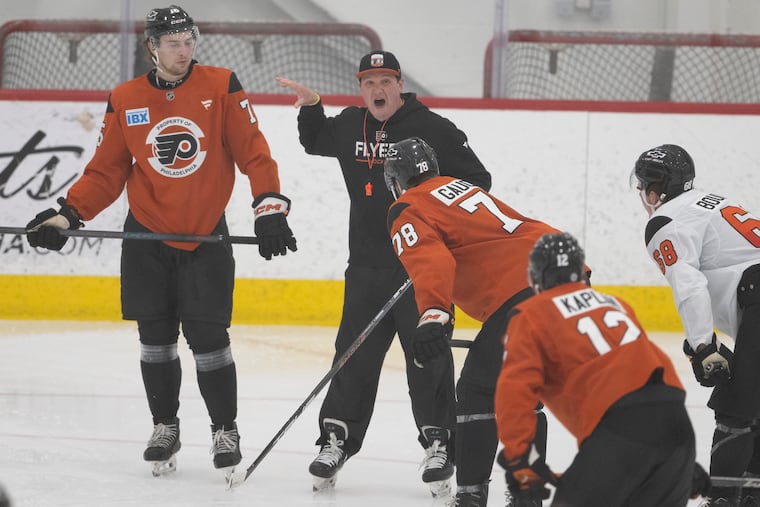
John Snowden is already itching to get back to work.
The coach for Lehigh Valley, the Flyers’ American Hockey League affiliate, just wrapped up his first season at the helm. The season may have ended a month ago, but he is ready to develop the organization’s top prospects next season.
Despite the Phantoms missing the postseason for the first time since the 2021-22 season, several players got a taste of the NHL. Next season will be even more of a challenge for the 44-year-old coach and his staff, as he expects the team to be more skilled but younger, with players like 20-year-old defenseman Spencer Gill and center Jett Luchanko possibly heading to Allentown.
» READ MORE: Which Flyers should stay or go? Swipe and decide.
The Inquirer recently chatted with Snowden about the rising prospects who cracked the NHL lineup this season and the ones waiting in the wings.
This interview has been edited for clarity and length.
Q: How do you assess your first season as the Phantoms head coach?
A: Obviously, not making the playoffs was disappointing. But if you really look at the big picture of what the league is, what our job as a coaching staff is — our job is to develop players for the Flyers, and I thought we had an extremely successful year when it came to that. … I think it was a successful and strong year for our prospects. Some trended quicker than others, some found their way, and some are right where they need to be. All things are part of the process when it comes to coaching in the American Hockey League.
After having conversations with management and reflecting on the season, we did a very good job of getting our players ready to play in the NHL, and when they got there, they were impactful, and they were ready to stay there, essentially.
Q: You had a lot of prospects who will either be in the NHL or strongly compete for a job with the Flyers next year. When Alex Bump was called up in March, did you see the changes you noted in November, and do you think that helped him find some success?
A: Yeah, I definitely think so. The great thing about Alex is that he wants to be a hockey player. He wants to play in the NHL. We’ve all seen what his skill set is; we’ve seen it in the American League, and obviously, we see that skill set translate into the NHL as well. He still finds a way to produce offense. He can score, and he can shoot it with the best of them. He’s elusive when he has the puck and is able to slip and slide through things. The biggest things we wanted to get into his game were number one, his physicality, and the consistency of being a physical player, and using his size and his frame to complement the skill set that he has. The other part of it is just his without-the-puck play, and when it comes to the defensive side of the game.
I thought he did a very good job at really focusing on those moments inside of our games, and then obviously seeing him consciously doing those things at the NHL level was a good thing to see.
Q: General manager Danny Brière said at his end-of-season availability that they kept thinking Denver Barkey would go back to Allentown, but he stuck around. Were you surprised by how well he fit in with the Flyers?
A: I’ll be honest with you, no, I’m not. I got to coach him for the start of his pro career, and I got to see him operate every day, and I got to see his habits when it comes to his on-ice and off-ice habits, and his practice habits, and his gym habits, and I’m not surprised at all. … Everybody’s talked about it, [that] his hockey IQ is elite. But when you watch him play, and you watch him move around the rink, and you watch him play incredibly fearless — he’s 5-foot-10, 171 pounds [and] he plays like he’s 6-foot-3. He plays a hard game, and he plays a heavy game.
… He’s cerebral and he’s competitive. He plays in hard areas, he can make plays all over the ice, and he has a ton of skill. The number one thing that everybody questions is [whether] size is going to be a factor? He just negates that with all the intangibles that he has. I think he’s going to continue to grow [and] I think he still has to grow in a bunch of areas in his game, like a young player has to, but I think his process and his mindset, the way that he goes about his every day, it’s going to serve him very well when it all comes to an end for him, and he becomes an everyday NHL player.
» READ MORE: Q&A: Flyers prospect Oliver Bonk discusses his injury, introduction to pro hockey, and more
Q: Oliver Bonk made his NHL debut and played one playoff game. What do you think his best attributes are, and what is something that he still needs to work on? Where do you see his projections at the NHL level?
A: He started the season late with an injury and missed training camp. His training camp for him this year was essentially playing hockey games with us, and he kind of got thrown right into the fire. … So, when you ask me to project what he’s going to be, I don’t think I have a good answer for you on that one. I think he’s going to be an NHL player, and I think he’s going to be a very good one. … He has a very high hockey IQ, and he’s got a very good sense of offense and of the defensive side of things. He’s incredibly competitive and he cares a ton, just like every player.
I think the areas of growth , especially being an everyday NHL defenseman, are that he’s going to continue to have to get stronger, his skating is going to have to develop, and his foot speed. I think his brain helps him in those areas because he is so smart, and he understands the game, and he understands how to anticipate situations. He does play a physical game, and he’s not afraid to stick his nose into things, and much like Denver, and a lot of our prospects in general, is that you tell them once, and they’re pretty good about learning and growing from it.
Q: David Jiříček is expected to be in the NHL next season as he will no longer be waiver-exempt. He showed an offensive side in Lehigh Valley, but there’s questions about his skating. Is it a fair criticism, and can he help the Flyers’ power play?
A: I’ve heard that a lot about him and his skating. I think there’s room for growth and for a little bit more speed, but I don’t think he’s a bad skater by any stretch of the imagination. I think he does his patterning and his routes, playing the defensive position. He’s got a very good sense of plays, where he can look to anticipate some situations and keep himself on the offensive side of things. The one question mark that I think people had coming into us was how willing is he to defend? He was a high first-round pick, and he was drafted because of his offensive abilities. The defensive side of things, much like every offensive defenseman, is something you always question. But I thought he defended his [butt] off for us, and he did all the things that we asked.
He’s a dangerous player on power play. … You have to respect his ability to shoot the puck. He’s got an absolute missile.
You look at a Tampa power play with [Darren] Raddysh at the top, he’s just a threat because he can shoot it, and then it opens up everything, because you have to respect that. … What I noticed in our games is that teams killed us differently because you have to worry about [Jiříček] shooting the puck. So I do think there’s a big value in that. He’s got an elite NHL shot — that’s how good he shoots the puck, and how good he sees the power play. I think he’s very good at it. And will that transition to the NHL? I think he’s got all the tools to do that, but that’s up to him once he gets there.
Q: Your goalies are Carson Bjarnason and Aleksi Kolosov, who recently signed a new one-year deal. How did you see their development for the NHL?
A: It was a bit up and down this year. I’d say the first quarter of the season, I thought it was really good. I think both of them were above a .915 [save percentage, and] they’re both winning games. … [Then] our team changed, and the types of chances that we were giving up changed, and the amount of time that we had the puck changed. I think that’s when we kind of saw the up and then the down part of the season. And just understanding the league, especially for a Carson who hasn’t been in the league before. It’s a good league, and you can’t guess, you have to understand the situations, and I thought he had a little bit of a stretch where it became pretty hard for him, but Brady [Robinson, Lehigh Valley’s goaltender development coach] did an incredible job with him, continuing to push him and teach and teach the moments of where we’ve got to clean up. And then he found his game again, and then it was kind of, it was a roller coaster, and I expected that. … Those are all things that we expected as a staff and as an organization, that’s going to happen. It’s just how he reacts to those situations, and I thought he did a pretty good job with that.
And as for Kolosov, I thought he had some really strong moments in the season. I like the way he finished the year, and toward the end of the year, he was playing a lot of games for us. We were giving him the net more, and kind of made him our number one toward the end of the year, and Carson was a two. I thought he did a good job in finding his game, and understanding it, and really buying into the whole process of being in the American Hockey League, and having to work to get himself to the NHL. I think with Koly, from where he was the previous season, his first year over here, to where he was [this] year, he was great. He inserted himself into the room, and guys love him. He’s a funny guy, his English started to come around towards the end of the year — it’s still not great — but enough to where we can have a conversation and laugh and giggle, and see a different side of his personality.
… The only tough part is at some parts of our season, they both struggled at the same time and that becomes hard sometimes when it comes to just the team aspect. But that’s part of the game, and you can’t just pick when a player is going to struggle with just the process of their development. … [But] if you do it the right way, and you have the right mindset to it, you always come out on the other side, and I thought that every time there was a struggle, we came out on the other side..
» READ MORE: Flyers draftee meets with 7-year-old player who is also hearing-impaired
Q: A few players came late in the year. How was it working with Noah Powell, who has bilateral sensorineural hearing loss and wears hearing aids? And how did you see his game grow?
A: He’s really easy to work with, and the hearing part of it for him was never an issue. … He understands, as well, what the things are that he needs to do to best gather the information for him. His stall is toward the back of the room, so he sits at the front of the room when it comes to our video sessions, and when you talk to him, you make sure you’re face-to-face, and he can see your mouth. … He’s incredibly eager to learn, and he’s an awesome kid, like he’s as good as they come as a person. Asked a ton of questions, which is great — and good questions at that. And always asks little skill things, like ‘What can I do here? Do you think I can take a little bit off my stick?’ He’s just always asking questions, which is great, because some people don’t.
As for his game, I thought, coming from development camp to where he finished with us, I thought there were a lot of strides. I think he’s a pretty raw player [and] there’s a ton of growth opportunity for us. I think the thing that I like about him the most is that he’s willing to take on any kind of role that you’re asking of him. We’ve got a lot of teaching to do when it comes to just the fine details of the game, stick position, feet, where your toe cap faces in certain situations, playing on angles, and how does your stick meet in those places. He wants to be a physical player who has a presence on the ice. How does that look, and what are those moments? Are you chasing hits? Are you being smart with it? Are you getting into the scrums at the right time? He’s a very vocal player when it comes to being engaged with the other team, so when is the time to do it? When is the time to not? All those things are just part of the process. We only had him for a little bit at the end of the year, and we noticed that there’s a lot to be taught there, and we have a pretty raw, uncut diamond that we can shape if we put the right time in and give him the right messaging.
Q: Assistant general manager Brent Flahr said that one of his favorite players drafted by the Flyers is Cole Knuble, but that, while he has a good motor, he needs to work on his skating. Does that sound a little like Denver Barkey?
A: [Knuble’s] a very similar player. Very smart and incredibly high when it comes to his competitiveness. He’s just a super tenacious player, really smart and calculated when he has the puck, and [understands] how to get through the neutral zone to position himself offensively. His defensive details are really good for his age, and coming in from college to pro. He’s got a good stick. He understands that. His dad was an NHL player for a long time, so he’s got that pedigree. … I think the world of him. I thought when he came into our team, it was at the perfect time, the end of the season, when we needed a player like him, a player that can produce offense and play the whole game, and 200 feet. He kills penalties and he plays on the power play. [He] can create plays with his passing ability, he can score, he takes the pucks to the inside — everything that you just love in a player.
Brent said that he needs to work on his skating, and that’s something that needs to continue to grow. I think that is an area that will need to continue to grow, as I think, I’ll be honest with you, every player needs to be a better skater. I don’t care how good they are; they should continuously work on their skating because, as you well see, the game gets faster every year. … I think he has all the qualities to be a very good NHL player at some point.
Q: You had Jack Berglund for five games. What did you see in that short window, and can he be that middle-six centerman the Flyers project him to be?
A: I thought he was very good with us. I thought his first two games at home with us were really good. He drove play, he was around the puck, and his ability to play below the dots with the puck is exceptionally good. He understands how to use his body and his frame to get guys on his back and get out of situations. Super smart offensively, when it comes to the ice that he puts himself in, defensively responsible — understands it — competes, cares about it. There’s a lot to like. I think the biggest thing with him is going to be his foot speed and continuing to grow in the skating side of it, and his strength. He’s a big guy. And his skating is better than I thought it was going to be.
… I had conversations with Jack when he first got here, like, how are you feeling? What’s the feeling you have right now? And he’s a really good kid, and he’s got natural leadership qualities to him, and obviously he was a captain of the [Swedish] World Junior team, and he’s very good at that stuff. But the answer was super mature — I got to understand that I don’t have time anymore. … And he gave me some really intelligent answers, which to me, as a coach, and us as an organization, to be excited with him. He’s already problem-solving those things before you touch the ice for his first game, to be honest with you, and I thought he did a good job with it, and he understands it. He wants to be an NHL player. He’s going to continue to find ways to grow those things, and he’s a nice hockey player, and he’s got a lot of qualities like the other guys that we talked about. His brain is number one, and then all the attributes when it comes to his offensive puck skills and his ability to make plays and play with guys on his back, like he’s got a pretty unique skill set when it comes to that of playing inside of contact and playing in tight spaces.
Q: Is there anybody that we didn’t talk about that is someone that maybe Flyers fans should keep on the radar?
A: I think Ty Murchison is a guy you should keep on the radar. Obviously, an injury shortened his season, but he was trending in an incredibly good direction. I think he’s a guy who fits that kind of middle-bottom-six pair. He’s physical; he does not care who you are, he’s going to get you. He is efficient with the puck, he skates incredibly well, and he’s a very good skater. He’s up in the play, knows when to go and not to go. He sticks his nose into the tough stuff. He’s one of those types of players who has that unique ability to find a big hit every game, and those big hits usually change momentum in games, and he knows when to time it, and he’s very good at it. He defends incredibly hard. He’s very, very good on the penalty kill.
I think Hunter McDonald is another guy. … He’s still learning the game and learning the type of player that he’s going to have to be to be an NHL player every day. I thought he did a really good job with that. And maturing to and handling the ups and downs of the season, and knowing that you’re knocking on the door, and maybe you’re not the guy called up, and then you get your call up, and what do you do with it? We saw his one game, and he was very good. And I thought Riley Thompson showed really well for us, too. He’s a good middle-six center, maybe a depth centerman that can win draws. I think he’s really hard on the puck. He’s got a really good stick. Skating is going to be the thing he’s going to have to grow with. He’s a confident kid; he showed his ability to play the power play and kill penalties.
So we have a lot of really young, exciting prospects that we’re going to see here in the next season, and a lot of things for Phantoms and Flyers fans and us as an organization to be excited about.