Center City’s Kissho House is an approachable gem in Philly’s otherwise exclusive omakase scene
Kissho House offers one of the best $150 omakases Inquirer critic Craig LaBan has had in a while, but its izakaya gives it even more appeal.
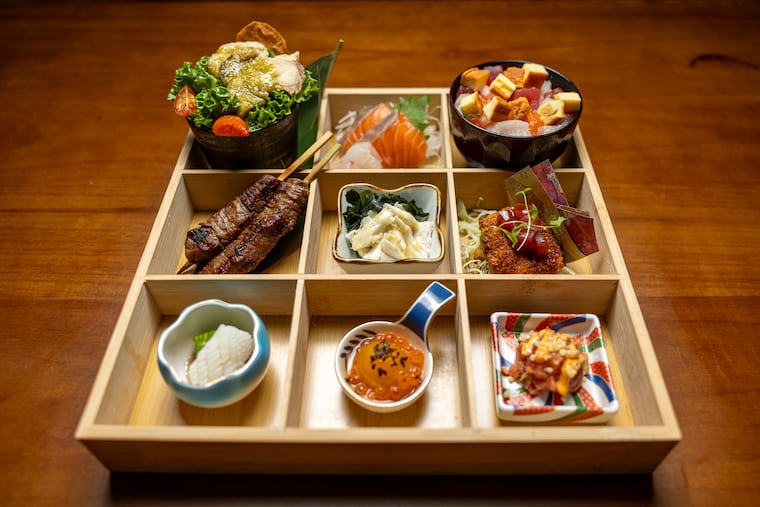
The moriawase box at Kissho House is my kind of combo platter. This wooden tray is divided into nine cubbies filled with Japanese delights — an edible treasure hunt of textures, temperatures, and tastes.
I found crispy-tender fried octopus nestled into salad greens in the top left nook, while another corner held a mini-chirashi bowl of warm, lightly seasoned rice scattered with jewel-like cubes of fish. There were skewers of tender Wagyu tri-tip, still hot from the robata grill, perched beside compartments of cool crab salad in creamy yuzu-miso dressing, a homey warm potato croquette, and a brilliant orange sphere of kombu-cured Jidori egg yolk topped with saline salmon roe beads.
There were two more alcoves of excellent fish: lusciously thick slices of kanpachi and salmon sashimi, plus a vinegar-tanged yellowtail sunomono. Those fish, among other box components, vary depending on whatever’s currently inspiring chef and co-owner Zhengmao “Jeff” Chen at his sleek omakase counter in the Locust Street basement below his ground-floor izakaya, where the moriawase is served for $70 — easily enough for two to share as part of a larger meal.
You can spend even less at the izakaya and put together a fine à la carte meal of charcoal-cooked meats, stir-fries, and raw seafood platters. The fried monkfish nugget riff on karaage (traditional chicken is available, too), spicy salmon tartare with crisp nori chips, and juicy koji-marinated lamb chops off the grill might be my low-key midweek choice. A warm rice bowl topped with a slow-simmered gyudon of shaved beef and pickled red ginger is a satisfying comfort lunch for $20.
You will pay much more for one of the eight seats in Chen’s subterranean lair, where the 18-part omakase runs $150 — not including drinks like an old-fashioned made with Japanese whiskey, ginger syrup, and smoke, or the junmai daiginjo and nigori sakes. That’s a lot for dinner by any measure, but it’s actually midrange in the current omakase boom, where the sub-$100 bargain menus are often blow-torched style over substance, and the elite counters cresting the $200-to-$300 watermark (Royal Sushi, Ogawa) are so coveted that reservations are exceedingly rare.
Kissho House is not the most surprising or stylish new omakase I’ve visited in the past few months. My biggest eye-opener was a tasting of rare fish beside a bail bonds office at Nakama on North 13th Street, where I feasted on giant squid and Japanese sea snail dabbed in its own liver in the shadow of the municipal criminal justice center. The coolest design detail was a bookcase at the back of a bar in Northern Liberties; it opens onto the hidden omakase room of 637 Philly Sushi Club, the latest counter stop for peripatetic chef Kevin Yanaga’s “Big Daddy” roll and generously garnished nigiri parade, tucked inside the pub-like confines of his self-named Yanaga Kappo Izakaya.
By contrast, there’s an air of no-gimmicks accessibility, paired with high-quality ingredients and outgoing service, that keeps drawing me back to Kissho House, on Locust just west of Broad. The chef and his partners, Rainei Chen and Qifan Chen (no relations between the three), have done a solid job renovating the former law office into a warren of dramatically lit rooms framed with Japanese-styled wooden grids, dark tile, and stone.
They have also fortunately landed in one of the few remaining pockets of Center City without a destination omakase. Yes, the wider neighborhood is experiencing a bump of intriguing Japanese newcomers with the recently opened dancerobot (Jesse Ito and Justin Bacharach’s retro Japanese diner, which is already booked a month out) and a forthcoming branch of the splashy Texas-based chain Uchi. But until recently, the only genuinely high-quality sushi option in this otherwise posh dining district has been the stalwart Zama on Rittenhouse Square.
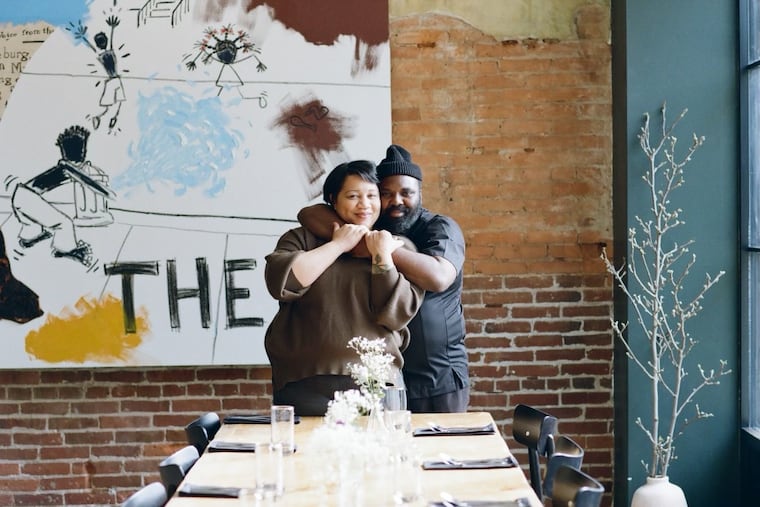
Kissho House now fills that niche. Chen, 42, who moved to the United States from Southeast China over two decades ago, has trained at every level of this field for years, working for relatives from Lansdale to Baltimore before opening his own place in Northeast Philly, Ume No Hana (now closed), then cheffing at Mount Fuji in Ardmore for three years until 2019.
Chen subsequently took major steps to improve his skills by working with some of Philly’s best. He studied the elements of omakase tastings and learned to cut and care for the highest-grade fish at Royal Sushi & Izakaya, then went to Hiroki, where he refined his techniques with rice — the oft-overlooked building block that is a true sign of a sushi chef’s skill. Not only must they season that rice properly with select vinegars to allow the fish on top to shine, but a deft touch is required to sculpt the grains for nigiri so they hold together — but not too much.
“You want to put air into the rice,” says Chen, who says the oxygen helps amplify the flavor of the fish on top. “But when you reach for the fish, you feel like the rice and fish are one.”
Chen’s instincts for pacing and flow are obvious as his omakase tasting glides gracefully from bite to bite, building from the perky brightness of a sweet scallop and madai red snapper splashed with citrusy sudachi ponzu to the marine richness of creamy sea urchin over a plump Kumamoto. Diners linger over a cool summer chalice of silky corn mousse laced with noodle-like mozuku seaweed before a classic warm course of sweetly roasted black cod announces the nigiri to come.
That’s when you’ll see Chen’s rice game. He modulates the temperature for every piece, choosing slightly cooler rice for lean fish like the kelp-cured kinmedai. Fattier fish benefit from warmer rice that he believes accentuates richness — shima aji striped jack, a toro belly with caviar, and an intricately scored, lightly torched sanma pike mackerel cradling a flavorful nugget of shichimi. Chen retreats briefly to moderate temps for an interlude of snow crab salad blended with a miso made from its own innards, then returns once more to warm rice as shaved truffles tumble down from the grater onto a nigiri wrapped in A5 Wagyu layered with the unexpected crunch of deep-fried baby sardines.
Once we devoured the velvety anago sea eel glazed in sweet brown sauce (reduced for 10 hours from the eel’s bones), followed by a toro hand roll wrapped in snappy crisp nori, and then finally sweet-tart passionfruit cheesecake, we were thoroughly satisfied.
Chen, serious and focused behind the counter, is not yet the showman, like some of his competitors. But the quality is there for one of the best $150 omakases I’ve had in a while.
It is Kissho’s ability to step beyond special-occasion destination status and fill the role of a more casual neighborhood Japanese haunt, however, that makes it such an asset, especially as a promising new pretheater option. There were date-night duos galore in the izakaya sharing platters of premium nigiri, mango-wrapped maki, and gyoza dumplings embedded in a plate-size cracker of sheer pastry.
A pair of post-college friends beside us grazed on an eel-topped unagi don rice bowl as they sipped through a rainbow of colorful cocktails (a matcha-green Roku gin martini and an orange-hued mango-tequila brew garnished with mango pearls). I plan to return to general manager “Billy” Zheng’s bar near the entrance to sample his growing collection of Japanese whiskeys.
My hungry table, meanwhile, explored the à la carte kitchen’s range, from the pickle deftly “snake cut” into a foot-long slinky to an excellent agedashi tofu stacked carefully above a pool of mentsuyu broth for maximum dipping pleasure. The “nigiri fantastic” platter is a $46 fish-centric alternative to the moriawase that gives you a more traditionalist glimpse of the quality fish being cut here. A truffled Wagyu short rib fried rice special came with a refreshing garnish of butterleaf lettuce for wrapping, with a side of the spicy Szechuan bean paste doubanjiang that I dabbed on each leaf for an extra spark.
I kept ordering items off the charcoal-fired robata grill: moist chicken thighs bundled on skewers around scallions glazed in tare sauce, a crispy-skinned fillet of mackerel, a melty hunk of eggplant glossed in garlic miso, surprisingly juicy shiitake caps, and a sublimely sweet butterflied Madagascar prawn.
Perhaps the most telling example of Kissho’s worth was the simplest dish possible, made for a guest in my party with a temporarily restricted diet: a basic stir-fried rice topped with two skewers of juicy chicken. She savored every bite while I enthusiastically nibbled through the intricate details of my moriawase box.
I was reminded that sometimes valuable restaurants are defined by the small things they do as much as their grandest gestures. My guest, polishing off her chicken skewer, clearly agreed: “It was perfect.”
Kissho House
1522 Locust St., 610-332-7387, kisshohouse.com
Open Sunday, Tuesday through Thursday 11:30-10 p.m., Friday and Saturday until 11. Closed Monday.
Wheelchair accessible on ground floor only, though special accommodations can be made for a modified omakase experience with advance notice.
Not suitable for gluten-free diners.
Drinks: The bar is stocked with over a dozen Japanese whiskeys and quality sakes by the glass, and also makes colorful Asian-themed cocktails — scattered with mango pears, infused with matcha, wafting ginger smoke — that are better than they have to be.
Menu highlights: Omakase — oyster and sea urchin; corn mousse; kinmedai; sanma; Wagyu nigiri with fried baby sardines; anago. Izakaya — monkfish karaage; spicy salmon with nori chips; robata skewers (chicken-scallion, lamb chop, prawns); Wagyu fried rice; gyu-don; nigiri fantastic platter.