Philly bar legend ‘Fergie’ Carey is taking over Mac’s Tavern in Old City
The ‘It’s Always Sunny in Philadelphia’-owned bar is getting a deep clean and a Irish-Scottish menu from the owner of Fergie’s Pub.
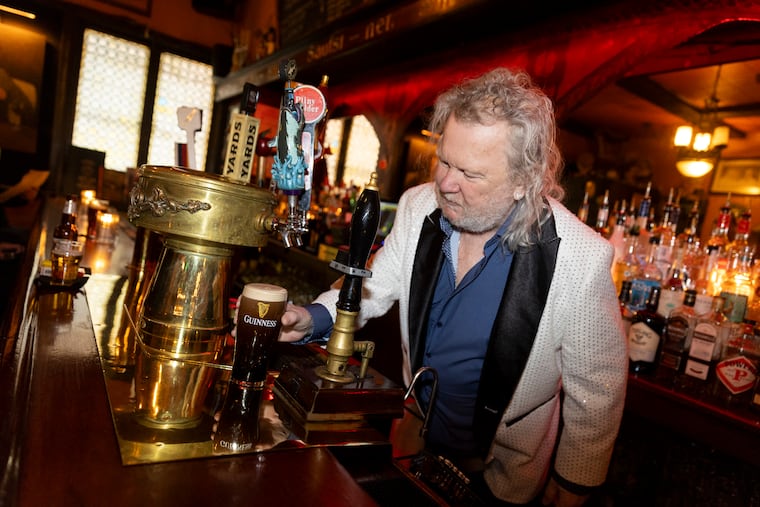
Fergus Carey, arguably Philadelphia’s best-known barman, is expanding his empire.
Carey and business partner Jim McNamara, who own the popular Fergie’s Pub in Washington Square West, the Jim in South Philadelphia, and the Goat Rittenhouse, are taking over the shuttered Mac’s Tavern at 226 Market St. in Old City.
Mac’s — whose ownership roster included the South Philadelphia-raised actor Rob Mac (the former Rob McElhenney) and his wife, Kaitlin Olson, of TV’s It’s Always Sunny in Philadelphia fame — closed last summer after 15 years.
Carey said the name was not final, but the concept will be a Celtic pub with Irish-Scottish food — “our usual stuff.” Opening is penciled in for the spring. He described the work ahead of them as “more of a cleanup and opening up than a full renovation.” They want to open at noon weekdays but earlier on the weekends for European sporting events.
Carey has spent three decades shaping the city’s bar culture. Known to generations of Philadelphians simply as Fergie, his trademarks are his Irish accent, an encyclopedic memory for names, and a knack for turning strangers into regulars.
Born in Dublin and raised on the city’s north side, Carey left for the United States in 1987 at age 24, armed with a background in hospitality and fast-food management, including a stint running a fast-food shop called Burgerland. His first U.S. stop was Houston, but he left after a few weeks because, he said, he hated it. He likes to tell the story that he arrived in Philadelphia on a Saturday night and started a job at the Cherry Hill Mall food court at 9 the next morning.
He landed behind the bar at McGlinchey’s on 15th Street, quickly earning a reputation as a natural host.
In 1994, Carey and business partner Wajih Abed opened Fergie’s Pub at the old Hoffman House on Sansom Street in Washington Square West, at a time when Center City nightlife was thin and new bar openings were rare. The pub’s easygoing, come-as-you-are atmosphere helped spark a revival of the neighborhood’s drinking scene.
Carey went on to play a role in launching some of the city’s most influential beer destinations, including Monk’s Café, the Belgian Café, and Grace Tavern — each helping introduce Philadelphia to Belgian ales and European café culture long before craft beer became mainstream. He also ran Nodding Head Brewery and the Fairview.
