Robots run the kitchen at this new Chinatown restaurant
InstaFoodz is more than a restaurant, say Kenny Poon and David Taing. They want to sell the technology and their expertise.

When he was a boy in Hong Kong, Kenny Poon loved to watch Japanese cartoons, and remembers being transfixed by a scene of a restaurant kitchen staffed by robots.
“I said, ‘I’m going to open a kitchen like that one day,’” said Poon. He is now 47, and technology has caught up with his childhood dream.
InstaFoodz — which had its grand opening at noon Sunday at 1023 Arch St. — is actually three tech-powered brands under one roof: WokBot, whose Chinese menu is prepared in a robot cooker; Tap Tea, which uses a robot to create bubble tea drinks; and InstaNoodz, a self-serve ramen counter.
InstaFoodz also houses a pop-up version of Drip Vietnamese Cafe, a new nearby coffee shop, that is staffed by multiple humans. (“In the future, I want to franchise it,” Drip owner Tiffani Nguyen said. “I thought, ‘Let me see what it’s like to have two shops and see if I can handle it.’ It’s a test for me.”)
This mini-food hall is set up in the front of the Ebisu Japanese Life Store, which Poon and his business partner, David Taing, opened two years ago. A Mochinut shop was initially in the space.
Poon has always been an early adopter. In 2012, he caught America’s nascent bubble-tea craze and opened the first of nearly a dozen Tea Do locations with relatives. Through the years, he and the Toronto-born Taing, 45, have collaborated on a string of eateries mainly in Chinatown and University City, including Chinatown Square food hall, Lion Sports Bar, Tango, Miss Saigon, Chinatown Beer Garden, XOX Lounge, three BonChon locations, and two Paris Baguette franchises.
But InstaFoodz is more than a restaurant play. Poon, Taing, and a third partner, Allan Xu, view it as a showroom for the robotic equipment, especially the Next Robot food cookers, dubbed “Robby” by the machines’ Chinese manufacturer. They plan to sell the equipment, packaged with their consultancy services, to folks like convenience-store operators who might not have a full kitchen or access to trained cooks.
The training is key, said Poon, who for two years shuttled back and forth to the manufacturer’s representative in California, where he worked with a company chef and learned to adapt his own recipes and, in effect, program Robby.
The company representative “explained to me things like, how many grams, how much salt, how much soy sauce go into a dish,” Poon said. “You don’t learn this automatically.”
The $35,000 AI-controlled Next Robot machines stand about 5 feet tall, including its base. It functions as a wok, even rotating, but looks like a pot. The cook — and that’s a loose term here — taps the name of the dish from a menu on the screen. Robby heats the pot to the correct temperature, directs the cook to add proteins, noodles, and vegetables at specified times, and automatically adds spices, sauces, and starch water. Robby’s arm stirs all the while. One pot can handle 17 pounds of food, making it ideal for large orders, Taing said.
Poon and Taing are installing three Robbys in a WokBot location they are opening this fall in the Marketplace at the Comcast Center.
Perhaps the robots really are poised for a restaurant takeover. They’re already roaming dining rooms, delivering food, and whisking dishes to the kitchen. Robby isn’t even the only robotic cook. Brennan Foxman of Wokworks is developing a robot named Wendy to create stir-fries at his new location, opening soon in Bryn Mawr.
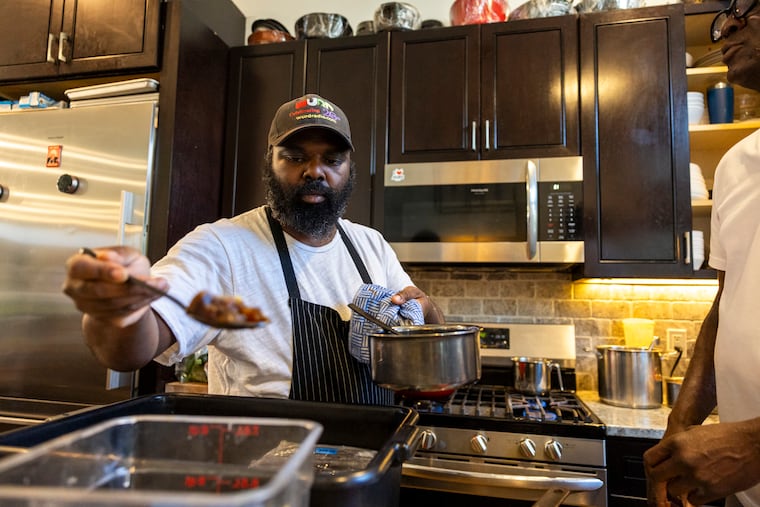
Poon demonstrated Robby the other day by whipping up an order of yi mein, a Cantonese dish also known as E-fu noodles or “long-life noodles,” generally served as a birthday treat.
Poon tapped the yi mein icon on Robby’s menu screen and dropped pre-deep-fried noodles into the pot. Robby began steaming them. The timer told Poon when to add chicken, shrimp, and bok choy as Robby stirred, before tilting upright to squirt in soy sauce, oyster sauce, and sesame oil. In three minutes, the yi mein was done. Poon slid the dish into a takeout container, and Robby went into its self-cleaning cycle to await the next order.
At $8, the yi mein was priced at the low end for Chinatown. “It’s easy to do that, too,” Taing said. Even with the need to prep ingredients, “our labor [cost] here is so low.” (They do employ a human dumpling maker, unlike a nearby restaurant that has a dumpling robot in the back.)
Tap Tea’s bubble-tea machine is a tabletop unit that houses sugar, water, boba, and flavors. The “bobarista” just punches buttons and inserts the completed drink into a machine that applies a plastic film to seal it.
For the InstaNoodz counter, Poon and Taing bought three induction kettles ($1,000 each) that let you adjust the broth and noodle consistency to your liking. The walk-in customer buys one of two dozen ramen packets ($5) from a wall display, adds the noodles to a bowl, and sets it into the machine.
Water flows into the container. Three minutes later, the water boils and the customer stirs in the seasonings.
Toppings (50 cents or $1 extra) such as crab sticks, corn, and bamboo shoots are stored in an adjacent refrigerator. There’s a counter and stools for eating.
InstaFoodz, 1023 Arch St., Philadelphia, PA 19107. Hours: 11:30 a.m. to 8 p.m. Monday, Wednesday, and Thursday and 11 a.m. to 10 p.m. Friday to Sunday. Closed Tuesday.