Some restaurateurs are coping with rising food prices by charging you less. Here’s how that works.
Harvest Seasonal Grill, a regional restaurant group, says cutting prices has boosted customer counts and profit. At Mission Taqueria, menu engineering allows it to hold the line.
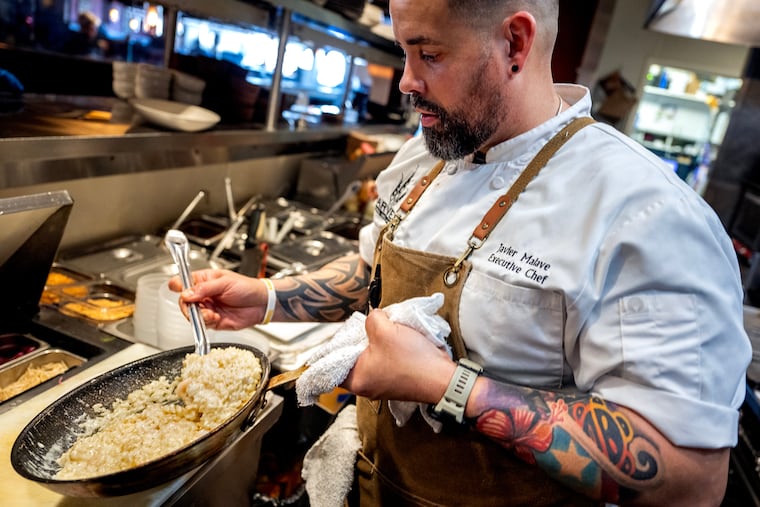
Restaurant diners are eating less, ordering fewer drinks, skipping dessert, and, in many cases, dining out less often altogether.
For restaurants, however, the cost of doing business has not come down. Labor prices are up. So are food prices, particularly beef. Rents continue to climb. But the old solution — raising menu prices — has become increasingly risky as owners worry about alienating customers who are already cutting back.
This was happening at Harvest Seasonal Grill, a farm-to-table bar-restaurant with eight locations between Lancaster and Moorestown. “Every time check averages went up, guest counts went down,” said founder Dave Magrogan. “Revenue stayed flat, but we were serving fewer people.”
Rather than raising prices further or shrinking portions, Harvest moved in the opposite direction last summer. First, the restaurants added a lower-priced, three-course supplemental menu, which Magrogan said caught customers’ attention.
Then last fall, Harvest cut prices across the board while tweaking dishes to eliminate frippery like microgreens and most garnishes, which Magrogan said customers pushed to the side of the plate anyway.
The seared scallops had to go. As recently as a few years ago, Harvest offered four New Bedford scallops — the picture-perfect, 10-to-a-pound “U-10” beauties — atop a pool of risotto for $34. When the wholesale price began creeping up, Harvest bumped it to $38. When another price increase took it to $43, Magrogan said, “guests complained: ‘Four scallops for $43? I don’t see the value.’”
» READ MORE: Smaller portions, fewer second drinks: How restaurateurs are adapting to changing consumer trends
Harvest chief operating officer Adam Gottlieb said the company went back to its seafood supplier, who offered scallop pieces — the same scallops, though broken during harvesting — for about half the price. “Instead of putting these seared scallops on top of the dish, we sear the pieces, fold them into the risotto, and make a shrimp and scallop risotto that we can offer for $34 instead of $42,” Gottlieb said. “Guests like it more, and it sells for less.”
Harvest also changed its prime steak. “For a while, we were buying individually cut steaks from a big farm operation with a great story behind it [Niman Ranch],” Gottlieb said. “But the prices kept climbing. We found a purveyor that sources all-Pennsylvania prime beef, and now we’re bringing in New York strip loins instead of individually cut steaks. By buying whole loins by the case, we’re able to lower the cost of the dish and use the byproduct for other menu items.”
Harvest’s across-the-board price drop was scary at first, Magrogan said. Check averages dropped from $44 to $36 while guest counts remained flat.
But then, word spread of the lower prices. Traffic is up 10% to 14% year over year while check averages have crept back up into the high-$30s, Magrogan said. “Revenue is up. Profitability is up. And we didn’t sacrifice quality.”
At Mission Taqueria, a second-floor cantina above Oyster House near Rittenhouse Square, owner Daniel McLaughlin has done his own version of what he calls “menu math,” weighing customer psychology against volatile ingredient costs. Like every owner of a Mexican restaurant, he accepts the yo-yo of avocado prices: When they’re reasonable, he’s doing well; when they’re high, he must absorb a loss.
Tacos, the menu mainstay, he said, are especially tricky. Diners have firm price expectations, regardless of what the ingredients actually cost — even as beef prices are up by double digits in the last year.
At its opening a decade ago, Mission charged $14 for two carne asada tacos. They’re now $18 — a 29% rise, but below the estimated 47% inflation over that time.
“Carne asada was our top-selling taco last year, but you can only charge so much for a taco,” McLaughlin said. “
Each taco has 3 ounces of beef. “The same portion of protein somewhere else, like in a steakhouse served as an entrée, would be totally justifiable at $28 or $32,” he said. “But because it’s in a tortilla, people flinch.”
To keep costs in check, McLaughlin and his chefs rethought the beef. Mission previously used sirloin for its carne asada but last year switched to chuck roll, a cut from the shoulder. “It actually eats better as a taco,” he said.
The kitchen still serves seared steak as an add-on for salads, but now economizes by buying whole sides and breaking them down. Aside from the chuck roll, other cuts are used for slow-cooked dishes like barbacoa and birria.
The upshot: Mission is charging less for carne asada tacos, relatively speaking, but is making a bit more money. And traffic counts are similar.
The menu engineering around beef trimmings has factored into Harvest’s moves, as well. Some finds its way atop the chain’s flatbreads, and even becomes the centerpiece of a new dish, Korean-style tacos. “It looks impressive, and it’s become one of our most popular items,” Gottlieb said.
“The labor part isn’t as complicated as it sounds,” Gottlieb said. “Kitchen work has always been about minimizing waste and being smart with product.”
A big part of the changes was to make Harvest feel accessible again, Gottlieb said. “I said to Dave, ‘I’m a middle-class guy, and I can’t afford to eat at Harvest as much as I’d like right now. It’s $100 for two people, and I can’t do that on a regular basis.’ Before the price increases, you could get in and out for about $67. The goal was to get back to that — to stop being a special-occasion restaurant and become a place people could think about for regular dining.”
Magrogan said: “The goal is to serve more people, not fewer. You can’t price yourself out of relevance. If guests feel taken care of, they come back — and that matters more than squeezing every last dollar out of a single check.”