Has Sweet Amalia outgrown the Pinelands? How septic rules and red tape put its summer on hold.
When the celebrated oyster stand and eatery along Route 40 announced it wouldn’t be opening as usual, its customers despaired.
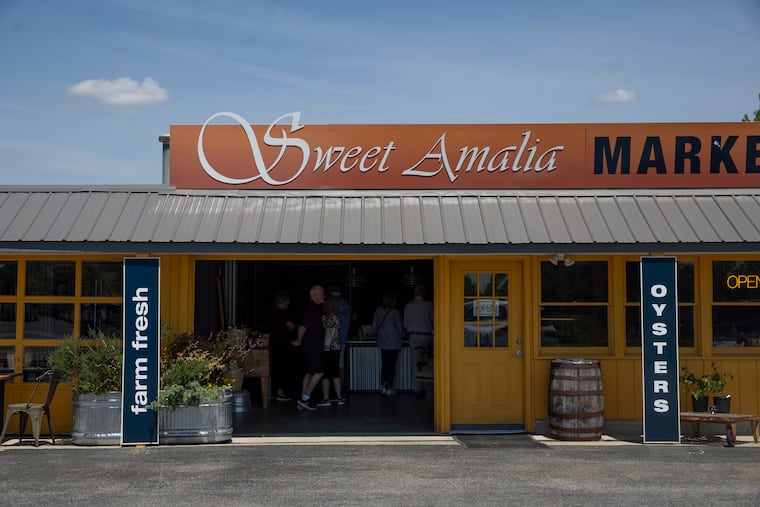
NEWFIELD, N.J. — If the cute mango yellow farm stand that morphed over the last decade into the acclaimed Sweet Amalia Market & Kitchen were located on the other side of Route 40, there wouldn’t be these problems.
That side of the street is outside the boundary of the 938,000-acre Pinelands area of South Jersey. So there would be no Pinelands-related interruption to the “dreamy” seasonal oyster slurping and Farmstand Italian sub savoring (pistachio mortadella, soppressata, mozzarella, Parmesan) offered by Sweet Amalia.
But, as Sweet Amalia fans are aware, the nationally celebrated, if obscurely located, eatery on the way (kind of) to the Shore announced April 6 that roadblocks with Pinelands regulations left it unable to open as usual this season.
“While we are eager to open our doors, we must wait on seating approvals,” Sweet Amalia wrote on Instagram. The owners had been asked to remove the picnic tables used and be takeout only. They chose to remain closed.
The reaction from those who have made a Sweet Amalia pilgrimage a beloved summer rite was faster than it takes to swallow one of the Delaware Bay buttery oysters farmed on the Cape May Peninsula by partner Lisa Calvo.
“Maybe if you change your name to Sweet Amalia Data Center they would be more willing to approve?” commented one person, a reference to the controversial data center in nearby Vineland (outside the Pinelands).
As it stands, along that stretch of rural road a couple of miles from another Route 40 landmark, the St. Padre Pio Shrine, Sweet Amalia remains closed.
Chef Melissa McGrath said Sweet Amalia chose not to open this season as takeout only, as the township and county would have allowed. “A lot of the menu items are meant to be enjoyed right away,” she said.
Is there hope for oysters this year?
We pried open the bureaucratic oyster shells of this impasse to find out what’s going on and which solutions seem within reach. (Spoiler: It’s about nitrate dilution.)
Is it really about the picnic tables?
The underlying issue, while triggered by Sweet Amalia becoming a place with seating, is more complicated than picnic tables. It’s about septic systems. And bureaucracy.
The New Jersey Pinelands Commission and Franklin Township both note that when Calvo originally bought the farm stand, she used the building, halfway between Cape May and Philadelphia, as a distribution and storage hub for her oysters. Food service use was added to the property by the previous owners in 2015, according to co-owner of Sweet Amalia Ed Pappas, but when Sweet Amalia added seating, no application was ever made to the Pineland’s Commission. Sweet Amalia did however, secure local zoning and county health approvals prior to opening.
“What we’re trying to do is resolve an issue where a restaurant was established in a farm market without application to the Pinelands Commission,” said Chuck Horner, the commission’s director of regulatory programs.
In 2023, Sweet Amalia shut down after township officials flagged the indoor seating but was allowed to reopen two days later with just patio seating, and trailer porta-potties.
But porta-potties, it turns out, were not a permanent solution.
The impasse, years of asynchronous correspondence in the making, is over septic dilution standards for the 1.31-acre property that sits atop the Pinelands’ massive Kirkwood-Cohansey aquifer, which is the groundwater supply for a million residents and visitors.
Franklin Township does not have municipal water or sewer, which means Sweet Amalia has to provide its own septic system that will not pollute the groundwater.
Pinelands Comprehensive Management Plan groundwater quality standards require that the concentration of nitrate in groundwater from development ”not exceed 2 ppm [parts per million] at the limits of the property.”
The standards are designed to keep the groundwater pure and drinkable. Changing the relatively small property’s purpose to a sit-down restaurant put Sweet Amalia out of compliance.
Regulations require them to file a formal application and come up with a solution. That could mean a septic-dilution system that treats the wastewater, and which Sweet Amalia says could cost as much as $600,000.
“We’ve been working with them,” said Matt Finley, Franklin Township’s administrator. “We were not blessing it, we were also not enforcing. It got to a point where it had to stop. It’s going to impede us if we have to enforce anywhere else in the township.”
On the same page?
All parties agree this is not a frivolous issue, especially to those concerned about preserving the Pine Barrens, a group in which the owners of Sweet Amalia include themselves.
“I’m sure the neighbors would want to know if the neighbors are protecting the groundwater,” Horner said. “They’re all served by wells.”
At the Pinelands Alliance, a Pinelands advocacy group, there is sympathy for Sweet Amalia’s difficulties navigating complicated regulations, but a recognition that the septic issues are more than just picnic tables.
“You couldn’t have oysters in New Jersey without these rules,” said Jason Howell, public lands advocate for the Pinelands Alliance. “The rules show this is working. The application of these is the problem.”
Pappas says he, Calvo, and McGrath want to meet those regulations.
Pappas noted that reducing nitrate pollution is what their oyster farming is already doing over on the bay. “The oysters serve to clean up that pollution,” Pappas said. “We’re on the same page.”
Sounding the alarm
Sweet Amalia sounded the alarm and pleaded its case April 10 at a New Jersey Pinelands Commission meeting, which was the first time the commission staff brought the Sweet Amalia situation before the board as one of its monthly “notable cases.”
Pappas warned of “real consequences” to the South Jersey destination.
“We’ve now been in this process for more than three years,” he said. “We’ve been unable to fully operate on this site. We’re asking for clarity, consistency, and a path forward.”
McGrath described the “very unexpected” way Sweet Amalia grew.
“Sweet Amalia Market started as something very simple: a small farm market, a few tables, a passion for oysters and local food,” she told commissioners. “We built it completely ourselves, step by step, into a place people could stop, gather, and experience something uniquely South Jersey.”
Commission members worried aloud about misinformation and those social media comments about data centers. Sweet Amalia owners huddled with a commission staff member after the meeting and agreed to meet again, Horner said.
Finley, the administrator, said, Franklin Township understands Sweet Amalia’s unique standing in the community. “That’s why we’ve tried to work with them. … We know they’ve become kind of a niche restaurant and we support that. We can’t allow the rules to be continually broken. It creates chaos as a municipality.”
The regulations can be difficult. Every tweak, like parking improvements or solar panels, triggers additional approval processes. Every change in plans triggers additional information requests.
What’s next?
The commission notes, again and again, that Sweet Amalia was established in a former farm market building and became a commercial restaurant without application to the commission.
McGrath and Pappas acknowledged that it has taken them time and money to put together the professional team of engineers and attorneys to complete the application, answer questions, and address the septic and other requirements.
Pappas noted that the business began during the COVID-19 pandemic, when officials were less inclined to quibble over outside seating.
“It was obviously a period of great disruption,” he said. “It was hard to have a fulsome zoning process during that time. It was difficult to secure an engineer.”
Heidi Yeh, policy director with the Pinelands Alliance, says the slow process is partly due in an understaffed commission that can take months to reply to every correspondence.
(The governor’s press office referred a message seeking comment about Sweet Amalia and the New Jersey Pinelands Commission staffing back to the commission.)
“Part of the delay is just the inherent speed of working with the Pinelands commission,” Yeh said. “It has taken us years just to get an accessible trail around a lake approved. It could take months between iterations of a plan to have the Pinelands commission staff review it again.”
What about the Purple Penguin?
Sweet Amalia has proposed various solutions since making a formal application for approval in 2023, with changing plans on how to include an adjacent property it owns: the old Purple Penguin Frozen Custard Stand, which predates the New Jersey Pinelands Commission. That would make the property 2.59 acres, and help with the septic dilution calculation.
In some plans, Sweet Amalia would be serving ice cream from the Penguin; in others, the Purple Penguin houses a new wastewater treatment system.
“We’re really dedicated to meeting these standards,” Pappas said. “We know the Pinelands are a great treasure, and that’s what we’re all about: local treasures.”
Even about the former frozen custard stand, Yeh said, there have been “complications and confusion.”
“Although Sweet Amalia wanted to maintain this as a separate building for serving ice cream, there have been iterations where they demolish it, and now they are exploring repurposing it to serve as the control room for the new septic system and bring that $600K cost down,” Yeh said.
Yeh cited another Franklin Township case where she has urged the commission to work faster: the clearing of about 50 acres of Pinelands property owned by township Committeeman Timothy Doyle.
Yeh said she alerted the commission back in June 2025, when the clearing was about 15 acres, but its first action was not until March, when the clearing had expanded to 50 acres.
Doyle, who did not respond to a message seeking comment but whose reelection signs dot the street near Sweet Amalia, has told regulators that the clearing is allowed under an agricultural exemption. The commission is looking into whether that is the case, Horner said.
An evolving solution
A review of recent correspondence between New Jersey Pinelands Commission staff and Sweet Amalia engineers and lawyers, provided to The Inquirer by the Pinelands Alliance and the commission, shows repeated information requests, Sweet Amalia’s changing plans, and little progress.
One plan to buy adjacent land to expand the overall footprint fell through in late 2025.
On April 23, Horner, the regulator, said the commission was still waiting for answers to questions about Sweet Amalia’s plans and maximum daily usage, sent to them April 9, including information previously requested back in October.
An evolving solution is the high-tech septic treatment system that could cost as much $600,000, a price chef McGrath and Pappas told the commission is unrealistic.
But Horner said the system, common throughout the Pinelands, could be installed for $75,000 to $100,000.
And in an interview on April 22, Pappas said Sweet Amalia was again looking at this system.
Horner said the next step remained the same. “The most straightforward path, in my opinion, is to give us the information we’ve asked for,” he said.
Will you be able to slurp oysters on Route 40 this summer?
Both sides seem to think things can be resolved in time to save the season.
Although the Sweet Amalia principals have looked at other locations over the years, Pappas said, they are committed to the quirky Pine Barrens location, five minutes from where Calvo grew up and still lives.
They would like to eventually open 11 months out of the year, with indoor and outdoor seating.
“We love that property,” Pappas said. “It really came together in what we think is a magical way. That authenticity, you can’t buy that.”
They have learned the hard way, though, that New Jersey definitely can regulate it.
“None of us were expecting it to become what it’s become,” McGrath said. “The national press and accolades have been great. We want to get back to feeding people.”

- 15 places that prove Lancaster’s food scene is in full bloom
- My boyfriend took me to his ex's restaurant... three times. Am I part of a psychological experiment?
- His out-of-pocket costs were only $1,400 for this four-bedroom home in Brewerytown | How I Bought This House
- Sixers Game 7 or Flyers Game 1? Philly has a problem. | Weekly Report Card
- A no-traffic Shore escape on Absecon Island | Field Trip
- The best things we ate
- Citywide Quest: Where were the Broad Street run photos taken?
- How to have a Perfect Philly Day, according to Gilda’s Brian Mattera
- See it, hear it, feel it: All the Philly art we loved this week
- The case of the missing elk statue