Health officials urge vaccination as flu cases surge in Pennsylvania
Cases in late December hit higher counts locally and statewide than at this time the year before, according to city and state data.
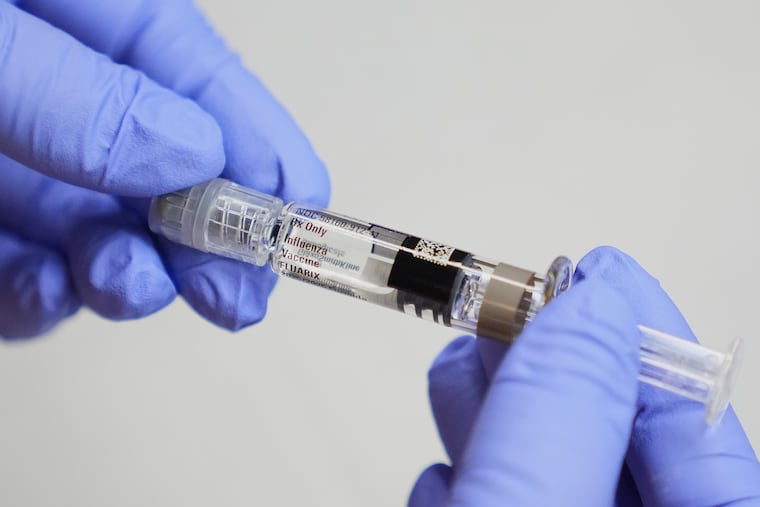
More Philadelphians are visiting emergency departments with the flu than a year ago, as cases are surging across Pennsylvania.
Flu cases in late December hit higher counts locally and statewide than at this time last year, according to city and state data. It’s too early to say whether flu has peaked for the season, or whether cases will continue to rise, health officials say.
Philadelphia-area physicians say they’re dealing with an increased flu caseload, including patients suffering from severe complications.
COVID-19 and respiratory syncytial virus (RSV) cases are also rising, but flu is the biggest concern right now, said Brett Gilbert, Main Line Health’s infectious disease chief.
“We’ve been fighting COVID for the last five years, while flu took a back seat,” he said. “But flu is in the driver’s seat this year.”
One reason for the high number of flu cases this early in the flu season, which runs from winter to early spring and typically peaks in December to February, is a new flu variant that emerged this summer.
World health experts meet twice a year to determine which flu variants are circulating and recommend seasonal flu shots to target them.
The variant causing the most cases right now, subclade K, was detected after flu shots for the Northern Hemisphere had already been selected this year, Gilbert said. “There is some degree of vaccine-disease mismatch,” he said.
But that doesn’t mean that the current flu vaccine is not effective, especially in preventing hospitalizations and deaths.
“It may not be so great at preventing the illness itself, but [with a vaccine], it may be a mild illness, easily treatable with antivirals or supportive care,” Gilbert said.
Flu in children
Just over half of Pennsylvania children were vaccinated for the flu this season, according to federal surveys, slightly up from last year’s rates.
Childhood flu vaccination rates in Philadelphia were even higher than the statewide rate, with about 56% of children vaccinated this season.
Some of the most serious cases of flu that pediatrician Daniel Taylor sees are among unvaccinated children.
At St. Christopher’s Hospital for Children, where Taylor sees patients, the outpatient sick clinic is filled with children with severe cases of flu and RSV.
Some are suffering from dehydration and require care in the ER at the North Philadelphia hospital.
Taylor stresses the risk of serious complications from the flu in conversations with parents about vaccination. (Taylor also regularly writes about his experiences as a physician for The Inquirer.)
The flu can trigger severe health crises that can cause brain damage or temporary paralysis from inflammation of the spinal cord. Taylor has seen two children this flu season with benign acute childhood myositis, a rare complication of an upper respiratory infection that causes swelling and muscle damage in the legs, and in even rarer cases can lead to kidney failure.
“They’re not able to walk, and in so much pain from the swelling of the legs,” he said.
Nine children have died nationwide from the flu this season. The season before, flu deaths among children were the highest since 2004, when the Centers for Disease Control and Prevention began tracking them, the American Academy of Pediatrics noted. Among Americans of all ages, the CDC has estimated 5,000 total flu deaths so far this season.
Taylor said that President Donald Trump’s chaotic upheaval of longstanding vaccine policy — with the CDC changing recommendations around flu vaccines and slashing six vaccines from the routine childhood immunization list — makes it harder for physicians to help patients.
He said he had recently met with a mother who told him she’d previously vaccinated her children, but now was avoiding vaccines because she was “scared of giving her kid vaccines with everything going on in the government.”
“They hear something different from the government and the CDC, and they question the relationship” with their doctor, Taylor said.
He said parents can find trustworthy information about vaccination at websites run by the American Academy of Pediatrics and the Children’s Hospital of Philadelphia.
‘It’s never too late to get a flu vaccine’
Anyone who hasn’t been vaccinated for the flu still has time to get immunized. Flu season runs through May, and cases can occur year-round.
About 40% of Pennsylvanian adults and about 42% of New Jersey adults have been vaccinated for the flu so far this season, lower than in previous years and slightly below the national rate for the first time.
About 47% of Philadelphians have been vaccinated so far this season, above the national rate.
Patients who are feeling sick can get tested for the flu at a hospital or a doctor’s office, and home tests are also available. Antiviral treatments can help ease symptoms. Wearing a mask can also protect others from contracting the flu.
In Philadelphia, residents can get free flu and COVID vaccines at five health centers, and the health department regularly conducts vaccine outreach in the city, said Gayle Mendoza, a spokesperson for the Philadelphia Department of Public Health.
“People might say ‘We’re past the holidays, what’s the point in getting vaccinated?’” she said. “Sure, winter break is behind us, but the influenza virus is still forging ahead.”