Bailout gains, then falters
Congress calls it a night as talks stall
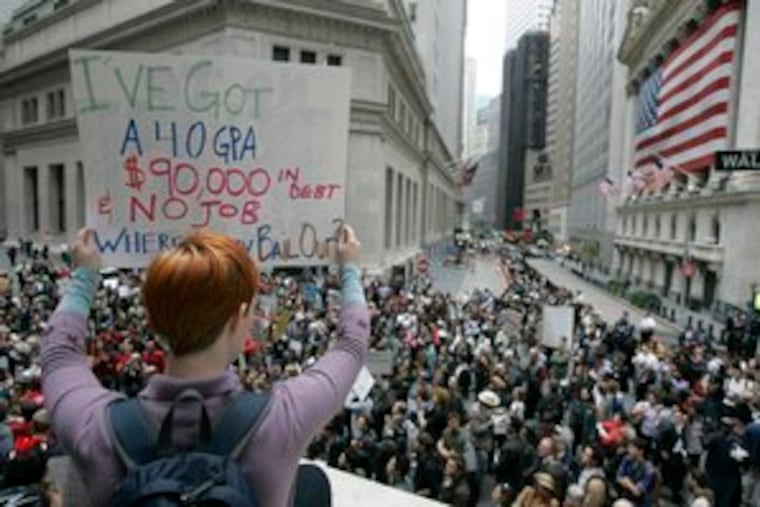
WASHINGTON - A Republican revolt stalled urgent efforts last night to lash together a national economic rescue plan, a chaotic turnaround on a day that had seemed headed for a success that President Bush, both political parties, and their presidential candidates could celebrate at an extraordinary White House meeting.
Weary congressional negotiators worked into the night, joined by Treasury Secretary Henry M. Paulson Jr., in an effort to revive or rework the $700 billion proposal that Bush had said must quickly be approved by Congress to stave off potentially "a long and painful recession."
They gave up after 10 p.m., more than an hour after the lone House Republican involved, Rep. Spencer Bachus of Alabama, left the room. Democrats blamed House Republicans for the apparent stalemate. Those conservatives have contended the plan would be too costly for taxpayers and an unacceptable federal intrusion into private business.
Talks were to resume this morning on the effort to bail out failing financial institutions and restart the flow of credit as the national economy begins to starve.
Yesterday's White House summit, bringing together Bush, presidential nominees John McCain and Barack Obama, and top congressional leaders, had been aimed at showing unity in resolving the crisis, but it broke up with conflicts in plain view.
After six days of intensive talks on the unprecedented package proposed by the Bush administration, with Wall Street tottering and presidential politics intruding six weeks before the election, there was more confusion than clarity.
Late yesterday, McCain's campaign said in a statement that the administration proposal "does not enjoy the confidence of the American people as it will not protect the taxpayers and will sacrifice Main Street in favor of Wall Street."
Key Democrats and Republicans had announced they had the outlines of a tentative pact at midday, just hours before the White House meeting. That agreement would have given the administration just a fraction of the money it wanted up front, subjecting half the $700 billion total to a congressional veto.
But conservatives were still in revolt, balking at the astonishing price tag of the proposal and the hand of government that it would place on private markets.
Inside the White House meeting, House Minority Leader John A. Boehner (R., Ohio) expressed misgivings about the emerging plan, and McCain would not commit to supporting it, said people from both parties who were briefed on the exchange. They spoke on condition of anonymity because the session was private.
McCain's campaign statement described the meeting as a "shouting match that did not seek to craft a bipartisan solution."
Sen. Richard C. Shelby of Alabama, the top Republican on the Senate Banking Committee, emerged from the meeting to say that the announced agreement "is obviously no agreement."
One group of House GOP lawmakers circulated an alternative that would put much less focus on a government takeover of failing institutions' sour assets. Their proposal would have the government provide insurance to companies that agree to hold frozen assets, rather than have the U.S. government buy the assets.
Rep. Eric Cantor (R., Va.) said the idea would be to remove the burden of the bailout from taxpayers and place it, over time, on Wall Street instead. Cantor later said the Treasury Department had rejected the insurance approach, Bloomberg News reported.
The price tag of the administration's plan and the federal intrusion into private business matters have been major sticking points for many Republican lawmakers.
"I'm feeling somewhat puzzled at this point," said Rep. Barney Frank (D., Mass.), the House Financial Services Committee chairman who has been leading negotiations with Paulson. "We're closer to a deal among the House Democrats, Senate Democrats, Senate Republicans and the administration. . . . We seem further away with the House Republicans."
"Sen. McCain and the president between them ought to be able to get House Republicans back to the table," Frank said.
There is wide agreement that the U.S. economy is in peril, with financial institutions going under or near the edge, and recession looming along with resulting job layoffs and increased home foreclosures.
Obama and McCain, who have both sought to distance themselves from the unpopular Bush, sat down with him at the White House for the hour-long session that was striking in this brutally partisan season - but also, according to one participant, "a full-throated discussion."
By also including Congress' Democratic and Republican leaders, the meeting gathered nearly all of Washington's political power structure at one long table in a small West Wing room.
McCain and Obama, in separate television interviews after the meeting, both said they still expected an agreement could be reached.
Obama said jobs, economic growth, retirement accounts, small businesses and financial markets would all be at risk without a bailout plan. "There are no good options at this point," he said. "There are bad options and worse options."
McCain said that he knew going into the meeting that progress was not as far along as it seemed. "There never was a deal, but I do believe the meeting was important to move the process along," he said.
Under the accord outline announced at midday among key lawmakers, the Treasury secretary would get $250 billion immediately and could have an additional $100 billion if he certified that it was needed. The approach aimed to give lawmakers a stronger hand in controlling the unprecedented rescue.
The government would take equity in companies helped by the bailout and put rules in place to limit excessive compensation of their executives, according to a draft of the outline obtained by the Associated Press.
The plan's centerpiece was still a government purchase of the toxic, mortgage-based assets of shaky financial institutions in a bid to keep them from going under and setting off a cascade of ruinous events.