A leak in Independence Hall
INQUIRER STAFF WRITER On most very rainy days, Charlie Tonetti leaves his house in the Italian Market, takes a bus to Independence Hall, unlocks the stately doors, and climbs a creaky staircase into the clock tower to watch wood.
INQUIRER STAFF WRITER
On most very rainy days, Charlie Tonetti leaves his house in the Italian Market, takes a bus to Independence Hall, unlocks the stately doors, and climbs a creaky staircase into the clock tower to watch wood.
"I may spend a few minutes or an hour," said Tonetti. The last time he went, "nothing happened."
As chief historical architect for Independence National Historical Park, Tonetti is responsible for the care and conservation of Independence Hall. For the last two years, he has been monitoring the slow and inevitable deterioration of one of the nation's most hallowed buildings - in particular, the upper levels of the clock tower.
"For a tower that was built in the 1750s and rebuilt in the 1820s, it's in very good shape," he said yesterday, leading reporters up the rickety stairs. But moisture seeps in between the wooden slats and is rusting the iron dowels that secure the walls from within. It is that rust, not the water, that is destroying the wood fibers, making some of the slats warp, and threatening the structural integrity of the tower.
Modest, cerebral, and thrilled to have an audience for work that he mostly conducts in solitude, Tonetti was kept busy yesterday with serial visits from newspaper reporters and television crews.
Yesterday, Tonetti presented to the Philadelphia Historical Commission the park's $4 million plans to repair and restore sections of Independence Hall. When a radio station reported that a commission member was shocked at the building's condition, the press came knocking.
"I think it's a great opportunity to educate the public about the conservation of this historic building," said Tonetti, who has been with the park service nearly 10 years. The problems are serious and must be addressed, he said, but there is no imminent threat.
Every decade or so, the buildings are due for "cyclic maintenance," he explained. "It's like getting your roof replaced every 20 years."
Randal Baron, a historical planner on the commission staff, said it was too soon to make a judgment about what should be done and how soon. "We don't know all the information yet," he said. "We're learning."
The methodical nature of the work seems to suit Tonetti, who said he didn't have the patience to finish graduate school after he got his undergraduate degree in architecture at Syracuse University.
But now that he's fully engaged in his profession, he said, he is perfectly happy staring at walls in the vigilant search for leaks in the cracks. He keeps his white goatee trimmed to a fraction of an inch and wears pewter-gray wire-rim glasses. Yesterday, beneath a charcoal black sports jacket, he had stuffed his flash drive and National Park Service ID card into the breast pocket of his white oxford button-down.
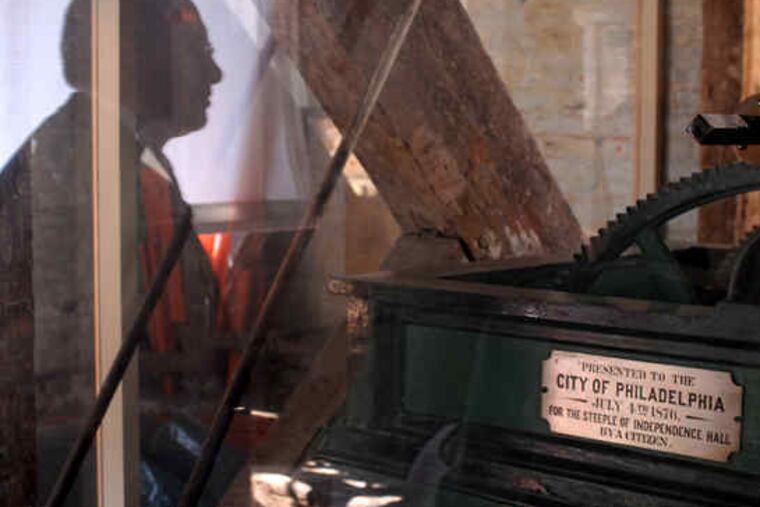
"This tower has stories to tell," he said, making his third trip of the afternoon past the clockwork's long black chains and undulating brass weight. "This was an apartment at one time for the clock keeper." Now, the space is a bare boxy room with a layer of green and ivory plaster that has peeled off to reveal the slatted wooden ribs beneath.
"We think we found a piece of Franklin's lightning-rod installation," he told a reporter, pointing to a three-foot length of crooked metal pipe stapled into the northwest corner. The whole rod, he said, once measured 168 feet, 71/4 inches. "That's all that's left."
The restoration work is a collaborative undertaking, he explained. The City of Philadelphia owns the building, but the park service maintains it. The park service's contracting and construction arm, based in Denver, did much of the work contained in the 813-page restoration plan that Tonetti was presenting to the Historical Commission. The commission will be working with Tonetti on the project, which is scheduled to begin in 2011.
"If we can get funding sooner, we'll start sooner," said Jane Cowley, public relations officer for the National Park Service. "This project has been on the agenda for long enough that it's scheduled for funding. But we're talking about the 2011 budget. Nothing is funded until it's funded."
Tonetti, meanwhile, will be keeping a close eye. He's got X-rays of the iron dowels. Four months ago, he had monitors installed to measure any expansion of old fissures in the bricks. He's looking into the best way to deal with damage in spots where paint was used to cover over graffiti scratched into the upper levels of the tower in the 1840s. The cracks in the clock face will have to be addressed.
And it's likely to rain tomorrow.