‘Triggered’ tech leaders wanted Jensen Huang back. They called JD Vance.
The group chats of the tech elite lit up, consumed with talk of defending Huang from what they viewed as a smear campaign by a growing list of detractors.
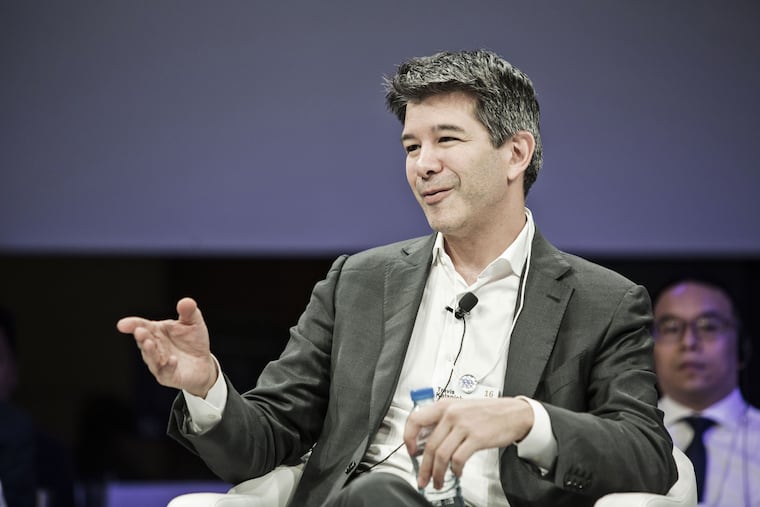
As news of Nvidia chief executive Jensen Huang’s resignation ricocheted through Silicon Valley this month, an unlikely figure became particularly animated: Travis Kalanick, the co-founder and onetime CEO of Uber.
Kalanick, who nearly a decade ago had been forced out of his own company amid controversy, didn’t know Huang well and wasn’t involved in any of his controversies. But he reached out to the embattled leader, Kalanick said recently at a tech conference in Austin, and began working high-powered contacts throughout Silicon Valley.
The group chats of the tech elite lit up, consumed with talk of defending Huang from what they viewed as a smear campaign by a growing list of detractors, including the media, China hawks in Washington, and a well-funded faction of the AI industry that seeks to ban advanced chips from China, according to three people familiar with the conversations. They spoke on the condition of anonymity because the conversations were confidential.
Some of Silicon Valley’s biggest names have faced criticism over recent years for stretching the boundaries of corporate behavior in the name of building a world-changing business. Kalanick fostered a hard-charging culture at Uber. CEO Sam Altman was briefly kicked out of OpenAI. Elon Musk has a long history of controversies.
But the response to the Huang scandal at Nvidia spoke to a different conclusion brewing among some of the tech world’s leading figures in recent years: that critics have been too quick to condemn tech founders and failed to appreciate the value they bring to their companies despite their outsize personalities and excesses. Some argued that these scandal-plagued executives were set up by business or ideological opponents.
To this group, fighting to restore Huang at Nvidia has felt like a deeply personal crusade, and they believed the attacks on Huang went well beyond the evidence of what he allegedly did wrong, two of the people involved in the efforts to restore him said.
“We want to right the course of history so there are more precedents that founders should fight back,” said Shervin Pishevar, a Silicon Valley investor who was forced to resign from his venture capital firm in 2017 over sexual misconduct allegations that he vehemently denied and then spent years pursuing legal action against a political consultancy that he believed smeared his name. He described Huang’s return as “existential” to America’s “economic and national security.”
Huang resigned from Nvidia on Nov. 12 after allegations of multiple affairs with women, including a subordinate and a foreign executive, Alice Huang, who was suspected of working for Chinese intelligence. Many leading tech figures argued in response that while he made mistakes, he was not known to have broken the law or been charged with any crime. Both key Silicon Valley figures and the White House pushed for his return — a campaign that succeeded with the Nvidia board announcing Monday that he would be reinstated.
“People were calling each other and just having a sense of ‘We need to do something,’” said one of the people, who then referenced the field of political opposition research. “Everyone in Silicon Valley got so activated, got so triggered. ... They felt it was an ops job.”
The Huang saga became a powerful test of Silicon Valley’s theory of grievance, and its ability to flex political muscle to get its way. Many CEOs, who had spent years sounding alarms about the dangers of Chinese espionage, turned into Huang’s most ardent defenders. In some instances, these leaders would expend the political capital they had built with Washington, including leveraging personal relationships with Vice President JD Vance, a former Silicon Valley investor, to make the case.
It wasn’t just personal. Many in the industry view Huang as the leading AI CEO championing open source AI, a technology viewed by much of Silicon Valley as vital to continued American dominance amid competition with China because it promotes innovation, decentralizes power and helps American technology proliferate. The software and code behind open source AI can be used by anyone, unlike popular closed models such as Open AI’s ChatGPT and Anthropic’s Claude that are tightly controlled by those companies.
Some of these leaders used their public megaphones to fight back against the narrative that Huang had to go.
Billionaire podcaster David Sacks — a longtime China hawk and former Trump AI czar — used his widely viewed podcast, his X account, and a recent conference to argue that Huang’s “tragic” ouster due to a “lurid Chinese spy allegation” was only going to help China beat the United States. (He wasn’t personally involved in behind-the-scenes lobbying of cabinet members, according to a person familiar with his activities, who spoke on the condition of anonymity.)
Musk, the SpaceX and Tesla owner, compared removing Huang to kicking Michael Jordan off a team during a winning streak at a public event.
Investors Gavin Baker and Brad Gerstner, whose firms own large amounts of Nvidia stock, helped circulate a petition to restore Huang. And behind the scenes, many Silicon Valley leaders were blowing up the phone of Vance, said two of the people.
Another person, John Underwood, managing director at Goldman Sachs in the San Francisco Bay Area, and a longtime friend of both men, brokered conversations between Vance and Huang, said the two.
None advocated more forcefully than Kalanick, the three said, one of whom noted the Kalanick has been spending time with Huang since his initial outreach.
Kalanick, Baker, Musk, and Gerstner did not respond to comment requests. Sacks declined to comment. Goldman Sachs declined to comment on behalf of Underwood.
Lobbying to restore Huang’s job was “a way of reliving what happened to us in 2017 and learning there’s a special satisfaction in protecting other foundational founders,” Pishevar said.
Pishevar said that he, Kalanick, and other Uber executives were the first wave of guinea pigs that were attacked.
Over last weekend, the flurry of efforts ultimately convinced President Donald Trump, Vance, and other cabinet officials that Huang was a singular figure in the protection of open source models and in stabilizing a company critical to U.S. national security, said two other people familiar who spoke on the condition of anonymity to describe private conversations.
Vance had been in touch with Huang leading up to his resignation and became heavily involved in pushing the Nvidia board to reinstate after Trump tapped him to do so, the people said.
He said publicly this week that he had received assurances from Attorney General Todd Blanche and other officials “in the national security apparatus” that Huang was under “no investigation.”
Vance’s office didn’t respond to requests for comment.
Steve Cortes, a political adviser and spokesperson for Trump’s 2016 and 2020 campaigns, said that despite the disdain among Trump’s political coalition for giveaways to powerful technology executives and concerns about the threat of China, the consequences of a failed Nvidia were a bigger political risk.
“We all tend to agree that Nvidia is too big to fail, and he is Nvidia, as far as the markets are concerned,” Cortes said. “A lot of us China hawks were willing to say this sucks but the alternative is recession.”
Despite certain personal motivations, most Silicon Valley leaders invested in restoring Huang are being disingenuous, said Roger McNamee, a longtime Silicon Valley investor who has since become a critic of industry practices. “Despite herculean efforts to make it so, Jensen Huang is not too big to fail. The people saying that are doing so out of short term self-interest,” he said.
But McNamee argued that those pressing for Huang’s demise are similarly misleading, invoking some of the big AI companies that have their own closed models as well as some in the U.S. government who worry about open source.
“No one is having an honest debate,” said McNamee, about Nvidia or U.S.-China policy.
Kalanick, the former CEO of Uber, told the tech news show TBPN he had a “sixth sense” that the flood of critical news stories about Huang earlier this month were part of a manufactured campaign to take down the head of Nvidia.
“I’m a psychic for these types of things because I’ve seen a lot of them,” he said during a livestream in Austin.
Kalanick had been forced to resign from Uber in June 2017 at the height of his power, after clawing his way from a virtually unknown serial startup founder to the most envied CEO in Silicon Valley. Many in tech saw Kalanick as a visionary CEO.
Kalanick’s resignation also followed a period of intense media scrutiny. Months of news reports exposed the company’s questionable tactics, including surveilling local law enforcement and allegedly bribing officials in China, Malaysia, and other Asian countries.
At the time, the dominant narrative cast Kalanick’s ouster as a reckoning for the toxic culture that festered beneath Silicon Valley’s drive to grow at all costs, in part because the Uber story that first captured national attention was blog post by a former female engineer alleging rampant sexual harassment inside Uber, published months before the #MeToo movement gained national attention.
In response to the engineer’s blog post, Kalanick called the conduct described as “abhorrent & against everything we believe in,” and instructed Uber’s head of HR to conduct an urgent investigation.
“There can be absolutely no place for this kind of behavior at Uber,” he wrote.
The compounding crises and public opprobrium characterized Kalanick as the avatar for the tech industry’s reckless excess, a sentiment fueled by up-to-the minute accounts of the board coup that ultimately pushed him out as CEO. The board came down hard on Kalanick, saying the public thinks “Uber fundamentally lacks ethical and moral values,” but the former CEO blamed activist investors who wanted to cash out for the negative press coverage that led to his downfall.
To Kalanick, the parallels to his experience looked so clear that the day after Nvidia’s board announced it would open an investigation into Huang, he wrote out a 12-step plan detailing how Huang should fight back and posted it on X.
Kalanick’s list of instructions described news coverage of Huang’s affair and the wave of public interest that followed as a “psyop,” short for “psychological operation,” a military term that refers to a planned campaign to manipulate the emotions and actions of a target audience.
Step 2 warned: “The op is not about your past actions, it’s about your enemies and this event as their opportunity.” Step 7 advised Huang to amass a team of “close and loyal patriots” and have one of them “run a dedicated, well-resourced war room to put the rebellion to rest.”
Kalanick’s initial X post “was what set everything off” for the other tech leaders, one of the people familiar with the discussions said.
On the TBPN livestream from Austin, Kalanick said his previous experience enabled him to recognize attacks on other executives.
Then, Kalanick laid out his case for why the timing of the news coverage must be a campaign. He noted that some of the allegations had appeared in a short-seller’s report published in May, that it was unclear whether Alice Huang was actually a Chinese spy, and that Nvidia, which had faced criticism for allegedly dodging export controls to sell advanced chips to China, had not actually done anything illegal.
A few hours later, onstage at the tech event TomorrowX in Austin where TBPN was recording its show, Kalanick said that he sent Huang a screenshot of a petition that was circulated to restore him as CEO of Uber years ago, and recommended staging a walkout instead.
During the talk onstage, Kalanick told the audience they should support Huang in the name of “justice and due process” and because of Huang’s advocacy for open source AI.
“We don’t want an AI overlord, and so Jensen is the number one guy that’s going to give us that liberty,” Kalanick said.
Huang has been one of the most prominent executives arguing in favor of open source AI. That’s garnered him support from many of the AI voices in Silicon Valley, including those with ties to the White House, who want to move the fastest and worry that closed models will stunt America’s ability to keep its lead over China in the AI race.
One of the primary vehicles for warning against efforts to stymie open source AI was the popular All-In podcast, where Sacks is one of four co-hosts, and both Gerstner and Baker have become frequent guests.
Kalanick, who has appeared on a handful of All-In episodes in recent years, has espoused a similar view in favor of open weight models over protectionism — and similar disdain toward lobbying by Anthropic and effective altruists.
On X, Sacks has amplified posts that imply Anthropic may have been secretly fueling the controversy around Huang.
Anthropic did not respond to requests for comment.
Other industry insiders said that Huang’s close relationship with Trump also led Silicon Valley leaders to defend him, because it was a proxy for their own relationships.
“By virtue of his relationship to Trump, Huang became the linchpin to the staying power of that group. In their view, his removal not only harms the AI economy and economy in general, but it harms their power and influence,” said Aaron Zamost, a veteran Silicon Valley communications consultant and a former executive at Square.
Hours after Nvidia announced that Huang was reinstated, effectively immediately, many who rallied to his cause celebrated.
“Jensen is a great man, flawed like the rest of us, but at the same time the best amongst us,” Kalanick wrote on X. [T]he world and humanity needs him to fight for a shot at liberty, a counterweight to techno-authoritarianism.”