America loves mahjong, but Chinese Americans hardly recognize it
The craze has been driven largely by the growth of the American version, prompting something of a rift between some loyalists of Chinese and American mahjong.
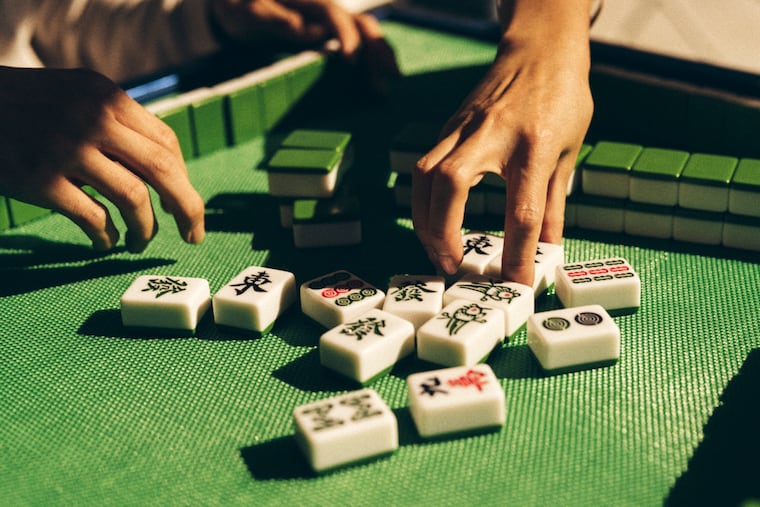
MONTEREY PARK, Calif. — At 10:30 a.m., the clattering of tiles began.
Around 50 mahjong players — grandparents and hipsters, doctors and housewives — sat four to a table in a grassy park outside Los Angeles, shuffling, stacking, and calling chows and pungs.
Whittled down from an initial 322 contestants, they were competing in one of the largest Chinese mahjong tournaments ever held in the United States.
The prize money wasn’t nothing — $3,000 — but for some, the event last month had a deeper resonance. Many of the contestants, mostly Americans of Chinese descent, had grown up playing the traditional tile game in, say, tiny apartments in Hong Kong or suburban tract houses in California.
To play in such a large event in Monterey Park, Calif., seemed to quietly affirm their Chinese culture, even as American mahjong — the homegrown spinoff — has ballooned into a multimillion-dollar industry, with its own rules and modified tiles that render it nearly unrecognizable to devotees of the original game.
“Playing mahjong has always been a moment for us to connect over Lunar New Year, to socialize, see family, and get together,” said Steven Hoang, 32, an American of Chinese and Vietnamese descent who drove from Orange County for the event. “It feels like American mahjong doesn’t really pay tribute to that history.”
Mahjong — or ‘mahj’ to some — has seemingly taken over the country. People are playing at home, in libraries and wine bars, on cruise ships, and by the pool, even in the pool. Last year, Yelp searches for mahjong clubs jumped more than 4,000%.
The craze has been driven largely by the growth of the American version, prompting something of a rift between some loyalists of Chinese and American mahjong.
Critics have accused a few entrepreneurs of profiting from American mahjong, while disrespecting the game’s cultural heritage. Those detractors have focused on boutique tile sets — often priced around $400 and marketed as “modern” and “refreshed” — which swap out the traditional Chinese characters or designs for Western motifs like cowboy boots and palm trees.
The sharpest comments have come not from China, where state media has hailed America’s mahjong craze as a model of cultural exchange, but from U.S.-born Asian Americans, some of whom said in interviews that growing up as a minority made them more protective of a heritage they felt was being erased.
Gathering was, of course, a good thing, but some said they wished there was more curiosity about the people and culture that invented the beloved game.
“There’s a feeling that this is a game that belongs to my culture,” said Nicole Wong, an author and founder of the Mahjong Project, which documents the game’s history. “But it feels like it’s being suddenly taken away.”
Many promoters and players of American mahjong, however, point to its century-old history in America, especially in Jewish American communities. Adaptation, they say, is natural across time.
Johni Levene, the main administrator for the popular “Mah Jongg, That’s It!” Facebook group, often finds herself moderating such arguments.
“The more traditional community has been very upset that American mahjong is taking over the narrative,” she said. “Many American players don’t even know another version exists.”
The game traces back to 19th century gambling parlors in China and shares similarities with gin rummy. “Mahjong” refers to moziang, the Shanghainese pronunciation for sparrow, a possible nod to the way shuffling tiles can sound like a flock of chittering birds, said Annelise Heinz, a historian who wrote a book about mahjong. Over time, dozens of variations have emerged, including Japanese riichi and Filipino mahjong.
Mahjong took off stateside in the 1920s thanks to Joseph Park Babcock, a Standard Oil representative. Even as exclusion laws barred most Chinese immigrants, Heinz noted, the game became a hit, and mahjong sets were one of China’s largest exports to the United States.
In 1937, a group of Jewish American women founded the National Mah Jongg League and established the standardized, card-based system known today as American mahjong.
Rob Ollander-Krane, 65, still remembers the gossip and laughter emanating from his mother’s kitchen during her weekly games with other women from their Jewish American community in Illinois.
“I think my mom really thought that Jewish mahjong was traditional mahjong, and that there was no other mahjong,” he said.
About a decade ago, the Chinese and American versions burst back into popularity. Chinese mahjong became particularly trendy among young Asian Americans, who embraced it as a cultural touchstone — especially after the 2018 movie Crazy Rich Asians gave it a starring role.
American-style mahjong also surged, especially among Southern women who turned it into a lifestyle statement, with color-coordinated tile racks and mats.
By 2021, as racial protests and recriminations roiled the country, American mahjong came under fire. The founders of the Mahjong Line, which makes luxury tile sets, wrote on their website that the artwork on traditional Chinese tiles, “while beautiful, was all the same” and needed a “respectful refresh.”
Some of the company’s tiles used the word “BAM!” in place of the traditional bamboo sticks, bubbles instead of coins and sacks of flour to replace flowers.
After an online lashing and reported death threats, the company apologized. Its website now features information about the game’s history. But the tiles did not change.
Kate LaGere, a company co-founder, said in a podcast that the experience had left her with “a little bit of PTSD.” She also said there was a history of changing tile designs and that American culture benefited from being a “melting pot.”
“We don’t see a rift between American and Asian play,” LaGere said in an emailed statement. “What we’ve seen is a growing, side by side.”
Tensions flared again this year when the founder of Oh My Mahjong, another American company, upset some Asian Americans when she said mahjong had become “this beautiful way of hosting — not just slapping a game on a table.”
Megan Jett Trottier, the company’s founder, said in an interview that her intention had always been to respect the culture. She had visited China, where her sets are made, several times, she said, and included traditional red envelopes with orders to honor the Lunar New Year. While her company still puts a “modern twist” on its tile sets (recent releases include “Papaya Spritz” and “Palm Royale”), she said she was committed to keeping the core Chinese motifs.
“There are people that don’t know the roots of mahjong, and that’s horrible,” she said.
Some Chinese Americans had no issue with the American rebrand.
Raymon Cheng, 37, who grew up in New York and lives in Alexandria, Va., said he took some pride in seeing mahjong become so dominant across America — even if it was different from the game he had played with his family.
“Cultures transfer and adapt,” he said.
In some places, American mahjong is becoming a gateway back to the traditional game.
Ollander-Krane, whose mother played American mahjong, now teaches traditional style in Palm Desert, Calif. He found the Chinese game easier to learn and more sociable than American mahjong, which often requires close attention to a rule card. (Scoring is more complex in Chinese mahjong.)
Over the last three years, Ollander-Krane estimates that he and a friend have taught about 1,200 people to play.
“There are games going on every minute of every day in this valley,” Ollander-Krane said. “These are white faces playing Chinese mahjong.”
At the Hong Kong-style tournament in Monterey Park, the final round commenced with four contestants. Emcees narrated the action in Cantonese as a crowd followed along on a big screen.
Kam Chuen Kwok, 75, a retired warehouse worker who grew up in Hong Kong, was crowned the winner. Desmond Chan, an executive with TVB, a Hong Kong TV network, presented him with a trophy and the $3,000 check.
In an interview, Chan said TVB hoped to promote Chinese mahjong globally and would look to expand the tournament next year.
He had never heard of American-style mahjong. But he sensed a business opportunity.
“Maybe we can take American mahjong,” he said, “and introduce that to Chinese communities, too.”
This article originally appeared in the New York Times.