Abington is paying the feds to ‘harass’ geese with lasers, pyrotechnics, and boats
Abington Township approved a contract with the USDA on July 9 for goose abatement in Alverthorpe Park, where birds are attacking people driving golf carts and dropping slippery, bacteria-laden feces.
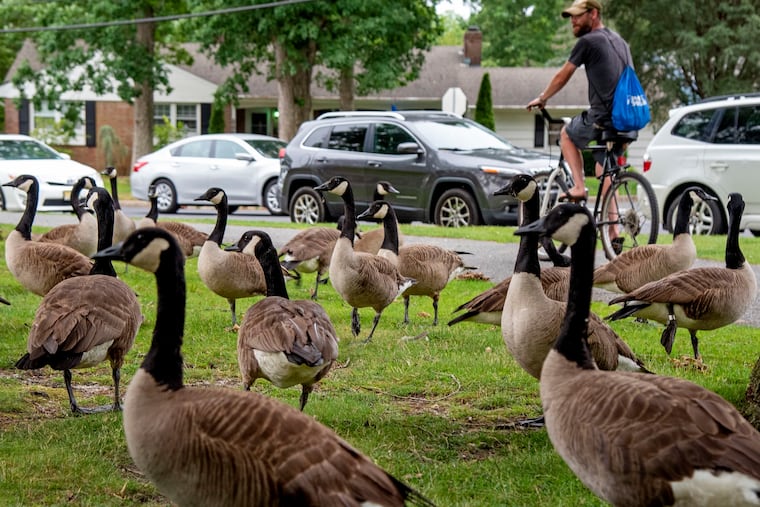
Like many American suburbs, Abington accidentally spent centuries building a goose paradise. Now, the feds will help the township evict the waterfowl from their ideal habitat.
Abington Township approved a contract with the U.S. Department of Agriculture on July 9 for Canada goose abatement in Alverthorpe Park, where airborne birds are attacking people driving golf carts, digging into sand traps, and dropping slippery, bacteria-laden feces onto walking paths and around the playground, township staff said.
Goose droppings may also be affecting water quality at the park and interfering with fishing, according to the contract.
Each goose can deposit up to a pound of feces per day, a USDA spokesperson said.
“It’s a mess,” said Abington’s assistant parks director, Patricia Platt.
USDA to harass Abington geese 35 times, may kill some to be used as food
Between this month and June 2027, USDA personnel will conduct “waterfowl harassment” at the park, according to the contract, with “visual deterrents, use of lasers, and remote controlled boats, pyrotechnics, etc.”
The service will cost about $15,000 for the yearlong contract.
“Approximately 35 visits of harassment will be conducted throughout the spring and fall seasons,” the contract reads.
The pyrotechnics mentioned in the contract are typically propane-powered noisemakers to scare the birds, a USDA spokesperson said.
“It’s not like fireworks,” spokesperson Tanya Espinosa added.
Lasers can mean green light beams trained on the ground to deter the birds.
USDA workers start with less intensive goose-scaring methods and then escalate as needed, township and USDA staff said.
The feds will also throw away goose eggs and, if the geese start molting, euthanize up to 150 birds for people to eat.
Abington officials have considered other goose abatement tactics in the past. In 2023, the township’s shade tree commission asked whether a planned development across from Alverthorpe could include more shrubs and trees to reduce the goose habitat, but the engineering consultants said the community was adamant about an expansive grass lawn. The town’s 2023 parks plan suggests that closing some of the town’s outdoor ice rinks, which are wet lawns when not frozen, could help reduce goose habitat. The township parks director, Jessica Tholey, did not return calls and emails.
Canada goose damage has been a problem across Pennsylvania for at least three decades. In 2010, USDA Wildlife Services received more than 400 “technical assistance requests” for goose damage in the state.
Falls Township in Bucks County began reducing its resident goose population at a public park in 2015, according to its parks director. Falls spends about $17,000 annually for a private company to chase the geese with border collies.
Honkers plentiful nationwide, Pa. says
Goose populations have exploded across the United States in recent decades, rebounding from a dangerous low in the early 1900s when open hunting threatened migratory populations, according to the Pennsylvania Game Commission.
“There probably are more honkers on the continent today than when the Pilgrims landed,” state officials write.
Canada geese still migrate through the Philadelphia region — a group dubbed the Atlantic population.
But many local geese are part of a nonmigratory population that is relatively new.
Pennsylvania had no year-round populations until 1936, when the state game commission released 30 Canada geese with amputated wing joints at a reservoir near Lake Erie.
The state added to the reservoir population in the 1950s, and by the 1970s, Southeastern Pennsylvania landowners were complaining about geese, according to a 2011 report from a group of government officials and wildlife biologists.
Nuisance geese settled in Abington over 40 years ago
The geese, which prefer open fields with short vegetation near water, thrived on the lawns, golf courses, and fake lakes of the Philadelphia suburbs.
By the 1980s, the geese had reached Alverthorpe Park, where Abington officials considered balloons and plastic swans to deter them.
But with tens of thousands of them already settled in the Delaware Valley, The Inquirer reported in 1984, the game commission officer for eastern Montgomery County, William Wasserman, was not optimistic: ”What we’ve got right now with Canada geese is probably going to remain the same to the year 2000 and beyond.”

Inquirer Greater Abington
This suburban content is produced with support from the Leslie Miller and Richard Worley Foundation and The Lenfest Institute for Journalism. Editorial content is created independently of the project donors. Gifts to support The Inquirer’s high-impact journalism can be made at inquirer.com/donate. A list of Lenfest Institute donors can be found at lenfestinstitute.org/supporters.