Cheltenham EMTs saved a 1.5-pound baby, then attended her parents’ wedding
“I really didn’t think we had any chance of saving her,” said the Abington neonatologist who resuscitated the baby.
At 1.5 pounds, Isabella was big for her age.
Her parents were home with their youngest children in Elkins Park around 7 p.m. on July 19 when her mom, Crystal Hilliard-Keith, went into sudden, painful labor with Isabella.
Only six months pregnant, Hilliard-Keith began preparing to drive to the hospital. But Isabella’s dad, Anthony Robinson, knew they wouldn’t make it. He called 911.
“She prayed,” Robinson said. “I prayed.”
Two veteran paramedics, Jessica Barto and Gerald Speed, were filling in for other EMTs that day. They were standing next to the truck, one mile away from the family’s house, when they got the call.
“There were people and things in places that, if even one of those things had been different, the outcome wouldn’t have been the way that it is,” Barto said.
CPR with one finger
Five minutes later, Barto and Speed arrived. Barto delivered Isabella, freeing her from the amniotic sac and clamping the umbilical cord while Speed notified Jefferson Abington Hospital. The baby was smaller than the palm of her hand, and she wasn’t making any noise.
Then, Barto saw Isabella’s ribs flare: She was trying to take her first breath.
“She’s a fighter,” Barto thought. “And we’re in this together.”
None of Barto’s equipment fit, so the EMT of 24 years improvised, using a smaller syringe hooked up to an IV catheter to clear Isabella’s nose. She started CPR, performing chest compressions with one finger.
Four miles away, neonatologist Erin Cipko’s team at Abington was alerted by Speed’s call that a baby born at 23 weeks would be arriving at the emergency room. Because it was after 4 p.m., Cipko was the only neonatologist in the NICU.
Her team grabbed the specialized tools they wouldn’t have in the ER, Cipko said, and started running.
Resuscitating a 23-week preemie born in the hospital is difficult enough, said Cipko, who’s treated newborns for over a decade. A 2022 study found babies of that gestational age born at medical facilities had a survival rate of just 55%.
A 23-weeker born at home? Cipko had never seen that.
“I really didn’t think we had any chance of saving her,” she said.
Quran Frazier, a firefighter and EMT who’d responded from the fire department, drove the ambulance as Barto continued CPR and Speed connected the baby to a heart monitor, finding a very slow pulse.
“Everybody knew what they were supposed to do and did it, really without us talking about it,” Barto said.
‘We were in shock’, Abington doctor says
Meanwhile, Cipko, nurses, and ER staff were in the trauma bay preparing medications, hooking up oxygen, and locating other equipment.
Isabella arrived at the hospital, 25 minutes old and lighter than a cantaloupe, on an adult-sized gurney with Barto on board, continuing CPR. The clamp that Barto put on Isabella’s umbilical cord, Cipko said, had prevented the baby from bleeding out.
Hospital staff got to work — placing Isabella on a warmer, giving medication to restart her heart, and inserting a breathing tube. Because Barto had been delivering continuous CPR, Cipko said, her lungs inflated more quickly, and her blood flowed easily. Within five minutes, Isabella had a heart rate and stable oxygen.
“We were in shock,” Cipko said.
The doctor believes Isabella’s large size — heavier than the typical weight for 23-weekers, who are often under a pound — helped save her. Isabella was so large that Cipko assumed at first she must be older, until she noted the skin texture and other signs that confirmed Isabella’s extreme prematurity.
“I can’t even conceptualize what smaller would’ve looked like,” Barto said.
A wedding
Almost four months later, Isabella is doing great, her parents and doctor said — she weighs over six pounds, eats almost everything by mouth, and is working on developing her heart. Isabella, who has four older siblings, is still in the NICU at Jefferson Abington Hospital.
“Life now, we look at it differently,” her mom, Hilliard-Keith, said. “It’s a blessing.”
Barto has stayed in touch with Isabella’s parents since the delivery — making sure the family is doing well, and even running an errand in an overwhelming post-delivery moment, Robinson said.
Weeks later, Barto visited Isabella. Through tears, she held her hand up next to the baby, unable to believe how small she once was.
“She’s so perfect,” Barto said. “She looks like a baby.”
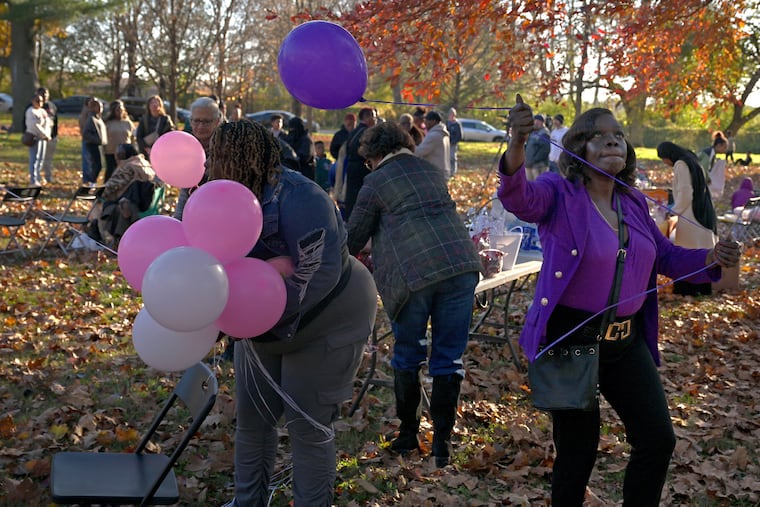
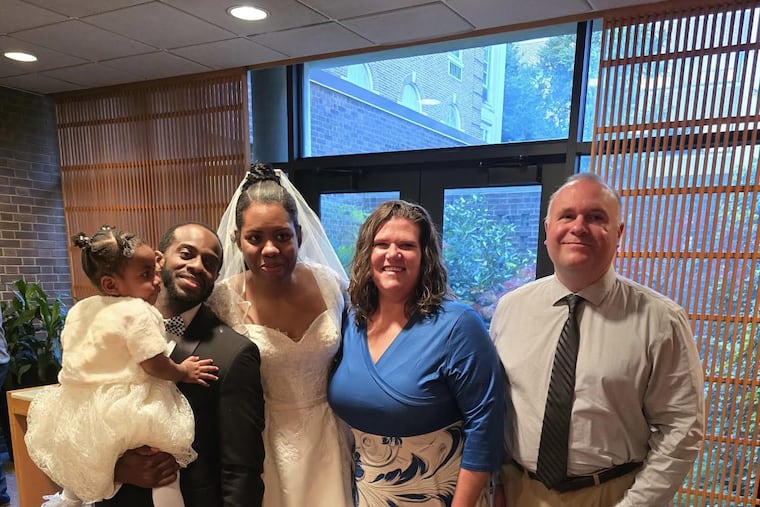
On Saturday — two days before Isabella’s due date — Barto and Speed attended Hilliard-Keith and Robinson’s wedding alongside Isabella, on a short field trip from the NICU.
Cipko and Barto both credited all of the medical staff, from paramedics to nurses to ER personnel, whose quick work made Isabella’s survival possible.
“A lot of people contributed to something so special,” Cipko said. “Without everybody, you can’t do that.”

Inquirer Greater Abington
This suburban content is produced with support from the Leslie Miller and Richard Worley Foundation and The Lenfest Institute for Journalism. Editorial content is created independently of the project donors. Gifts to support The Inquirer’s high-impact journalism can be made at inquirer.com/donate. A list of Lenfest Institute donors can be found at lenfestinstitute.org/supporters.