LACK OF JUDGMENT
Lawyers in Pennsylvania are allowed to ghost clients for years. Why don’t more judges stop them?
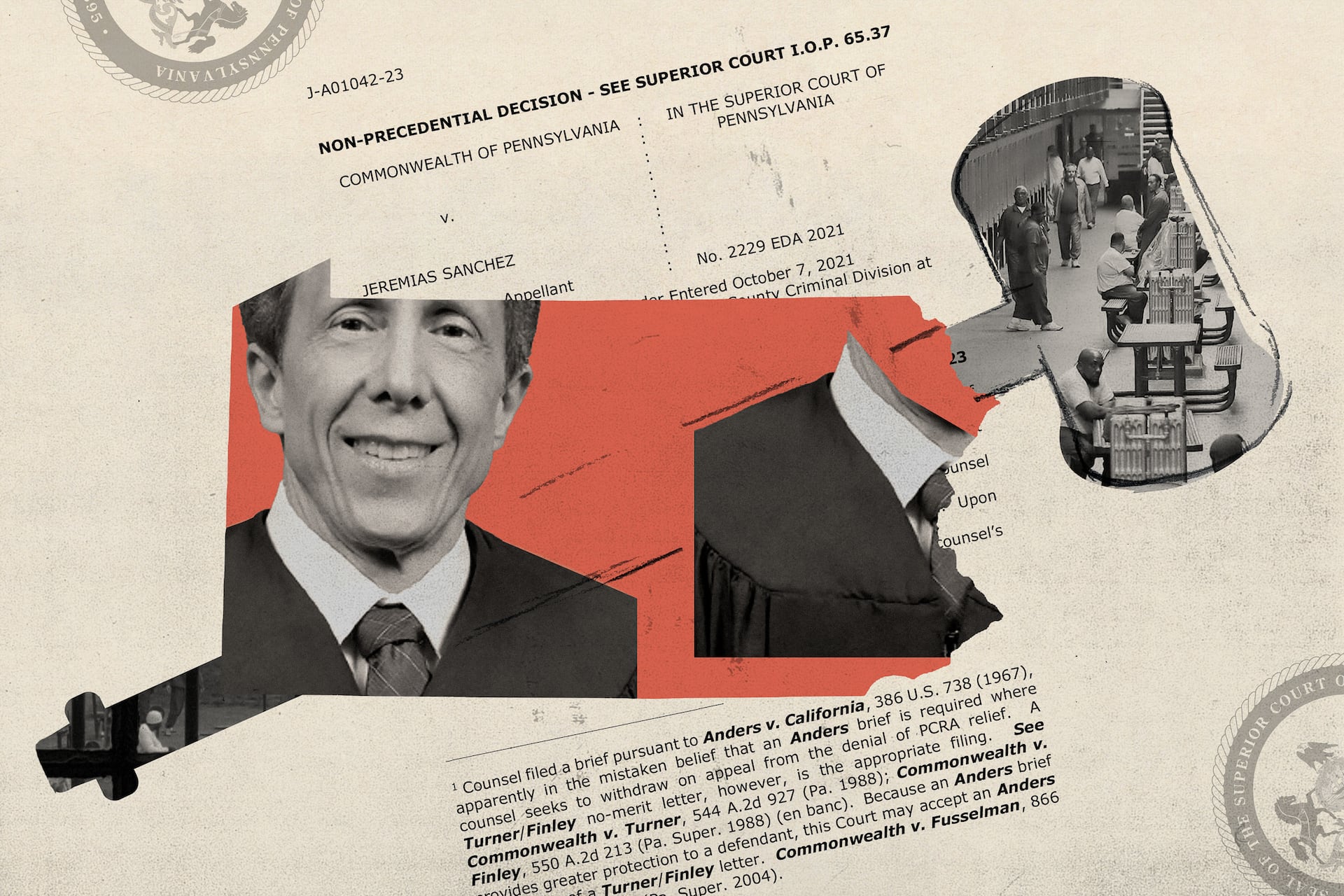
One morning in July 2025, I was the lone spectator in Judge Frank Palumbo’s courtroom in Philadelphia, watching prosecutors and public defenders haggle over the fates of defendants.
Palumbo paused the proceedings to talk to a lawyer he’d appointed to help a prisoner who had ineptly challenged his conviction. The lawyer profusely thanked the judge for the job. Then, Palumbo offered a bit of guidance: “I think I know where this is going to go. I don’t want to make it overly complicated. It’s real simple.”
The judge said he’d pass along a brief that a different lawyer had filed arguing that there was no merit to the man’s claims in a related case. “I’m not saying plagiarize,” the judge said.
The attorney told the judge he got the message. “So it’s called a Finley letter,” he said, using the common legal term for that no-merit brief, in which an attorney can argue against the client’s claims and ask to withdraw from the case.
“It’s looking like it’s going to be a Finley dismissal,” the judge agreed after a bit more discussion, “but every option is open.”
I’ve spent years covering criminal justice in Pennsylvania, including the post-conviction system that allows people to argue that their lawyer had mishandled their case or to raise newly discovered evidence. That day, I left the courtroom wondering how what I’d observed squared with the state’s promise of effective legal representation in cases like this.
That question sent me on a yearlong reporting odyssey, during which I read hundreds of Finley letters, tracked down court financial records from all 67 Pennsylvania counties, interviewed dozens of lawyers and analyzed thousands of court dockets. What I wanted to know was: Why has it become the norm for Pennsylvania’s lawyers to argue against their own clients? And who is this system serving?
I found that lax rules, low pay and heavy caseloads have compromised legal representation under the state’s Post Conviction Relief Act. Over the past year, I’ve reported on how lawyers, working under fee structures banned in other states, fell years behind on their cases. I spoke with prisoners who’d waited nearly a decade for their lawyers to file anything and others whose lawyers filed Finley letters despite compelling evidence of innocence. I also looked at three years’ worth of invoices and found that, three quarters of the time, Philly lawyers who wrote Finley letters had never spoken with their clients, contacted the trial lawyer or obtained available police files before deciding their claims had no merit.
None of those seemingly basic steps, I was surprised to learn, is required under the law. In fact, dozens of lawyers I spoke to expressed sharply divided opinions about the extent of their obligations to these clients.
But court-appointed lawyers are not working unsupervised. Judges are largely in charge of appointing them to cases, and those same judges are supposed to make sure they’re doing a timely and diligent job.
I noticed that judges continued to assign lawyers more cases even after appeals courts flagged serious issues with their work. And when it came to Finley letters, judges accepted almost all of them over the three years of cases I reviewed, despite the lawyers’ minimal investigative efforts. Some of the letters they approved contained obvious factual errors or even named the wrong client.
Last fall, after Palumbo gave the lawyer a copy of a Finley letter, the lawyer followed the template. His no-merit brief said that his client’s claim could not be considered because he’d missed his filing deadline. The bulk of the document was, in fact, identical to the other lawyer’s brief.
Palumbo, who didn’t respond to my requests for comment, accepted the Finley letter anyway, let the lawyer drop the client and dismissed the claim.
Who judges judges?
I thought a fair way to evaluate judges would be to look at the rulings of the Pennsylvania’s Superior Court, the state’s appeals court that hears hundreds of challenges to judges’ rulings on post-conviction matters each year.
And boy, did the Superior Court have thoughts on how judges are handling post-conviction cases.
In one withering opinion, a judge bemoaned an “embarrassing saga” of deficient lawyering that a Berks County judge had tolerated. Another derided a Philly judge and the five attorneys she’d appointed who all missed appeals deadlines, writing, “As Hall of Fame manager Casey Stengel said of the hapless 1962 New York Mets, ‘Can’t anybody here play this game?’”
After logging hundreds of rebukes laid out in Superior Court opinions by hand, I asked some colleagues with data skills to help identify as many of these cases as possible across the last 14 years, the time frame for which opinions were reliably posted online.
We found that the appeals court flagged more than 250 cases in which judges didn’t intervene as lawyers provided what the court labeled ineffective representation: “sandbagging” a client at a hearing, stonewalling a petitioner who’d mailed two dozen letters to the lawyer’s office or filing boilerplate appeals so vague that they doomed their clients’ cases. In hundreds more cases, judges failed to appoint a lawyer at all, held hearings where petitioners went unrepresented or allowed a lawyer to drop a case, leaving the client stranded on appeal. More than 200 times, they oversaw lawyers who abandoned clients, tanking their appeals or stalling their cases for years.
Judges are in a terrific position to be able to prevent these kinds of injustices.
“Judges are in a terrific position to be able to prevent these kinds of injustices,” said Marissa Boyers Bluestine, a longtime post-conviction lawyer who now works at the University of Pennsylvania’s law school.
The scathing reversals aside, the Superior Court affirms about 80% of lower-court rulings. That’s expected given the strict deadlines and complicated rules about how appeals must be filed. The appeals court is also required to defer to the lower court’s factual decisions. And when it reverses due to an error, the recourse is generally limited to ordering a do-over or, on rare occasions, instructing the lower court to explore sanctions. In one opinion, the court resorted to using boldface to call out an egregious failure: “The PCRA court did nothing in this case for 20 years.” Then, it told the lower court to try again.
Judges do have the authority — and, in fact, an obligation under state rules — to make disciplinary referrals. Because complaints are confidential, there is no way to know how often they do so. But only six lawyers in the last decade have been publicly sanctioned for work on court-appointed post-conviction cases.
Judicial discipline is even rarer. No lower-court judge in at least a decade has been publicly disciplined for mishandling a post-trial matter. Judges who, according to the Superior Court, exhibited biases, imposed vindictive sentences or improperly denied recusal requests remained on the bench.
Even after the Superior Court raised alarms, more than 100 cases ricocheted between the appeals court and county judges two, three, four or more times, as judges repeated errors or reappointed lawyers to cases they’d already mishandled.
One such case played out after Jefferson County’s only judge, John Foradora, sentenced a woman to up to 22 years in prison for passing two narcotics pills in prison. Her lawyer failed to object to or appeal the lengthy sentence. After she filed a PCRA, the Superior Court found that her lawyers’ inaction enabled the “unduly harsh and clearly unreasonable” punishment to stand. But each time the Superior Court reversed, Foradora again imposed a lengthy term. After three such reversals, the woman wound up serving more than eight years. Foradora said through a court spokesperson that he was unable to comment.
Shannon McDonald, an attorney in the Philly suburbs, said that “some judges don’t consider PCRA a priority.”
She described waiting as a petition languished on a Delaware County judge’s desk for two years, until her client had finished his sentence and been released from prison. Then, the judge finally ruled, dismissing the claim.
The Finley problem
Like lawyers, judges I’ve spoken with seem to be divided on their obligations, especially when it comes to the no-merit letters known as Finley letters. The state Supreme Court says that when a lawyer submits a Finley letter, the judge needs to conduct a review of the merits of the case.
Attorney Rob Perkins, who leads the nonprofit Allegheny Lawyers Initiative for Justice, told me that while he’s encountered some judges who take post-conviction matters seriously, others seem to view them as a nuisance. He said several lawyers told him that they were afraid that if they litigated cases too aggressively, judges would withhold future assignments. The no-merit letter becomes the simplest path forward: “When a judge is handed a no-merit letter that sounds good, I think their inclination is to accept that the attorney did their job.”
When a judge is handed a no-merit letter that sounds good, I think their inclination is to accept that the attorney did their job.
Superior Court opinions reflect this pattern as well. In my review, I found hundreds of cases overruling lower-court judges who accepted flawed Finley letters. The appeals court noted that lawyers claimed, incorrectly, that their clients had missed filing deadlines, rejected legitimate claims as meritless or failed to notice that their clients were serving illegal sentences.
In dozens of cases, judges approved defective Finley letters that did not fulfill basic rules, such as including a notification to the client or addressing all the claims the client wanted to raise.
Several judges told me that Finley letters serve an important purpose, in shutting down frivolous challenges that waste resources.
“Not all [claims] have merit,” Judge John J. Mead of Erie said. “A lot of them initially you could look at and make a determination [as to] whether or not it’s going to require a hearing.”
I’ve noticed that the system makes accepting Finley letters the simplest choice for judges. A judge who rejects a Finley letter must either find a new lawyer willing to take the case, or force the same lawyer to pursue a matter they previously deemed meritless.
Judges who take that path risk pitting a lawyer against his own client, the Superior Court wrote in one recent case, finding the judge’s actions resulted in the denial of a man’s right to counsel. His lawyer, forced to handle a hearing after writing a Finley letter, treated it “more like a cross-examination of a witness that [he] does not believe than a direct examination of his client.”
Jon Auritt, who retired after more than 50 years as a lawyer in Delaware County, said that these failures stem from a common cause: Instead of working independently, lawyers are beholden to the local judges who appoint them.
Even if judges are not as explicit as Palumbo was with their instructions, Auritt said, their message is often clear: “The judges are never incentivized to appoint a lawyer who might earnestly find a reason to overturn the conviction.”

To identify cases in which Pennsylvania appeals court judges reversed or vacated lower court rulings on Post Conviction Relief Act cases, we compiled about 19,000 opinions from 2011 through July 2026 published on the Pennsylvania’s Superior Court website. The documents were identified by a keyword search for “PCRA.”
We used artificial intelligence to identify cases in which the appeals court took issue with judges’ errors and lawyers’ failings in lower-court proceedings. To make the AI classifications as accurate as possible, we first read and classified about 500 of the 19,000 opinions. We then tested the classifications of multiple AI prompts against these 500 classifications, to make sure they were giving us accurate results. Finally, we ran the prompt with the best results against the rest of the documents.
Every AI classification was checked against an AI-written summary of the opinion, or against the opinion itself. Finally, we manually checked a random sample of 50 AI summaries to confirm that AI accurately summarized the corresponding opinions.
The Inquirer’s journalism is supported, in part, by the Lenfest Institute for Journalism and readers like you. News and editorial content are created independently of The Inquirer’s donors. Gifts to support The Inquirer’s high-impact journalism can be made at inquirer.com/donate. A list of Lenfest Institute donors can be found at lenfestinstitute.org/supporters.