Philly police union defends questionable expenses, blaming city ‘ineptitude’ for delayed funeral payouts for officers killed in the line of duty
An Inquirer investigation found the union has for years billed the city following an officer’s death for expenses that are unrelated to funeral home and cemetery costs.
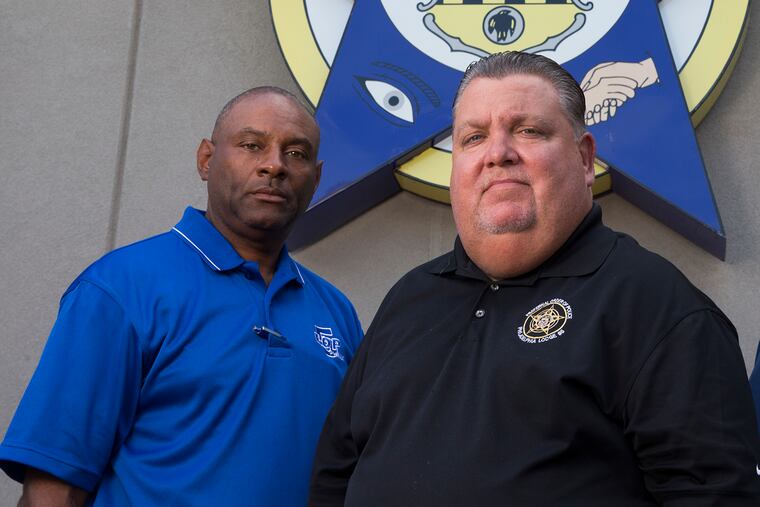
Philadelphia’s police union issued a statement criticizing city officials for failing to promptly reimburse expenses incurred for officers who died in the line of duty, and disputed the city’s claim that it did not use tax dollars to cover a roughly $11,500 funeral luncheon, which included a 94% “gratuity.”
The Fraternal Order of Police Lodge 5’s statement, which was posted on Facebook last week and emailed to its members, followed an Inquirer investigation that found the union has for years billed the city following an officer’s death for expenses that are unrelated to funeral home and cemetery costs.
“The problem has always been and continues to be the city of Philadelphia’s ineptitude to pay bills in a timely fashion,” the FOP wrote. “Which leads to the survivors’ families having to make large financial decisions for funerals, services, luncheons, transportation, cemeteries, funeral attire, and cremations within days of suffering a traumatic life-changing event.”
Since 2014, the city has contributed up to $75,000 in tax dollars for each line-of-duty death, up from $15,000. The FOP’s contract with the city calls for the union to be reimbursed for “reasonable and necessary funeral expenses.” But there is no further explanation of what would qualify, and The Inquirer found the union has asked the city to pay tens of thousands of dollars for everything from bar and restaurant tabs to socks and underwear.
The FOP has also billed the city for at least eight events at its own bar, 7C Lounge, located inside its sprawling headquarters in Northeast Philadelphia. One of those events was a luncheon in May 2020 for Cpl. James O’Connor IV, a 23-year veteran and married father of two, who had been shot and killed in March of that year.
His funeral had to be postponed for eight weeks due to the COVID-19 pandemic and only a limited number of people, all in masks, were permitted inside the church.
Even though the city had restricted bars and restaurants to takeout and delivery service, the FOP held a 2½-hour lunch for O’Connor at its own bar.
Records show the FOP billed the city for $5,700 worth of bottled beer, an open bar, and food for 160 people. The union added a $5,375 gratuity.
Sharolyn L. Murphy, the city’s risk manager and deputy finance director, wrote in an email to The Inquirer that the city did not reimburse the FOP for the O’Connor luncheon.
The FOP statement claims otherwise. The union wrote that it provided the city with comprehensive documentation and was fully reimbursed.
The FOP statement also says that the $5,375 was not all a gratuity — which is how it is listed on the bill — but just $925 for a tip while the rest was payment for kitchen and catering workers, bartenders, servers, and managers.
“This was the only way to add the payroll and gratuity expense to the catering invoice,” the FOP wrote. “This was all documented and explained in timestamped email records and provided to the city which is why they approved the reimbursement.”
The FOP attached to its statement copies of six emails listing the amounts paid to the staffers, all of whose names are redacted. Names of the senders and recipients are also redacted, except for then-FOP president John McNesby’s.
The emails were not included in the Right-to-Know records The Inquirer received from the city. The city did not respond to questions about whether the risk management team had gotten them and, if so, why they were not among the documents previously provided to the newspaper.
But Murphy on Tuesday e-mailed The Inquirer a breakdown of the items the city denied from a $32,600 reimbursement request, including the cost of the O’Connor luncheon, as well as liquor bills totaling $800 and $50 in miscellaneous beverages.
“The city provides expeditious payment of funeral expenses to support families of those who made the ultimate sacrifice to service to Philadelphia,” Murphy wrote in an e-mailed response to The Inquirer. “At the same time, the city has a responsibility to ensure that taxpayer funds are spent appropriately.”
Current FOP president Roosevelt Poplar and McNesby, who served as the union’s president for 16 years before stepping down in 2023, did not respond to multiple requests for comment before The Inquirer published its investigation. In its June 13 statement, the FOP called The Inquirer’s investigation a “hatchet job hit piece.”
The Inquirer’s examination of the funeral expenses underscored questions about the FOP’s nonprofit Charitable Foundation, commonly known as the Survivors’ Fund, which raises money to pay for funerals and support the families of officers who were killed or seriously injured in the line of duty.
A 2025 Inquirer investigation found that the FOP reported spending hundreds of thousands of dollars on “funerals and special events” in years when no officers died in the line of duty, and that its expenditures and cash donations had been loosely documented and were difficult to track.
The Inquirer sought further clarity by filing Right-to-Know requests with the city for more than 1,000 pages of invoices, bills, emails, and other public records concerning 17 police line-of-duty deaths since 2014. Eight of the deaths were attributed to COVID.
The FOP publicly criticized The Inquirer’s records request.
Included in the documents were FOP submissions of receipts from businesses such as Target, Home Depot, Walmart, Acme, 7-Eleven, and CVS that include no explanation as to why they were funeral expenses. The union has also forwarded statements of corporate credit cards requesting reimbursement for restaurants and beer stores.
Some reimbursement requests lacked receipts or itemized breakdowns, and at least two were for cash. The FOP did not address the cash requests in its statement.
The Inquirer found that the city has covered the bulk of the FOP’s requests, although in almost all cases, the documents do not point to which specific reimbursements were approved or denied. An FOP request for $1,870 to cover two bar tabs and pipes and drums after a dinner is the only explicit denial in the records.
The FOP wrote in its statement that its “finance office and accounting firm have comprehensive, accurate, and detailed records for all financial transactions for our multiple accounts. There are no missing or incomplete records.”

The Inquirer’s journalism is supported, in part, by the Lenfest Institute for Journalism and readers like you. News and editorial content are created independently of The Inquirer’s donors. Gifts to support The Inquirer’s high-impact journalism can be made at inquirer.com/donate. A list of Lenfest Institute donors can be found at lenfestinstitute.org/supporters.