‘Zero cost.’ Bucks County sheriff promises ICE alliance won’t hurt taxpayers
Sheriff Fred Harran insists the ICE alliance will prevent crime and keep people safe. Civil-rights groups say he's inviting racial profiling.
Bucks County Sheriff Fred Harran testified Friday that his plan to help ICE enforce federal immigration laws won’t cost local taxpayers a dime.
His contention came as the financial implications of the alliance continue to be probed, with some residents questioning why they should pay county deputies to do the work of federal officers.
“Zero cost,” Harran testified during his second day on the witness stand, as a coalition of civil-rights groups seek to stop him from going forward with ICE.
He described how U.S. Immigration and Customs Enforcement is about to begin backing its recruitment efforts with money, announcing this month that it would reimburse cooperating police agencies for costs that previously had been borne by local departments and taxpayers.
Starting Oct. 1, ICE says, participating police departments can receive up to 25% of the salary and benefits of each agency-trained officer. ICE also will pay quarterly performance awards, up to $1,000 for each participating officer, to local departments that successfully help the agency complete its mission.
Harran said federal money also can pay for cars, phones, and laptop computers.
And he offered a caveat: He will actively seek ICE reimbursement, he said, but he didn’t know if the Bucks County government would accept money from the agency. He also said, as he has in the past, that he would continue the partnership even without federal funds.
The Democrat-led County Board of Commissioners has disavowed Harran’s actions, voting 2-1, with the lone Republican opposed, to approve a resolution that declared the agreement with ICE “is not an appropriate use of Bucks County taxpayer resources.”
A county spokesperson, citing ongoing litigation, declined to comment on Friday on whether ICE money might be rejected.
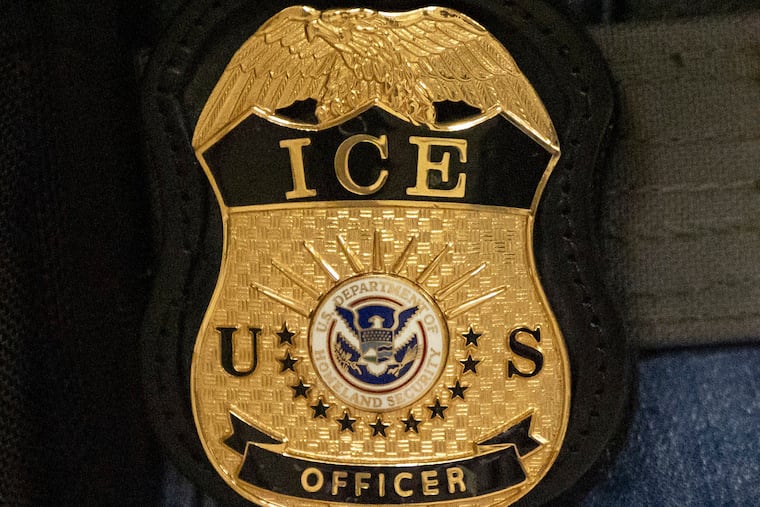
In the spring, Harran and ICE officials signed what is called a 287(g) agreement, a controversial program named for a section of a 1996 immigration act. It enables local police to undergo ICE training, then assist the agency in identifying, arresting, and deporting immigrants.
The number of police agencies participating in the program has soared to more than 1,000 under President Donald Trump. Seven states, including New Jersey and Delaware, bar the agreements by law or policy.
Harran testified at a second day of hearings before Bucks County Court Judge Jeffrey Trauger, whom the ACLU of Pennsylvania and other plaintiffs have asked to issue an injunction.
The judge made no ruling on Friday. He directed the attorneys to submit briefs, and said he would try to issue a decision by the end of October.
Harran, who is seeking reelection in November, insists the ICE alliance will prevent crime and keep people safe. Civil-rights groups say the sheriff is inviting racial profiling, taxpayer liability, and a loss of trust between police and citizens.
The court hearings come against a backdrop of months of name-calling and rancor outside the courtroom.
The ICE issue is central to Democrats’ effort to oust Harran, a Republican, while the sheriff says his intentions have been misconstrued by political opponents and the news media.
A key issue has been the difference between what Harran says he intends to do and the much broader powers conferred in the agreement itself. The judge has unsuccessfully pushed the attorneys to try to reach a settlement.
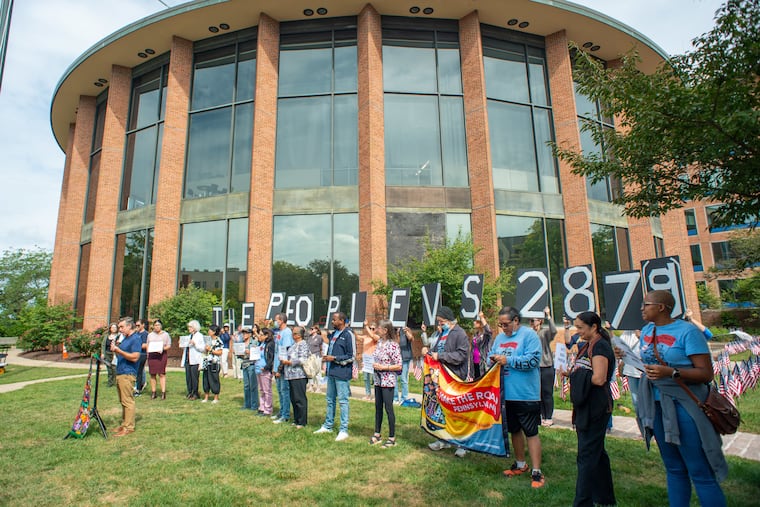
Witnesses from immigrant-advocacy groups, including Make the Road Pennsylvania, testified on Friday that 287(g), while not yet operational in Bucks County, invariably brings harm to local communities.
Karen Rodriguez, a member of Make the Road, said concerns about the alliance have caused her to make changes in her life: She has stopped attending events where Spanish is spoken, and stayed out of large groups that she believes could be targets for ICE.
She and others have stopped going to church, she said, out of concern that ICE and the sheriff’s office might try to take action there.
Under cross-examination by the sheriff’s attorney, Wally Zimolong, she said she was a U.S. citizen, and that she had never been racially profiled, detained or arrested by the sheriff’s office nor by ICE agents.
Still, she said, “People are terrorized right now.”
Harran signed up for the “Task Force Model,” the most far-reaching of the three types of agreements. It allows local police to challenge people on the streets about their immigration status and arrest them for violations.
Harran said his officers won’t do that.
His staff will electronically check the immigration status of people who have contact with the sheriff’s office because of alleged criminal offenses. Those found to be in the country illegally will be turned over or transported to ICE, if the federal agency desires, he said.
Harran said last week that he planned to create a sheriff’s office policy to specify the limits of his deputies’ powers but had not yet done so.
He insisted again during nearly two hours on the witness stand on Friday that his office would take only the actions he has described.
“I’m assisting ICE,” he said under cross-examination, “in what I have told you over and over again. ...We will not be stopping people to ask them on immigration status. I know what I am doing, and that’s all I intend to do.”