Police reforms in Quakertown are needed after student ICE protest, Bucks County NAACP says
The changes would include updated use-of-force policies and expanded use of body-worn cameras.
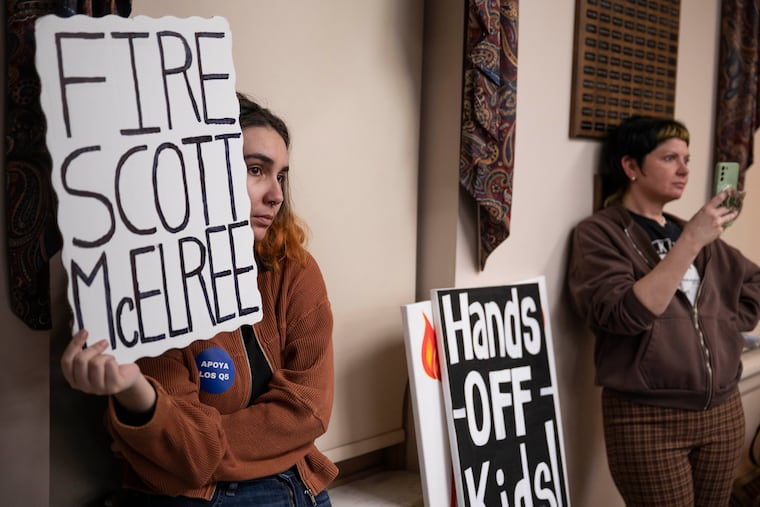
A leader of the Bucks County NAACP and a state legislator on Friday called for reforms in the Quakertown Borough Police Department, saying an investigation that cleared Police Chief Scott McElree of criminal wrongdoing for placing a teenage protester in a choke hold during a confrontation with students earlier this year should not end scrutiny of the incident.
NAACP president Adrienne King joined State Rep. Napoleon Nelson in urging Quakertown police to adopt stronger use-of-force policies to prevent a similar response in the future. Nelson, a Montgomery County Democrat, also said he plans to introduce legislation establishing statewide restrictions on choke holds and expanding the use of body-worn cameras, among other aims.
The calls for change came a week after the Bucks County District Attorney’s Office concluded its almost six-month independent investigation into a Feb. 20 brawl that broke out as students protested ICE enforcement. The investigation concluded that while McElree was the “precipitating factor” in the violence — and confirmed that he held a 15-year-old girl in a choke hold for at least eight seconds — he neither committed a crime nor violated his department’s policies.
In a 20-page report, investigators noted that Quakertown police have no policy restricting choke holds or other neck restraints and that Pennsylvania law likewise places no limits on their use. But investigators said McElree’s decision to engage with the students was “calamitous” and “led to confusion and trauma for an entire community.”
A panel of four members of the Police Chiefs’ Association of Bucks County had previously concluded that McElree had acted reasonably during the incident. On Friday, the group issued a statement saying it disagreed with investigators’ characterization of McElree’s actions as “calamitous.”
Investigators also concluded that several students continued assaulting McElree after it became apparent he was a police officer. McElree, who was 72 at the time, suffered what investigators described as “extensive and serious bodily injury,” including fractured ribs, multiple cuts, and a concussion.
Five students were charged with aggravated assault and various misdemeanors in connection with the confrontation, though their cases were later resolved through diversion agreements.
On Friday, King and Nelson said Quakertown’s lack of policies governing choke holds underscored the need for reform, regardless of the district attorney’s conclusion that McElree had not acted criminally. “No criminal charges,” King said, “cannot mean no accountability.”
After George Floyd’s death at the hands of Minneapolis police in 2020, then-Bucks County District Attorney Matt Weintraub announced that all 39 law enforcement agencies in the county had committed to adopting use-of-force policies that met nationally recognized best-practice standards, including restrictions on choke holds.
But by the start of this year, King said, 13 agencies — including Quakertown’s police department — had yet to update their policies.
In a statement Friday, borough attorney Peter Nelson said the NAACP’s characterization of Quakertown’s policies was incorrect, saying that the department had adopted the proposed standards before Weintraub announced the countywide initiative. He said borough officials had reached out to the NAACP “to discuss their misunderstanding of our policies.”
Separately, the district attorney’s office said Friday that Quakertown’s police department does not currently have updated policies in place and that District Attorney Joseph Khan is urging the borough to adopt them.
Khan considers the adoption of the standards by all law enforcement agencies in the county “a matter of unfinished business” that he “is committed to helping complete,” spokesperson Manuel Gamiz said.
McElree, who also serves as the borough’s manager, did not return a phone call seeking comment Friday.
Nelson, the state representative, said the legislation he plans to introduce would include “commonsense measures to help ensure what happened” in Quakertown does not “continue to go unanswered.”
Meanwhile, the Peace Center of Bucks County plans to host four “listening circles” in Quakertown, where residents will be invited to discuss how the conflict affected their lives.
Barbara Simmons, the organization’s executive director, called the gatherings an “opportunity to cultivate empathy” in a community that has remained deeply divided since the confrontation.
The sessions are expected to begin next week, with dates, times, and locations to be posted on the center’s website.