Smithsonian’s secretary to resign as Trump tries to rule the institution
“Americans are an amazingly brave people, who have accomplished so much,” Lonnie Bunch III said. “They’ve got to be brave enough to face their own history.”
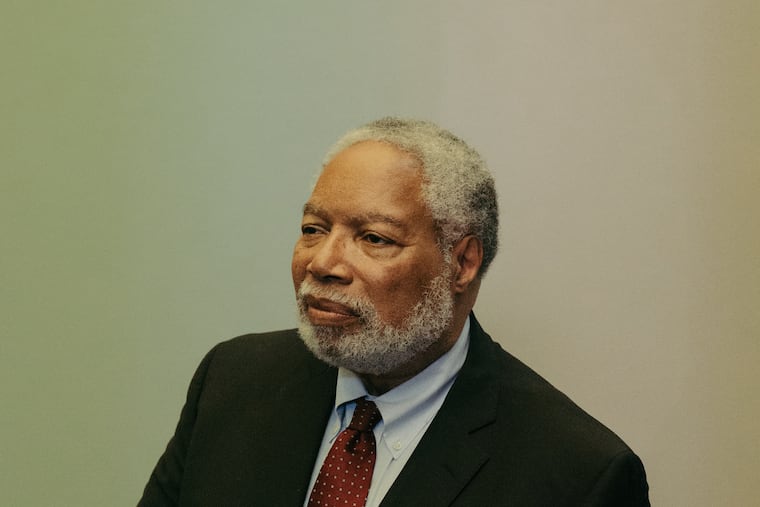
After a seven-year run marked most recently by attacks from the Trump administration, Lonnie Bunch III announced Tuesday that he was stepping down as secretary of the Smithsonian.
The White House has escalated its criticism of how the Smithsonian presents American history and values, prompting concern from some about what they see as an assault on the institution’s autonomy and commendation from others for reining in an organization they view as overtaken by liberal bias.
In an interview, Bunch, 73, said it was not the pressure that had led to his departure.
“It was really just saying, now’s the time,” he said.
“I’m a fighter,” he added.
At the same time, he acknowledged the strain of the role.
“I have to be honest, it has been stressful,” he said. “And at a certain point, I’d like to wake up in the morning and not look at my cell phone.”
In a statement, Chief Justice John Roberts, who serves as the Smithsonian’s chancellor, said that Bunch had “pursued excellence in the telling of our nation’s story” and that the Smithsonian had “benefited greatly from his wisdom, vision and leadership.” The Smithsonian said Bunch was expected to depart at the end of the year.
For more than a year, Bunch has tried to balance diplomacy and openness to criticism with a determination to resist a White House push to present what President Donald Trump calls “patriotic” history. Some admire how Bunch has managed to quietly hold the line against the White House. Others believe the Smithsonian has shown too much deference to Trump and even engaged in self-censorship.
Last year, painter Amy Sherald withdrew her blockbuster show at the National Portrait Gallery over a disagreement about how the museum would display her portrait of a transgender Statue of Liberty.
But Bunch said he had no regrets. “My goal has been to win, not to make me feel good,” he said. “To win — to protect the Smithsonian — there were times I would fight, make clear what the red lines were. And there were other times I let things go.”
Bunch, a widely respected historian who previously oversaw the creation of the National Museum of African American History and Culture, said his next chapter would most likely include teaching or a fellowship.
Created by Congress as a trust in 1846, the Smithsonian has long been viewed as independent of the executive branch. Its governing Board of Regents must now appoint a new leader in the face of withering attacks from the administration.
The 17-person panel, led by Roberts, includes six members of Congress, split along party lines; nine private citizens; and Vice President JD Vance. The terms of three citizen members have recently expired, and the names of replacement nominees have not made it to Congress, an unusual holding pattern that appears to be evidence of the shadow war over control of the Smithsonian.
In the short term, Bunch seemed to have sufficient board support to stay on. But he has indicated that he is weary of the fray and ready for some form of retirement.
“When you’re Black in America, you’ve got to figure out how to get through, right?” he told the New York Times in May. “You’ve got to figure out how to build allies, when to stand firm, when to bang the table. So in some ways, all of that prepared me for this moment.”
“But do I wish I was in it?” he continued, referring to scrutiny by the Trump administration. “Of course not. Good Lord, I wish that I was doing my goodbye tour.”
Over nearly 40 years in various roles at the Smithsonian, Bunch developed a reputation as a soft-spoken diplomat adept at raising money and dealing with public officials. As the institution’s first Black secretary, he has at times been a forceful voice on issues of race, particularly after the 2017 white nationalist rally in Charlottesville, Va., and in the wake of George Floyd’s murder in Minneapolis in 2020.
Trump did not pay much attention to Washington’s cultural organizations in his first term but has made them a focus of his second, including through his efforts to govern, close, and renovate the John F. Kennedy Center for the Performing Arts. The Smithsonian has been forced to respond to White House demands or risk potential cuts to its $1 billion budget, which is largely funded by the federal government.
Last month, in a letter to the board, Doug Burgum, the interior secretary, and Vince Haley, a senior White House adviser, made the stakes clear.
“The Smithsonian enjoys support from executive departments and agencies,” the letter said. “Those executive departments and agencies cannot in good conscience continue to support the Smithsonian under current leadership.”
The president’s attempt to overhaul the Smithsonian began last year with an executive order that accused the institution of promoting “narratives that portray American and Western values as inherently harmful and oppressive” and called for an end to spending on exhibitions or programs that “degrade shared American values, divide Americans based on race or promote programs or ideologies inconsistent with federal law.”
After the White House demanded that the Smithsonian turn over information about the content of its exhibitions, Bunch reasserted the institution’s independence while saying that materials had been submitted in an effort to be “transparent.”
The board adopted a resolution that called for its 21 museums to review their content for partisanship or bias. But the administration began its own review of exhibitions, wall text, and social media to assess “tone, historical framing and alignment with American ideals.”
Trump has been unrelenting in his criticism, posting on social media that “the Smithsonian is OUT OF CONTROL, where everything discussed is how horrible our Country is, how bad Slavery was, and how unaccomplished the downtrodden have been — Nothing about Success, nothing about Brightness, nothing about the Future. We are not going to allow this to happen.”
The president also announced online that he was dismissing the director of the National Portrait Gallery, Kim Sajet, calling her “a highly partisan person, and a strong supporter of DEI.” (The Smithsonian insisted it controlled personnel matters, but Sajet resigned, citing the institution’s best interests.)
The White House pressure reached a new pitch this year with a July 4 report about the National Museum of American History that accused its director of “radical activist ideology” and the museum of undermining “faith in American institutions.”
Many historians expressed serious concern about the report, but some conservatives applauded it, joining Trump in arguing that exhibits had become overly focused on race, identity, and injustice.
“Hardworking Americans don’t want their taxpayer dollars dedicated to Marxist indoctrination,” Sen. Mike Lee (R., Utah) wrote on social media.
After the report, Anthea Hartig, the museum’s director, came under fire at two congressional hearings. Then Trump ordered warning signs and exhibits installed to convey his view that the museum did not accurately reflect American history. The signs have yet to materialize.
Bunch said it had been difficult to have his colleagues attacked by the administration. “I have always tried to protect people,” he said. “So I’ve always said, ‘Let the most of the weight fall on me. They don’t deserve it.’ We’re in a time when people are being hurt.”
His priority has been “How do I always make sure that we put the Smithsonian in the strongest position?” Bunch said. “That we articulate what we believe in, the importance of nonpartisanship and scholarship?”
When Bunch became the leader of the African American museum in 2005, that institution remained a distant dream.
He worked with Congress to fund it and attracted big-name donors including Oprah Winfrey. He appointed Republicans such as Laura Bush and Colin Powell to the board and won support by arguing that the museum should recognize the horrors of slavery and the struggle for civil rights while celebrating historical Black achievements. Bunch said the museum needed to tell “the quintessential American story” of progress.
It opened to great fanfare in 2016 and was the Smithsonian’s fourth-most-popular destination last year, with 1.6 million visitors. Bunch ascended to the Smithsonian’s top job in 2019.
In the spring, Bunch said he was proud of what the Smithsonian had achieved under his leadership despite the barrage of Trump attacks. “Nothing can take that away,” he said. “So I’m trying to make sure I don’t let this moment steal my joy.”
This week, he spoke of how important it was for the Smithsonian to continue to explore the country’s past in all its complexity. “Americans are an amazingly brave people, who have accomplished so much,” he said. “They’ve got to be brave enough to face their own history.”
“To me, that is essential,” he continued. “And I will stand against wind and tide to prevent history from being erased, softened, and made palatable. That’s wrong.”
This article originally appeared in the New York Times.