For Trump’s former fixer, a tortured path from ‘rat’ to reconciliation
The president has said that Michael Cohen recanted the testimony that led to his convictions. But that's not what Cohen says.
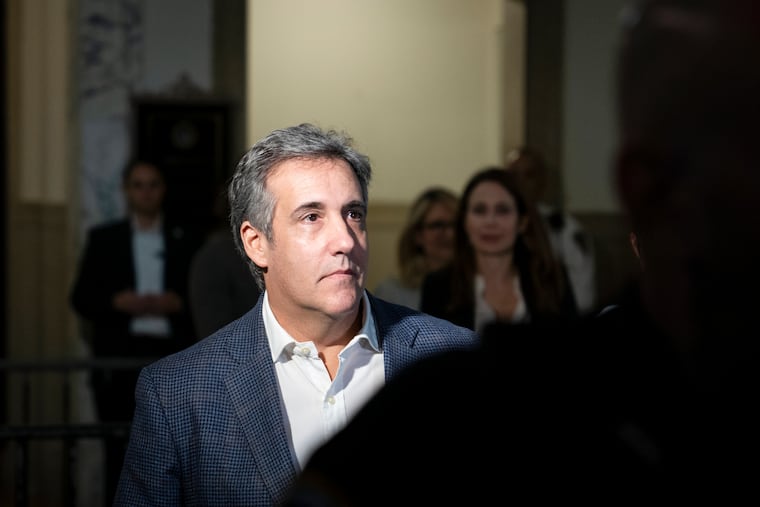
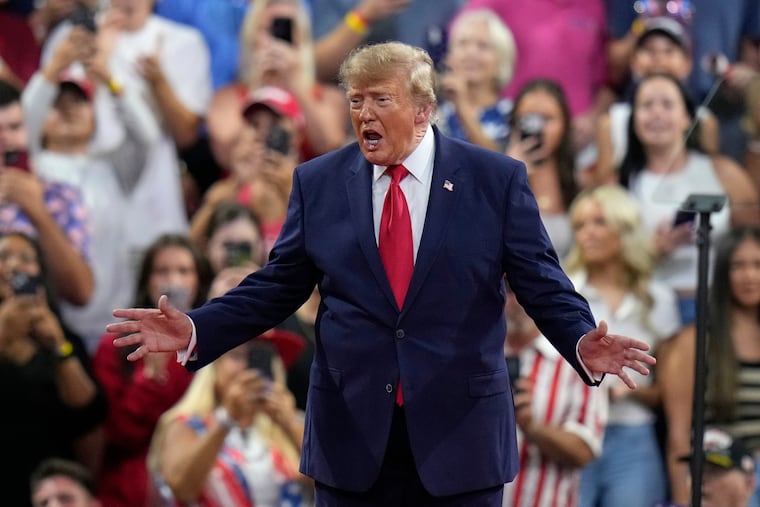
WASHINGTON — On a radio show last month, President Donald Trump welcomed Michael Cohen, the former fixer he once denounced as a “rat” for testifying against him, back into the fold. “I respect the fact that you recanted everything you said,” Trump said. He went on to use the word “recant” three more times.
In case anyone missed it, the president posted a message on social media Friday claiming that Cohen, a key witness against Trump in criminal and civil trials, “has just fully RECANTED his testimony.” Trump demanded “that any remnant of those Politically Weaponized Cases against me be immediately terminated and dismissed.”
Except that Cohen has not, in fact, recanted his testimony. He has not taken any of it back.
In his eagerness to return to the president’s good graces, Cohen now says he “felt pressured and coerced” by prosecutors to testify. But he has not actually disavowed anything that he swore to under oath about Trump’s hush money scheme to cover up an affair with an adult film actor or about his former boss’s efforts to defraud his lenders.
And so this unlikeliest of rapprochements between two men who helped get each other convicted of crimes is built not on an emotional outpouring of forgiveness but on what looks like a pretty straightforward bargain, spoken or unspoken, according to people close to both. Trump is trying to use his former lawyer’s desire for absolution to rewrite history as he presses his effort to overturn his conviction. Cohen gets to position himself as an insider once again and possibly obtain a presidential pardon to wipe out his own felony record.
“Everything is transactional,” said Brian Karem, a journalist who helped Cohen write the second of his books assailing Trump. “It’s the weirdest example yet of the transactional nature of the president of the United States and those around him. Who knows him better than Michael? I’m just surprised that it took him this long. The first thing I said was, ‘Wow, it took you long enough.’”
The unlikeliest of reunions
Even in the long history of strange-bedfellow political alliances, this may be one of the strangest. To call the reconciliation between Trump and Cohen Shakespearean would not fully capture just how mind-boggling it really is. The Bard would have been hard-pressed to come up with a scenario quite so far-fetched.
Trump, to be sure, has a well-known history of falling back in with people he has fallen out with. (Think Elon Musk, Steve Bannon, Michael Flynn, or, for that matter, his current vice president who once compared him to Adolf Hitler, or his secretary of state who once questioned the size of his private parts.)
But as one baffled Trump ally put it, Cohen is not someone who just trash-talked the president; he actually testified in court against him. Cohen went to prison because, he said, he committed crimes at the instructions of the man he now again calls “Boss.” And in a trial in which his onetime fixer provided evidence for the prosecution, Trump was convicted of 34 felonies that, had it not been for the intervening 2024 election, might have put him behind bars as well.
“You can’t write it,” said Donny Deutsch, a longtime New York advertising executive and television commentator who has been close with Cohen for years, reflecting the astonishment in both New York and Washington. “These two guys who were archenemies found mutual shared interest to get back in bed together.”
Deutsch said he did not blame Cohen, who in his view was collateral damage for Trump. “Michael was left by the side of the road as roadkill,” he said. “Beyond going to prison, he couldn’t practice law, he couldn’t get a job, he couldn’t get insurance. He’s doing what he needs to do to survive.”
As for Trump, accepting Cohen back into his orbit, even an outer orbit somewhere past Pluto, allows him to claim vindication.
“If you go grovel to him and suck up to him, he loves that because it’s validation of his power,” said George Conway, the former conservative lawyer who became one of Trump’s most vocal foes. “He has brought someone to heel. And part of what he does is try to intimidate people into doing that. He has a reptilian ability to sense who he can intimidate.”
Cohen did not respond to emails seeking comment. Trump posted his social media message Friday about Cohen’s supposedly recanting three hours after a request for comment was sent to the White House, which then passed along the link but otherwise did not respond to questions.
‘On the wrong side’ of the Boss
The relationship between these two men has arguably been one of the most consequential in modern presidential history. Cohen worked for Trump for years as his lawyer and fixer, a self-described “pit bull” who handled business and personal problems, and sought to intimidate people who got in the way. He styled himself as a consigliere so loyal that he famously said he would “do anything to protect Mr. Trump” including “take a bullet.”
Cohen secretly sought on Trump’s behalf to seal a deal with the Russians to build a Trump tower in Moscow even while his boss was running for president in 2016. He was the middleman who paid $130,000 to porn star Stormy Daniels to buy her silence about her alleged tryst with Trump before the election. (Trump denies the affair.)
That eventually led to criminal charges, a guilty plea. and prison. When Cohen was released, the Trump administration revoked his home confinement and locked him up again because he planned to publish a book, a move that a judge overruled because it was “retaliatory.”
Cohen later turned witness for Manhattan District Attorney Alvin Bragg in the case that convicted Trump for falsifying business records to cover up the payments to Daniels. He also testified for New York Attorney General Letitia James in her civil case that found Trump liable for business fraud. His was not the only evidence against the president, and some lawyers argue that there was enough to convict Trump even without Cohen’s testimony.
But when Cohen broke from Trump, he broke big time. In addition to testifying in court, he also went after the president publicly with both barrels, writing books titled Disloyal and Revenge and characterizing his former employer as “a racist,” “con man,” and “cheat” during a congressional committee hearing.
Outside the halls of Congress, Cohen went even further, calling Trump “a mob boss,” “the slime of humanity,” a “scumbag,” a “petty tyrant,” a “deranged president,” a “narcissistic sociopath,” a “Cheeto-dusted cartoon villain,” “Dictator D-Bag,” “this Frankenstein’s monster,” and “the poster boy for fascism” who was trying “to screw over the country.” And those were the lines printable in a family newspaper.
By the time Trump won a second term, though, Cohen’s tone began to change. He had not gotten the pardon he had requested from President Joe Biden, nor had he been welcomed with open arms by much of the anti-Trump resistance. With Trump returning to office, any hope for acceptance, much less clemency, now lay with his former boss, and he has resubmitted his pardon application, replacing the word “Biden” with “Trump.”
“I think he really wants a pardon,” said Stephanie Grisham, a former White House press secretary for Trump who broke with the president. “I also think he has realized just how hard it is to be on the wrong side of the administration. It’s damn scary out here on the anti-Trump island. And I never got the vibe from him that he wants to work hard at anything, and doing the right thing is never easy.”
In January 2025, just as Trump was assuming power again, Karem interviewed Cohen for a documentary that will be shown next month at New York’s Chelsea Film Festival and asked if he would go back to Trump if invited.
“You know what, it’s such a difficult question to answer simply because, one, I know it’s never going to happen,” Cohen said in the film. “Donald refuses to accept any type of responsibility for anything. We’ve all seen that. Do I think I’m owed an explanation? Absolutely.”
Karem saw that as an implicit yes. “Anybody who spent any time talking with him back then, it was obvious that was open to him,” Karem said. “It was an avenue he was willing to explore because he felt wronged by the justice system. He wasn’t considered the hero he thought he would be. He told me he wanted a pardon.”
‘His identity was Donald Trump’
In the summer of 2025, Cohen had a brief conversation with Trump at his golf club in Bedminster, N.J., joined by the president’s top personal legal adviser, Boris Epshteyn, as the New York Times previously reported. By January 2026, Cohen was writing on Substack that “I felt pressured and coerced to only provide information and testimony that would satisfy the government’s desire” to convict Trump.
Two months later, he reached out to Lara Trump, the president’s daughter-in-law, who then invited him onto her podcast, where he defended Trump against those questioning his relationship with disgraced financier and sex offender Jeffrey Epstein. Soon, Cohen was given a radio slot on WABC by John Catsimatidis, the station’s owner and a longtime Trump supporter.
Even so, Cohen for a while kept a foot in both camps. Conway, who ran unsuccessfully for the Democratic nomination for a House seat in New York earlier this year, said Cohen volunteered to help his campaign.
“At the same time I’m reading these clips about him trying to get back in, he was calling me up saying, ‘I want to help you with your campaign. I want to help you with your campaign. Let’s go be seen together on the Upper East Side. People love me. It’ll help your campaign,’” Conway recalled. “I’m like, what? He’s trying to suck up to Trump, and literally my entire campaign was about sending this guy to jail.”
Cohen’s turnaround shocked people he had gotten to know on the left. Joanne Carducci, a liberal podcaster who had become friends with Cohen, said she was so upset that she cried, feeling that she had been fooled. “I trusted him, and I believed him when he said, ‘I’m done with that guy. I’ll never recover from what he did to me. I went to prison because of him,’” she recalled. “What is the pathology there that he could be so convincing?”
After Cohen’s Substack essay, Carducci texted to ask why he was now publicly helping Trump undermine the cases against him. “I have attacked him and the administration 998 out of 1000 times,” Cohen replied in a text that she shared with the Times. “James and Bragg, and the entire system is broken and abusive. That’s the point I was making. I’m not going to be a puppet as I lived the abuse.”
By all accounts, including his own, Cohen was crushed and embittered by the events of the past several years. His life, as he put it on his radio show, was “shredded to pieces,” and he lost his sense of purpose.
“I know what it feels like to take hit after soul-crushing hit, to be bloodied and knocked to the dirt while a crowd of millions cheers for your destruction and then, then, to have to pick up the shattered pieces of your life, alone in the dark while the circus packs up and moves on to its next victim,” he said on his show. “I know the sheer suffocating terror of being turned into a public target sitting in silence while your family weeps, wondering if you’re ever going to survive the night.”
And yet after all that, Cohen turned back to Trump. “People have their sect, their team,” said Greg Ehrlich, a onetime friend who recalls first introducing Cohen to Trump. “It’s your identity. His identity was Trump. Then he got lucky and had a second life, which was against Trump.” But now, Ehrlich said, “he needs his identity, and his identity was Donald Trump.”
Indeed, when they finally had their bury-the-hatchet talk on the radio last month, Cohen sounded needy, anxious to reminisce about the old times with the Boss, but the Boss wasn’t having any of it. Distant and hardly warm, Trump focused on promoting the fiction that Cohen had recanted his testimony, making clear that their reconciliation was dependent entirely on that. “You took it back,” Trump said falsely. “I wouldn’t even be talking to you right now if you didn’t, to be honest.”
Cohen did not correct Trump during the show. But in other appearances, he has stood by his accounts. Asked by Dan Abrams on SiriusXM radio if his criticism of prosecutors meant that his past testimony was not truthful, Cohen said: “No, to the exact contrary. As I stated, I felt pressured and coerced. That’s my personal feeling, which I am certainly entitled to have. In no way, shape, or form should it connote that the information that I provided was anything but truthful and accurate.”
Stating otherwise, of course, could expose Cohen to criminal perjury charges, and it did not go unnoticed that he emphasized that he “felt” pressured, as opposed to saying that he actually was. When Jake Tapper said on CNN that Cohen had claimed that he was “pressured and coerced” into testifying against Trump, Cohen offered a word-parsing correction.
“The comment that I had written was in regard to Alvin Bragg and Tish James is that I felt pressured and coerced,” Cohen said. “And I think the distinction is extremely important.”
But that is a distinction without a difference for Trump. In the reality that the president is now selling, Cohen’s pivot is proof that Trump was innocent after all. Even if that is not what Cohen is actually saying.
This article originally appeared in the New York Times.