An FOP official was accused of swindling a police widow. Here’s what happened to the case.
An FOP official was accused of taking $20,000 from a police widow. Years later, a daughter waits for resolution.
Week after week, Terry Reid, a key member of the Philadelphia police union’s executive board, would ask the widow of a fallen officer for cash. Lots of it.
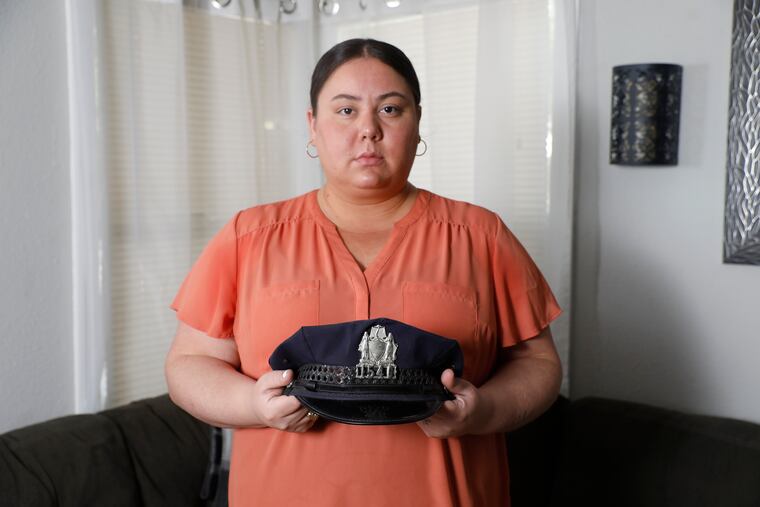
And from late summer of 2022 through early 2023, Meagan Diaz repeatedly agreed to help a woman she thought had been on her side. Reid, a disability coordinator for the Fraternal Order of Police Lodge 5, had been a steady, supportive presence in Diaz’s life since 2016, when her husband, Officer Raymond Diaz, died at age 47.
But after lending Reid at least $20,000, Diaz pleaded to be repaid — and Reid responded with silence, or shoulder-shrug excuses. In February 2023, Meagan Diaz died, and her relatives discovered text messages on her phone that revealed the scope of Reid’s alleged swindle.
» READ MORE: Family claims a top FOP official tried to scam a police officer’s widow out of $20,000
A month later, Diaz’s eldest daughter, Marissa Zito, filed a complaint against Reid with the Philadelphia Police Department’s Internal Affairs Bureau.
But nearly 2½ years later, the internal affairs investigation has yet to be resolved, leaving Zito angry and disillusioned. She said she feels like she has been abandoned by the police fraternity that had once been such an important part of her family’s life.
“I have no words,” she said. “We were a cop family. My dad was a cop for 20 years. My uncle was a cop. We were at the FOP all the time. They were like family. We went there for parties, for the holidays.”
Multiple police sources told The Inquirer that the internal affairs case is still open.
Sgt. Eric Gripp, a police spokesperson, said only that the department cannot comment on open investigations.
In summer 2023, investigators asked Zito to turn over her mother’s phone so they could review Diaz’s complete text history with Reid, sources said and Zito confirmed. Zito said she refused because she had grown distrustful of internal affairs.
Instead, Zito, who lives in Clearwater, Fla., offered to show investigators the contents of the phone. She said she emailed screenshots of the text messages to them, which she also shared with The Inquirer.
“I was very vocal about it,” she said. “I told them, ‘Look, you guys can look through her phone, but I’m not handing it over to anybody.’”
Zito said she has not been contacted by any other investigative agencies that might have taken an interest in her complaint.
Representatives for the FBI’s Philadelphia field office and the Pennsylvania Attorney General’s Office each said that neither agency could either confirm or deny the existence of an investigation. A spokesperson for District Attorney Larry Krasner said the DA’s office has not received a “criminal referral” from the police department about the Reid case.
Reid ultimately repaid the money that she had borrowed from Diaz, Zito said.
In an attempt to learn more about the status of the internal affairs investigation, Zito reached out to the Citizens Police Oversight Commission (CPOC), which oversees and investigates the conduct, policies, and practices of the Philadelphia Police Department.
But officials there could not provide her with much information, Zito said. During recent negotiations over a new police labor deal, the city sought to empower CPOC with the ability to conduct independent misconduct investigations, but a three-person arbitration panel rejected that proposal.
“We won’t be able to comment on the status of the case, even if we have found out some things,” CPOC executive director Tonya McClary told The Inquirer. “Some stuff is not in our purview to release. It’s only in the purview of the police department.”
After learning about Zito’s allegations, then-FOP president John McNesby fired Reid in July 2023. At the time, he told The Inquirer that he had told Reid: “You got to pay this family and do it f— quickly. Then move on.”
Reid did not respond to requests from The Inquirer for comment.
An FOP spokesperson did not reply to emails from The Inquirer. But in a statement posted Thursday to Lodge 5’s Facebook page, the union wrote that the Reid case is a “personal matter that does not involve the FOP Lodge 5 or any of its assets. FOP Lodge 5 had no knowledge whatsoever of Teri [sic] Reid’s actions, intentions, or behavior.”
Zito said she believes the FOP leadership wants to forget Reid’s alleged actions.
“I think there’s a whole lot of covering up that’s being done right now, because that’s the only thing that makes sense,” Zito said. “You’d think in an organization like this, if one of their people does something wrong, the family at least gets some kind of answers.
“I got nothing.”
‘Can we make this all go away?’
Raymond Diaz joined the police force in 1996 and spent 20 years as a patrol officer in North Philadelphia’s 24th District. He and Meagan married in 2005, and raised Zito and her two siblings in Northeast Philadelphia.
On Nov. 14, 2014, Diaz responded to a radio call about a burglary in progress. As he drove to the scene, another motorist slammed into his patrol car. Diaz suffered a concussion and severe neck and back injuries.
Plagued by poor balance that required him to use a cane, Diaz was unable to return to police work. Doctors prescribed two painkillers, oxycodone and a fentanyl patch, and he had a subsequent surgery for a torn left bicep tendon after a fall.
In September 2016, Diaz’s wife found him unresponsive at their home. He later died at Nazareth Hospital, and a medical examiner ruled that his death had been caused by an accidental prescription drug overdose.
One of Reid’s chief responsibilities with the FOP was to meet with families of officers who had died in the line of duty and serve as a point of contact for relatives as they navigated the aftermath of the tragedy.
After Raymond Diaz died, Reid, whose total compensation as the union’s trustee and disability coordinator was $189,000, became a regular visitor to his family’s home. She often brought lunches and dinners to his widow, and helped her fill out paperwork. Zito said Reid also gave her mother money that had been withdrawn from the FOP’s charitable foundation, known commonly as the Survivors’ Fund.
“She latched onto my mom because she knew my mom needed somebody,” said Zito, 31, “and my mom was lost after my dad died.”
In 2017, the city filed an application on Meagan Diaz’s behalf to the Pennsylvania Department of General Services for a $100,000 benefit that was available to families of late police officers through the Emergency and Law Enforcement Personnel Death Benefits Act.
The state denied the claim, arguing that Raymond Diaz had not died in the line of duty. Diaz appealed to Commonwealth Court, and Reid testified on her behalf.
In August 2022, a Commonwealth Court judge ruled in Diaz’s favor. Within weeks, Reid started asking Diaz to loan her money. Diaz soon withdrew thousands of dollars from her bank.
“My mom was a nice person, and she felt that she was doing the right thing, because this person had done so much for her since my dad died,” Zito said.
The text messages from Diaz’s phone, which Zito shared with The Inquirer, show how Reid was able to prey on Diaz’s kind nature.
“I need to borrow 12k until I get my bonus,” Reid wrote in an October 2022 text. “I really hate asking but I’m really in a [jam].”
In November 2022, Reid texted Diaz a photo of two yellow cones that were in front of steps that led to a rowhouse. “This is what I came home to,” she wrote.
Reid claimed that the previous owners of the property had a water lien that she was now obligated to pay, “because it’s attached to my title,” leaving her with no running water.
The Inquirer found that the photo she sent Diaz was taken outside a Northeast Philadelphia house where Reid was registered to vote. Reid, however, never owned the home, according to property records.
Reid pledged to repay Diaz at some future date. In one text exchange, after Diaz told Reid she hoped her “vacation went well,” Reid replied on Dec. 30, 2022, “just getting off the plane give me a minute to check the account and send it over.”
She apparently sent a small amount, but still left Diaz cash-strapped.
“It was, ‘I’m getting my bonus, my holiday pay,’ or whatever she was getting. ‘I’ll give you the money back,’” Zito said. “Of course, my mom’s going to say, ‘Sure, that’s no problem. After what you’ve done for me, I can help you out.’”
Diaz then was having trouble paying her own bills.
After months of being stonewalled by Reid, Diaz texted her in December 2022 that “now I really do need the money. I lent you $12,000 and then when we met for lunch I lent you $3,000 and the next day we met at Target and I gave you another $2,000 and then with your water I lent you another $3,500.”
Diaz was planning a baby shower for her then-20-year-old son, who was expecting a girl. She pleaded with Reid, texting that her phone would be shut off at day’s end.
“My family comes first. I should have never of lent all of that money to you. I need my money and I shouldn’t have to beg you and be sick over it,” Diaz texted.
“I’m at a funeral right now I will try later I honestly slept all day today,” Reid replied.
When Diaz texted Reid several weeks later to tell her she was in the hospital for a week, battling a host of health problems, she asked Reid if she could repay her $300.
“Hello sorry to hear,” Reid replied, “but I’m broke.”
‘A big can of worms’
On Feb. 26, 2023, Diaz died in her home.
The next day, Reid visited Diaz’s family and insisted on seeing her phone, according to Diaz’s relatives, a friend, and another family friend who was a former police officer. Then she started to frantically delete messages between the two women.
Relatives were able to restore the messages. Reid vowed to pay the money she had borrowed, but told Diaz’s family that they couldn’t tell McNesby about the arrangement.
Zito said Reid asked: “If I pay this money back, can we make this all go away?”
Zito opted to tell McNesby about the situation.
McNesby later told The Inquirer that Zito’s allegations left him “speechless.”
“I pride myself on how we take care of these families,” he said at the time. “If someone does something like this, it upsets me.”
In July 2023, Reid retired from the police department, where she held the rank of detective. Days later, McNesby fired Reid from Lodge 5, where she had been a member of FOP’s leadership team for nearly two decades.
Reid repaid the Diaz family in three installments through a cash app, Zito said. Reid made the final installment just a few days after she retired from the police department.
The Reid scandal has remained a source of frustration among rank-and-file FOP members, and prompted some to question how McNesby and other top officials managed the union’s finances. Those inquiries are now fueling a divisive internal campaign for Lodge 5’s executive board.
Months after firing Reid, McNesby — who had been the president of Lodge 5 since 2007 — resigned, taking even members of his inner circle by surprise. In an issue of Peace Officer, the FOP’s magazine, McNesby later wrote that he chose Roosevelt Poplar, his longtime chief of staff, to be his successor.
For much of this year, in social media posts and during contentious union meetings, candidates for the FOP’s executive board have accused McNesby and current union leaders of racking up millions in questionable credit card charges and lacking transparency about the union’s profits and expenses.
An Inquirer investigation, “The Blue Divide,“ published Aug. 10, found expenditures that pointed to limited oversight and a lack of internal transparency surrounding the union’s spending.
Red flags are most notable within the Survivors’ Fund, the charitable foundation created to support families of officers who lost their lives or were gravely wounded in the line of duty.
An Inquirer examination of tax filings from 2016 to 2024 found the FOP recorded questionable expenditures from the fund, including hundreds of thousands of dollars spent on “funerals and special events” during years when there were no line-of-duty deaths.
In 2016, the charitable foundation reported $572,520 in expenditures, including $350,831 on “survivor memorial services for families of police officers killed on duty.”
Although fundraisers and luncheons for survivor families are held annually, only one officer was listed by the city as having died in duty that year: Raymond Diaz.
Zito said she believes the Reid situation opened the FOP to intense scrutiny, for good reason.
“I think that the second she deleted those text messages and internal affairs got involved, they knew they were in big trouble,” she said.
“This opened up a big can of worms.”
» READ MORE: Click here to read the full Inquirer investigation into the FOP’s finances

The Inquirer’s journalism is supported, in part, by the Lenfest Institute for Journalism and readers like you. News and editorial content are created independently of The Inquirer’s donors. Gifts to support The Inquirer’s high-impact journalism can be made at inquirer.com/donate. A list of Lenfest Institute donors can be found at lenfestinstitute.org/supporters.