Suspect charged in active-shooter hoax at Villanova
The juvenile suspect, whose name was not released due to their age, was a self-identified member of the online “Purgatory,” prosecutors said.
Federal authorities have charged a minor in connection with the hoax active-shooter calls that led to widespread panic at Villanova University and a number of other institutions in August.
The juvenile suspect, whose name was withheld due to their age, was a self-identified member of the online group “Purgatory,” U.S. Attorney David Metcalf said in a statement Thursday. The group claimed responsibility for the calls last summer, and authorities said the suspect had no affiliation with any of the targeted schools, which were chosen at random. Authorities did not specify the number of schools that were targeted.
In an email to Villanova students and faculty, David G. Tedjeske, the school’s associate vice president of public safety and chief of police, confirmed the suspect was connected to the incident at Villanova.
“The hoax caller from that day has been identified as a juvenile who has no affiliation with Villanova University,” Tedjeske wrote. “Authorities have found no evidence that this individual was ever on campus, or that there were ever plans for an actual attack on the University.”
Hoax active-shooter calls like the one that prompted panic at Villanova are designed to provoke an emergency response from police known as “swatting.” The goal, Metcalf said, is to report a violent threat that causes the deployment of a Special Weapons and Tactics (SWAT) unit.
The hoax incident at Villanova began just after 4:30 p.m. on Aug. 21, when the school’s Department of Public Safety received an anonymous report of an active shooter at the Charles Widger School of Law. The call, officials said, included the sound of gunshots in the background, and triggered an immediate lockdown of school grounds.
At the time, parents and students were on campus attending move-in events designed to serve as a welcome to the fall semester. Panic and confusion quickly spread across the campus as police conducted a manhunt for a shooter who was never there.
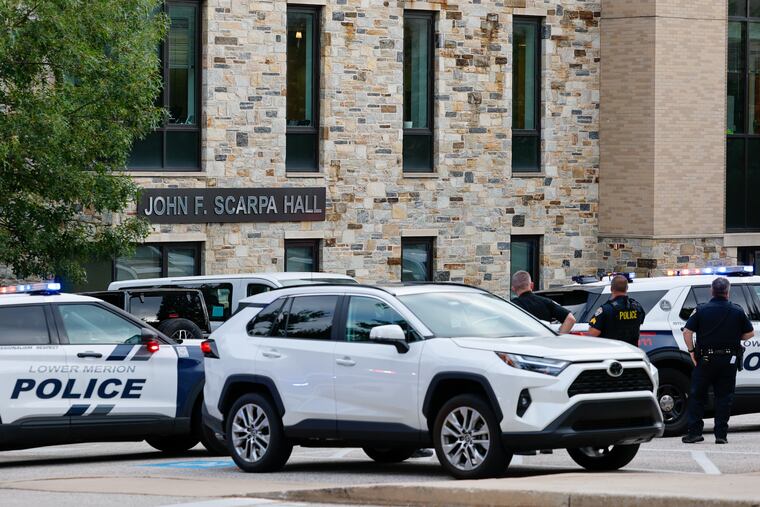
While the lockdown was in effect, scores of law enforcement departments responded to the campus, and SWAT units set up a perimeter around Scarpa Hall at the Widger School of Law. Responding officers initially said they had identified a suspect, as well as a gunshot victim, according to police scanner recordings.
Authorities and school officials later said the incident resulted in no injuries, and there was no shooter. It was, as the Rev. Peter M. Donohue, the university’s president, said, a “cruel hoax.”
On the same day as the hoax call to Villanova, similar calls were placed to Bucknell University in Lewisburg, Pa., and the University of Tennessee at Chattanooga, The Inquirer previously reported. Those calls were also determined to be hoaxes.
Days after the incident at Villanova, members of the nonprofit Global Project Against Hate and Extremism identified the Purgatory group as the source of the calls. One member using the alias “Gores” had bragged over his alleged success in “swatting” Villanova and other schools.
“It is all for them to watch and glory in,” said Wendy Via, president and cofounder of the nonprofit. “They talked about how successful it had been.”